How to Prevent Ringworm and Staph in a BJJ Gym (Without Destroying Your Mats)
Share
Every gym owner knows the feeling. One member pulls up their sleeve, shows you a red ring on their forearm, and asks if it is ringworm. Within a week half the roster is texting to ask whether it is safe to come in. Attendance dips, the group chat goes quiet, and a couple of people quietly do not renew. A single skin issue circulating a combat sports gym does not just affect one person, it hits your retention, your reputation and your bottom line. So the instinct to react hard is completely understandable.
The problem is what most owners reach for. Panic sets in and out comes the neat bleach, or a builder's tub of some heavy-duty industrial degreaser, scrubbed across the mats every night. It feels decisive. It is also one of the fastest ways to destroy the single most expensive asset in the building. I have trained in gyms that took this seriously and gyms that did not, and the difference showed, both in how the room smelled and in how quickly the mats went hard, cracked and tacky underfoot. This guide is about doing it properly: how to prevent ringworm in a BJJ gym and take gym staph infection prevention seriously, without corroding your mats to save them.
The real risks on the tatami
Combat sports mats are, from a hygiene point of view, about the highest-load surface you can build a business on. Think about what actually happens on them. People train barefoot, so bare skin is in direct contact with the floor for the entire session. There is constant friction and pressure as bodies drag, pin and scramble across the surface. There is heavy sweat, pooling and soaking into every square metre. And there is close, sustained skin-to-skin contact between training partners, on the same shared mat as everybody else in the room. Very few surfaces anywhere combine warmth, moisture, body oil and repeated human contact quite like a grappling mat does.
That environment is exactly why a handful of skin conditions are so strongly associated with combat sports. Ringworm, a fungal infection despite the name, is the classic one, spread readily in warm shared spaces. Staphylococcus aureus, or staph, is the bacterial one every coach worries about, and impetigo sits alongside them. I am naming these as context, not as a sales pitch, because understanding why the floor matters is the whole point. The mat is a shared surface that a lot of warm, sweaty, occasionally grazed skin touches in a single evening. Keeping that surface genuinely clean is one of the levers you actually control as an owner, which is why a proper cleaning routine belongs at the centre of any serious hygiene policy. For the full step-by-step routine, our combat sports mat sanitation SOP lays it out.
One thing to be clear about from the start: no cleaner, ours included, is a substitute for the rest of a hygiene culture. Clean floors are one part of a holistic picture that only works when members shower promptly after training, stay off the mats when they have an active skin issue, wash their kit, and keep on top of their own personal hygiene. The floor is the part that sits in your hands as the owner. The product's job is keeping the floor clean. The people are the other half of the job.
Why household and agricultural cleaners wreck combat sports mats
Here is the mistake that costs gyms thousands. Reaching for whatever is cheap and strong at the cash-and-carry, an aggressive acidic descaler, a caustic alkaline degreaser, or straight bleach, and treating your mats like a warehouse floor. Those products are formulated to blast grime off concrete and steel, and they do it by being chemically harsh at the extremes of the pH scale.
Your mats are not concrete. Vinyl-covered mats and EVA foam tiles are plastics, and their softness and grip depend on plasticisers held inside the material. Harsh acidic and alkaline cleaners strip those plasticisers out over time. The surface dries, hardens and loses its flex, and then it starts to craze with tiny micro-fissures across the top layer. That is a double failure. First, a hard, brittle mat is worse to train on and closer to needing replacement. Second, and this is the irony, those micro-cracks become exactly the kind of textured, hard-to-clean surface where grime settles and hygiene actually gets harder, not easier. You corrode the mat in the name of cleaning it, and you end up with a surface that is both degraded and no more hygienic. We go deep on the chemistry of what to use and what to avoid in the gym owner's guide to mat cleaning chemicals.
The takeaway is simple. The best combat sports mat cleaner is not the strongest or the cheapest. It is the one that reduces bacteria on the surface effectively while being chemically gentle on the mat itself. Strength at the wrong pH is not a feature, it is a liability.
The facts, from the Safety Data Sheet
- pH 7, perfectly neutral so it will not strip or degrade vinyl and EVA mats
- No hazard labelling under CLP and no specialist PPE required
- Not restricted for transport (ADR, IATA, IMDG) so no special storage
- UK-made by a regulated manufacturer, clear low-odour cotton profile
The science of a safe, neutral clean
This is where the CSH Mat & Gym Floor Cleaner is built differently, and the Safety Data Sheet (McKLords Ltd, UK, October 2025) backs up every word of it. It is a bactericidal surface cleaner designed specifically for the job a combat sports floor demands, and it does two things at once that the cash-and-carry products cannot.
First, the cleaning. The formula is built around a primary alcohol ethoxylate surfactant, and that surfactant is the workhorse. Its job is to lift body oils and sebum, the greasy sweat residue that a night of grappling grinds into the mat, off the surface and into the cloth or mop. That matters because bacteria and grime cling to that oily film, and a cleaner that cannot cut the sebum is just moving dirt around. Alongside the surfactant, the actives are Quaternary Ammonium Compounds, the well-established quat chemistry that delivers the bactericidal surface action, reducing bacteria on the mats and floors you treat. It is tested to recognised bactericidal standards [EN standard to be confirmed], and every bit of that kill-and-clean action is aimed at the surface, which is exactly where a shared training floor needs it.
Second, and this is the part that protects your investment, it does all of that at pH 7. Perfectly neutral. There is no aggressive acid and no caustic alkalinity to strip the plasticisers out of your vinyl and EVA, so the mat structure stays intact, flexible and gripping the way it should. You get a genuine bactericidal surface clean without the slow corrosion that harsh cleaners inflict. The Safety Data Sheet backs the rest of the story any owner cares about, with the headlines in the box above: no hazardous classification under CLP (EC 1272/2008) and no specialist PPE, which quietly lifts a whole COSHH admin burden off your staff and volunteers, and no transport restrictions under ADR, IATA or IMDG, so no special storage headache. It is a clear liquid, specific gravity 1.012, with that low-odour cotton profile, made in the UK by a regulated manufacturer. Strong on the surface, gentle on the mat, and boring in all the right ways on paper.
The £38.49 question
Let us talk money, because this is where the maths makes itself. Re-matting a training room is not a small line item. A full replacement of tatami or rolled vinyl for a decent-sized space runs from several hundred pounds for a small room into the low thousands for a full academy floor, plus the downtime while it is done. That mat is very likely the single most valuable physical asset your gym owns.
Against that, the CSH Mat & Gym Floor Cleaner is £38.49. A neutral, non-corrosive, bactericidal surface cleaner at that price is not really a cleaning cost, it is insurance on a four-figure asset. Cleaning your mats every night with something that quietly degrades them is like polishing your car with sandpaper. Cleaning them with a pH-neutral product built for the material means you get the hygiene benefit today and you keep the mat serviceable for years instead of replacing it early.
Double defence: clean floors, and something for your members
So the honest, compliant picture of hygiene in a combat sports gym is a shared one. The floor is your job, and the mat cleaner does that job: it keeps the surface members train on clean by lifting sebum and reducing bacteria on the mats and floors, at a pH that does not wreck them. That is the foundation, and it is entirely in your control as the owner.
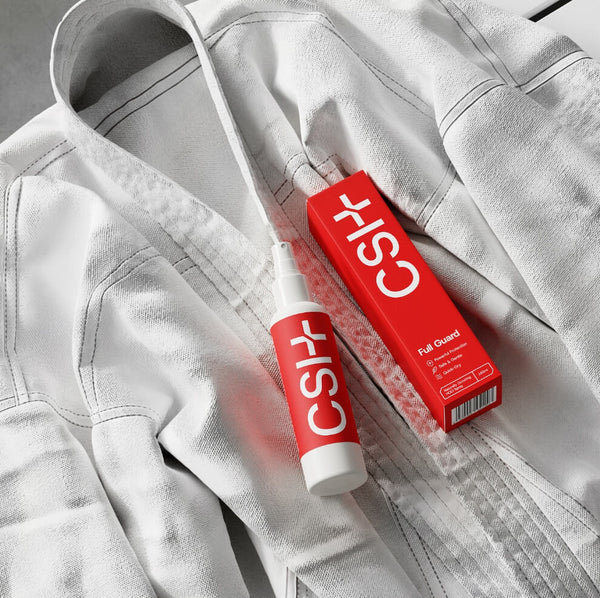
The members have their half too, and this is where the second layer comes in. Every order of the mat cleaner includes two free bottles of Full Guard. Full Guard is a rinse-free cosmetic skin cleansing spray that freshens the skin and lifts away sweat and surface impurities when a shower is not available, for use on skin. It is a cosmetic, it is entirely separate from the surface cleaner, and it is there for the honest gaps in real life: the member facing a long drive home in a damp gi, the one queueing for the single shower after an open mat. Keep a couple in the gym for members to freshen up when they genuinely cannot get under the water straight away, and you have covered both halves of the picture: the clean floor from the mat cleaner, and a way for members to freshen their skin after training when a shower is not on hand.
Put it all together and the recipe for keeping ringworm and staph out of the group chat is not complicated. Clean the floor properly with a product that respects the material, insist on the human habits that only members can do, showering promptly, staying off the mats with an active skin issue, and basic personal hygiene, and stop treating your mats like a factory floor. The CSH Mat & Gym Floor Cleaner handles the part you control. For everything around it, the combat sports mat sanitation SOP and the gym owner's guide to mat cleaning chemicals will get your routine right.
A surface and floor cleaner for mats and training areas. For external hard-surface use only, not for use on skin. Always use as directed on the product label.