The Combat Sports Gym SOP: Step-by-Step Mat Sanitation Protocol
Educational information only – read the full notice
Share
A cleaning routine is only ever as good as the person holding the mop. You can write the schedule on the whiteboard, buy the best surface cleaner on the market, and still lose the battle if the actual technique is wrong. The most common mistake I see in combat sports gyms is deceptively simple: a member of staff dips a dirty mop into a bucket, drags it across the mats, and calls the job done. What has actually happened is that the sweat, skin cells, and bacteria that were sitting in one corner have now been smeared evenly across the entire training floor. The mat looks wet, so it looks clean. It is neither.
The fix is not more effort or more product. It is a repeatable Standard Operating Procedure, an SOP that anyone on your team can follow the same way every single time, whether it is the head coach at 6am or a new front-desk hire on a Saturday night. This is the martial arts gym cleaning schedule and the step-by-step protocol we built around the CSH Mat & Gym Floor Cleaner, written so you can print it, laminate it, and stick it on the cupboard door.
Section 1: The three-tier cleaning schedule
The single biggest question owners ask is how often to clean gym mats. The honest answer is that there is no single frequency, because a busy mat has three different jobs to do across a training day. Treating all three the same way is why so many schedules fail. Instead, think in tiers. Each tier has a different goal, a different amount of moisture, and a different time cost.
Tier one: the pre-class reset
Before the first class of the day, and ideally before each new group steps on, the mats get a dry reset. This is not a wet clean. This is a dry microfiber sweep to lift the loose debris, hair, dust, tape scraps, and skin flakes that have settled on the surface. It takes two minutes for a small room. The reason it matters is mechanical: you cannot properly clean a surface that is covered in loose dry matter, and as we will see in the protocol, wetting that debris first is one of the worst things you can do. The pre-class reset is the foundation everything else sits on.
Tier two: the mid-day transition
Combat sports gyms run in blocks. There is a gap between the lunchtime open mat and the afternoon kids class, another between that and the evening BJJ session. Those gaps are short, often fifteen minutes, and that is exactly the window for a fast, low-moisture wipe-down. You are not deep cleaning here. You are knocking back the fresh sweat and body oils that the last group left behind so the next group is not rolling in them. A lightly dampened microfiber mop head with correctly diluted cleaner, passed once across the high-traffic centre of the mat, is enough. Low moisture is the key phrase, because the mats need to be dry and safe to train on within minutes.
Tier three: the nightly deep clean
This is the one most people picture when they think of mat cleaning, and it is the tier where the bactericidal surface action really earns its place. After the last class, the mats get a full wet mop with properly diluted CSH Mat & Gym Floor Cleaner across the entire surface, edge to edge, including the seams and the borders where sweat pools and where nobody looks. This is the clean that resets the whole room overnight. Done properly every night, it is what keeps your BJJ mat cleaning instructions from turning into a crisis-management exercise every time someone spots a suspicious mark on the vinyl.
Three tiers, three different levels of moisture, one product across all of them. That consistency is deliberate, and it is what makes the protocol below easy to teach.
Section 2: The step-by-step mat sanitation protocol
This is the core BJJ mat cleaning instructions sequence. Follow it in order. The order is not arbitrary. Each step exists because skipping it undermines the one after it.
Step 1: Dry preparation, always sweep first
Before any liquid touches the mat, clear the surface with a dry microfiber sweep. This is the single most skipped step and the most important. Here is why the order is non-negotiable: if you wet a dirty mat, you turn that fine layer of dust, chalk, and grit into a thin abrasive mud. Then, when you push your mop across it, you are effectively sanding the surface of your own mats with their own dirt. Over months, that is what wears the printed texture off vinyl and dulls EVA foam. Sweep first, every time, and the wet clean that follows is doing real work instead of grinding dirt into your investment.
Step 2: Correct dilution per the label
Mix the cleaner to the dilution ratio printed on the product label. Do not eyeball it, and do not work on the theory that more concentrate means more clean. Getting the ratio right is what gives you consistent results shift to shift. One practical detail helps here: the CSH Mat & Gym Floor Cleaner has a stable specific gravity of 1.012, which in plain terms means it mixes evenly into water and stays mixed. It will not sink to the bottom of the bucket or separate out while it sits, so the solution your closing-shift member pours at the far end of the room is the same strength as the first pour. Consistent dilution is consistent cleaning.
The facts, from the Safety Data Sheet
- pH 7, perfectly neutral so it will not strip or degrade vinyl and EVA mats
- No hazard labelling under CLP and no specialist PPE required
- Not restricted for transport (ADR, IATA, IMDG) so no special storage
- UK-made by a regulated manufacturer, clear low-odour cotton profile
Step 3: Controlled application and contact time
Apply the diluted solution with a clean microfiber mop head. Clean is doing a lot of work in that sentence. A grubby mop head from last night defeats the entire protocol, because you are reintroducing yesterday's bacteria to today's freshly prepared floor. Keep a set of laundered heads and swap them in fresh. Work in a systematic pattern, covering the whole surface rather than dabbing at the spots you can see, and then leave it alone. Allow the contact time stated on the label. This dwell time is not a suggestion; it is the window the bactericidal surface action needs to work on the floor. Wiping it dry the instant it goes down cuts that window short and leaves the job half finished. The independent surface testing that supports the bactericidal claim rests on the product being formulated to conform to recognised protocols (EN1276, EN14476 and EN13697), and that formulation only translates to your mats if you actually give the product its contact time.
Step 4: Air dry to a clean, film-free finish
Once the contact time has elapsed, let the mats air dry. You do not need to chase them with a towel. This is where the neutral chemistry pays off: because the formula is pH 7 neutral, it dries down cleanly without leaving the sticky pull or the slick, slippery residue that harsher or more alkaline cleaners can leave behind. A slippery mat is a torn ACL waiting to happen, so a film-free dry is a safety feature, not just an aesthetic one. Within a short window the surface is dry, matte, and ready for the next group to train on with confidence.
Why this protocol pays for itself
At £32.99, the value case for the CSH Mat & Gym Floor Cleaner is not really about the price of the bottle. It is about what the four-step protocol removes from your day. Because the product carries no hazard classification, your staff need no specialist PPE to run any of the three tiers, which means the pre-class reset and the mid-day transition can be done by whoever is on shift without a safety briefing. Because it works across all your hard surfaces, from the competition mats to the changing-room floor to the reception tiles, you are not buying and storing four different products. Because it dries film-free, you are not scheduling in extra time to buff off residue. And because it mixes evenly and stays stable, there is no waste from a separated, unusable bucket at the end of the night. Every one of those is staff time saved, daily, which is the real recurring cost in any gym.
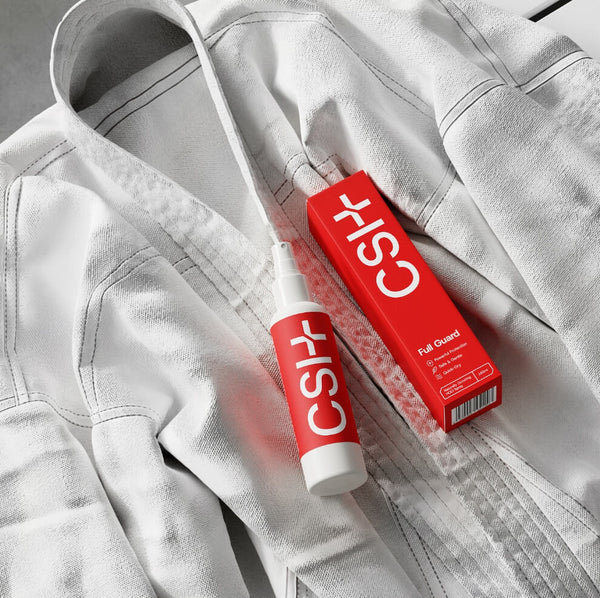
There is one more thing in every order that is worth knowing about. Each purchase of the Mat & Gym Floor Cleaner ships with two free Full Guard sprays. Full Guard is a cosmetic, rinse-free skin cleansing spray for your members: something they can use to freshen the skin and lift away sweat when a shower is not available after a hard round. It is a completely separate product from the surface cleaner, and it lives on a different side of the hygiene picture. The surface cleaner does the bactericidal work on your floors; Full Guard is simply a cosmetic freshen for the athlete. If you want to understand how those two halves fit together into one coherent gym policy, that is the subject of the companion piece to this one: The Two-Front Hygiene Strategy: Protecting Both Your Mats and Your Members.
Print the protocol. Laminate it. Put it where the bucket lives. A great SOP is not the one that reads well on a website; it is the one that still gets followed correctly at 10pm by a tired closing-shift member who just wants to go home. Keep it simple, keep the order, and the mats look after themselves.
By Eddie Bye, CSH founder and a combat sports athlete.
A surface and floor cleaner for mats and training areas. For external hard-surface use only, not for use on skin. Always use as directed on the product label.
For the team running this SOP day to day, the CSH Coaches Hygiene Course covers the why behind every step, so standards survive staff turnover.