Jock Itch (Tinea Cruris) in Grapplers
Educational information only – read the full notice
Share
Jock itch is exactly as annoying as it sounds, and grappling's mix of heat, sweat and tight kit is its natural habitat. The good news is it's common, generally minor, and responds well to sensible habits once you know what you're dealing with. Here's the plain-English version - general information, not medical advice, and not about any product we sell, and checked against trusted sources and the medical team we work with.
What it is
Jock itch (tinea cruris) is a fungal infection of the groin and inner thighs, from the same dermatophyte family as athlete's foot and ringworm. It typically causes an itchy, red or brownish rash in the skin folds, often with a slightly raised, scaly, ring-like border and a clearer centre, and it tends to start where the thigh meets the body before spreading outward. DermNet has a clinical overview of the tinea family if you want the detail (DermNet: Tinea cruris).
Why grapplers get it
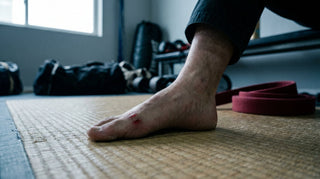
Warm, moist, friction-heavy areas under tight spats and shorts are close to perfect for fungi. Training in damp kit, not drying properly afterwards, and lounging around in sweaty gear after a session all tilt the odds the wrong way. There's also a sneaky link worth knowing: the same fungus behind athlete's foot can hitch a ride from your feet to your groin - often via a shared towel, or pants going on before socks - so dealing with one genuinely helps with the other.
How to recognise it
The classic picture is an itchy rash in the crease of the groin with a defined, slightly scaly edge. The itch is usually the first thing people notice, and it often feels worse after a sweaty session or in hot weather. It can spread down the inner thighs but tends to spare the scrotum itself, which is the sort of detail a clinician uses to tell it apart from other causes of groin irritation - not something to bank on from a blog. If it isn't behaving like a textbook case, that's exactly when to get it confirmed rather than assume.
Habits that help
- Shower and dry the area well after training - detail in the post-training shower routine.
- Change out of sweaty kit promptly; don't re-wear damp spats "just for the next round."
- Keep kit clean and fully dried between sessions - see rashguard hygiene.
- If you've got athlete's foot, dry your feet and put socks on before underwear, to avoid carrying the fungus upward.
- Choose loose, breathable clothing off the mat so the area gets a chance to dry out.
What to do if you get it
A pharmacist can advise on a straightforward case and is a good first port of call in the UK. Keep up the drying-and-clean-kit basics while it settles, because re-creating the warm, damp conditions is exactly what keeps it going. See a GP if it's not improving, spreading, or you're not sure it's fungal in the first place - other things cause groin rashes, and they aren't all managed the same way.
Common questions
Can I still train with jock itch?
Get it confirmed first, and where the skin is broken or weeping, keep it covered and follow a clinician's or coach's guidance. A mild, contained case isn't usually a reason to stop altogether, but rolling around shedding flakes of fungus isn't fair on your partners - when in doubt, ask your coach.
Why does it keep coming back?
Recurrence is usually about the conditions, not bad luck: damp kit, skin that wasn't dried properly, or an untreated case of athlete's foot quietly reseeding it. Tightening up the drying-and-clean-kit routine is often what finally breaks the cycle.
Is it the same as ringworm?
It's a close relative - the same family of fungus, just in a different spot. That's why the prevention advice overlaps so much across athlete's foot, jock itch and ringworm.
Can a pharmacy sort it, or do I need a GP?
For a typical, mild case a pharmacist can usually advise on what's appropriate without a GP appointment, which makes them a quick and sensible first stop in the UK. Save the GP for cases that are widespread, painful, not settling with the usual measures, keep returning despite good habits, or that you're simply not confident are fungal in the first place - those are the situations where a proper look genuinely pays off, because not every itchy groin rash is jock itch.
When to see a doctor
See a pharmacist or GP for a rash that's spreading, painful, weeping, persistent, or that you can't confidently identify. If it keeps coming back despite good habits, that's also worth a proper conversation rather than an endless cycle of self-management.
This article is general educational information and not medical advice, and it isn't about any Combat Sports Hygiene product. If you're worried about your skin, contact a GP, pharmacist or dermatologist.
BJJ Hygiene
Good hygiene is the best foundation for healthy training. Explore the everyday hygiene routine, kit and guides for BJJ athletes, all in one place. Explore the BJJ hygiene hub →