How Often Should You Actually Shower Around Training?
Educational information only – read the full notice
Share
"Shower after every session" is solid advice - but is more showering always better? For hard-training grapplers, the honest answer is: wash when it counts, and don't punish your skin the rest of the time. I train most days, so I've had to find that balance myself. General information here, not medical advice.
The one that's non-negotiable
Showering promptly after training is the high-value one. You've been in close contact, on shared mats, soaked in sweat - washing soon afterwards is the habit that matters most, as laid out in the post-training shower routine. If you only get one shower right, make it this one.
Where "more" stops helping
Beyond the post-training wash, piling on extra hot, soapy showers can dry out and irritate skin, working against your skin barrier. Thinking has shifted away from "scrub everything constantly" and towards washing effectively and protecting the skin you've got. Over-washing can leave skin tight, flaky and more easily irritated - the opposite of what you were going for, and a particular issue for anyone whose skin runs to the eczema-prone side.
A sensible default
- Always shower after training.
- On rest days, wash as your routine and body sensibly require - there's no prize for over-washing.
- Use lukewarm water and a normal wash rather than scalding water and harsh scrubbing.
- If your skin's getting tight, flaky or itchy, that's a signal to ease off the heat and harsh products, not to add more showers.
Signs you might be overdoing it
Skin that feels tight straight after a shower, persistent dry or flaky patches, itchiness that wasn't there before, or irritation that flares with very hot water - these are all hints you've crossed from "clean" into "stripped." None of it means washing less after training; it means turning down the temperature, simplifying your products, and moisturising dry areas. The goal is skin that's both clean and comfortable.
What "effective" washing actually means
"Wash effectively, not aggressively" is easy to say, so here's what it looks like in practice:
- Cover the contact zones properly - hands, feet, neck, face, anywhere kit trapped sweat - rather than a quick all-over rinse.
- Use the mechanical action of a normal soap and your hands or a soft flannel, not a brutal scrub with something abrasive.
- Keep the water lukewarm. Hot water feels great on tired muscles but strips skin faster.
- Dry thoroughly, especially between toes and in folds - the dry is as important as the wash.
Done this way, one good shower after training does more for both hygiene and skin health than three rushed, scalding ones.
Common questions
Should I shower twice a day if I train twice a day?
Showering after each session is reasonable - that's washing when it counts. Just keep those showers gentle: lukewarm water and a normal wash, rather than two scalding scrub-downs that leave your skin raw.
Is it bad to shower every day?
For most people, no - especially when you're training and sweating daily. The thing to watch isn't the frequency so much as how harsh each shower is. Gentle and frequent beats aggressive and frequent every time.
My skin's dry from constant washing - what now?
Keep the post-training wash, drop the water temperature, switch to a gentler product, and moisturise while skin's still slightly damp. If it doesn't settle, a pharmacist or GP can help - persistent dry, cracked skin is worth a proper look.
I feel gross if I don't shower the moment I wake up - is that bad?
A morning shower is fine if that's your routine; the point isn't to ration showers, it's to keep them gentle so daily washing doesn't strip your skin. Lukewarm water and a normal wash mean an everyday shower does no harm.
Do cold showers help my skin?
There's no need to force yourself under cold water for your skin's sake - lukewarm is the comfortable middle ground that cleans well without the drying effect of very hot water. Cold showers have their fans for other reasons, but they aren't a skin-health requirement.
Is it better to shower or bath after training?
A shower is usually the more practical choice straight after training - it rinses sweat and surface contact away rather than sitting you in it, and it's quicker. A warm (not scalding) bath now and then is fine for relaxing tired muscles, but if you've just rolled, shower first. Either way the principles are the same: lukewarm water, wash the contact zones properly, and dry off well.
Do I need to wash my hair every session?
If it's taken a lot of mat and sweat contact, giving it a wash makes sense; if you trained lightly and your hair was barely involved, a rinse may be enough. Let how sweaty it got decide, rather than a fixed rule.
When to see a doctor
If your skin is persistently dry, irritated or breaking down despite a gentle routine, a pharmacist or GP can help.
Your training-day shower game plan
BJJ · Wrestling · MMA · Grappling
The training-day timeline
-
1
Before you train
Turn up clean. A quick rinse washes off the day's sweat and grime so you're not carrying it onto the mats.
-
2
The second you step off
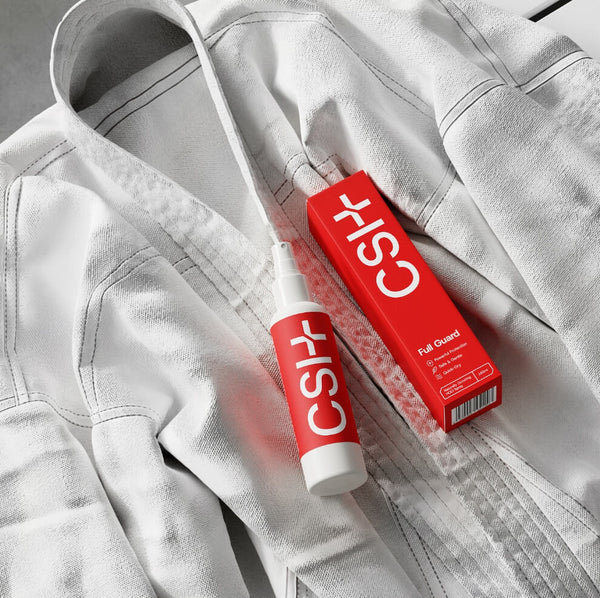
Can't shower at the gym yet? Mist exposed skin with a no-sting HOCl spray to stay fresh until you can - your first layer of hygiene, mat-side.
-
3
Shower ASAP - ideally within 30 minutes
The sooner sweat and mat grime come off, the better your skin feels. Wash head to toe with a gentle soap.
-
4
Dry fully & change kit
Towel off completely - especially feet, between the toes and skin folds. Damp skin is unhappy skin. Fresh kit every session.
So... how often should you shower?
Do & don't
✅ Do
- ✅ Shower soon after training
- ✅ Use a clean, dry towel every time
- ✅ Dry between your toes
- ✅ Wash rashguards & gis after every wear
❌ Don't
- ❌ Sit around in sweaty kit
- ❌ Share towels or bars of soap
- ❌ Scrub broken skin raw
- ❌ Skip the shower "just this once"
Hygiene is a habit, not a one-off. Build it into every session and your skin - and your training partners - will thank you. Full Guard makes the mat-side step effortless.
This article is general educational information and not medical advice. If you're worried about your skin, contact a GP or pharmacist.
BJJ Hygiene
Good hygiene is the best foundation for healthy training. Explore the everyday hygiene routine, kit and guides for BJJ athletes, all in one place. Explore the BJJ hygiene hub →