Why You Should Never Share a Towel or Razor in a Rugby Club
Educational information only – read the full notice
Share
Sharing kit is embedded in rugby club culture - borrowed towels, passed razors, communal water bottles. It feels harmless. It is not. Asymptomatic carriers spread bacteria and fungi across a squad through shared personal kit without either player knowing it is happening. The good news is that the fix is simple: treat towels, razors, and bottles as personal items, full stop. This post explains what transfers on what, and what every player should carry in their own kit bag.
How Asymptomatic Carriage Makes Shared Kit Dangerous
The most important concept here is asymptomatic carriage. A player can carry Staphylococcus aureus in their nasal passages, on their skin, or in their armpits without showing any signs of infection. Studies consistently find MRSA nasal carriage rates of 5-10% in the general population; contact sport populations tend to run higher. That player passes you their towel after a match. You have a small abrasion from a stud or a turf burn. The bacteria transfer and find an entry point.
The same applies to fungi. Tinea pedis (athlete's foot) and tinea corporis (ringworm) shed fungal spores onto any fabric that comes into contact with infected skin. A damp towel used by an infected player and then passed to you is an effective transmission vehicle - warm, moist, and loaded with viable spores.
The Specific High-Risk Items
Towels are the primary vector for both bacterial and fungal transfer in a changing room environment. They stay damp after use, are used across the entire body including the groin and feet, and are often handed around casually. Never use another player's towel. Never lend yours. If you forget your towel, air-dry rather than borrowing - it is uncomfortable for two minutes; an infection is inconvenient for weeks. For more on the fungal risks in communal environments, see our guide to ringworm in rugby.
The asymptomatic carriage point applies with particular force to towels. A player colonised with MRSA who shows no symptoms whatsoever - no visible wound, no irritation, no reason to think twice - can deposit viable bacteria on a shared towel in a single use. The next player who uses that towel to dry a minor cut, a turf burn, or a fresh stud mark has created a direct inoculation pathway. The bacteria do not need a significant entry point; a small abrasion is enough. This is not a remote risk. It is the routine mechanism by which MRSA moves through contact sport squads, and it does not require any player to behave carelessly or feel unwell.
Razors are in a different category of risk. A razor creates micro-abrasions on the skin even with careful use, and picks up blood and skin cells in the blade. Sharing a razor is a direct blood-contact exposure. Beyond staph - which razors transfer effectively - there is documented risk of hepatitis B, hepatitis C, and theoretically HIV from shared blades with blood contamination. This is not hypothetical squeamishness. Do not share razors. A cheap disposable is one of the most cost-effective pieces of personal kit you can buy.
Grip tape and strapping is an underappreciated risk item. Strapping is applied to hands, wrists, and ankles - areas with frequent minor cuts and abrasions in rugby - and often applied communally from a shared roll handled by multiple players and the physio. The tape itself is less of a problem than the hands touching it, but any tape applied over open skin in a communal setting is a cross-contamination opportunity.
Water bottles carry oral flora including streptococcal bacteria. Scrumpox - the herpes simplex infection endemic to the rugby front row - can also spread via shared bottles. Your water bottle goes to your lips; no one else's should. See our guide to scrumpox in rugby for more on oral HSV transmission in contact sport.
The Personal Kit Mindset
The shift required is attitudinal. In most team sports, sharing kit is socialised as normal - a sign of team spirit, no big deal. In a contact sport played on grass and artificial turf where skin abrasions are routine and changing rooms are shared with 40+ players, the risk calculus is different. Personal kit is not a hygiene quirk; it is basic infection control.
Each player should have, as non-negotiables: a dedicated towel (washed after every session at 60°C), their own razor (never shared), their own water bottle (labelled), their own bar of soap or body wash. These are not premium items. They are the baseline.
The Kit Bag as Your Hygiene Boundary
The practical way to enforce the personal kit mindset is to have everything you need in your own kit bag before you arrive at the ground. If it is in the bag, you do not need to borrow it. If you are borrowing it, something is missing from the bag.
For a complete rundown of what belongs in a well-stocked kit bag, see The Ultimate Rugby Kit Bag Hygiene Checklist.
What Clubs Can Do
Individual behaviour matters most, but clubs can make it easier. Providing labelled hooks so players' towels do not end up in a communal pile, running brief hygiene education as part of pre-season, and having the captain or physio reinforce no-sharing norms all help. If your club has a physio who tapes players before matches, a new pair of gloves between players and individual tape rolls rather than a shared communal one is worth raising.
Clubs with recurring skin infection problems - and most senior clubs have them if they look honestly - should review what communal touchpoints exist and where personal kit boundaries can be tightened. The shared equipment and infection problem is solvable with culture and kit. Start with the individuals who are willing, and the norm shifts.
Related Guides
- The Ultimate Rugby Kit Bag Hygiene Checklist
- Scrumpox in Rugby: Causes, Treatment and Return to Play
- Ringworm in Rugby: Recognition, Treatment and Return to Play
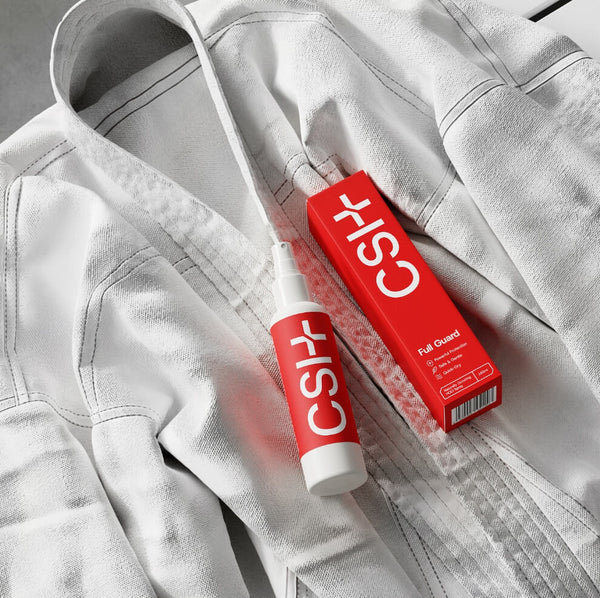
Full Guard is a cosmetic skin cleansing spray registered under the UK Cosmetic Products Regulation. It is not intended to treat, cure, prevent or diagnose any skin condition. For any active skin concern, consult a GP, dermatologist or pharmacist.
The rugby bag, sorted
First aid kits built for grass and astro burns, a rinse-free cleansing spray for after training, handmade soap for the shower, and the spray for scrum caps and shared kit. For players, parents and clubs, with the season written up in order.
See the rugby hygiene and first aid collection →