Impetigo in Wrestling, BJJ and Grappling: What Every Athlete Should Know
Educational information only – read the full notice
Impetigo is common, very contagious, and a regular visitor to wrestling rooms and grappling gyms. I've watched it move through a class more than once. The reassuring part is that it's usually recognisable and very treatable once a clinician is involved; the catch is that it spreads fast, so it's one to act on quickly rather than wait out. This is the plain-English version for wrestlers, BJJ and MMA athletes, coaches and parents: what it looks like, how it travels round a gym, what the outbreaks on record teach, and when you can get back on the mats. It's general information, not medical advice, checked against the NHS, the CDC and the NFHS wrestling guidelines.
⚡ 60-Second Summary
- Core issue: a bacterial skin infection that spreads by skin contact and shared towels, and gets in through broken skin
- What to watch: red sores or blisters that burst and dry to golden-brown crusts, like cornflakes stuck to the skin
- Immediate action: off the mats, see a pharmacist or GP, tell your coach the same day
- Never do this: don't tape it and train. Covered impetigo is still contagious impetigo
- Back on the mats: the NHS says 48 hours after treatment starts; US wrestling rules ask for 72 hours and no weeping sores
What impetigo is
Impetigo is a contagious bacterial infection of the top layer of the skin. It's most common in young children, which is why you'll hear it called "school sores", but adults absolutely get it too, and a busy contact-sport gym is a perfect setting. It's caused by bacteria: group A Streptococcus, Staphylococcus aureus or both (CDC: About impetigo), so it overlaps with the staph infections grapplers already know about. The difference is depth. Staph boils sit in the tissue under the skin; impetigo sits on the surface, which is exactly why it transfers so easily on contact.
There are two forms, and it helps to know both:
- Non-bullous impetigo is the common one, around seven cases in ten. Small red sores or blisters that burst quickly and dry into the classic honey-coloured crust. Usually around the nose and mouth, but on athletes it turns up wherever the skin was broken: forearms, hands, neck, knees.
- Bullous impetigo starts as larger, fluid-filled blisters that stay intact for longer, then burst and leave a scaly rim around a scab. The NHS describes yellow liquid that "oozes from the blisters and hardens" (NHS: Impetigo). It's the form that is more often caused by staph alone.
Either way, the bacteria mostly need a way in. Mat burn, a fingernail scratch, cracked knuckles, a shaving nick or a patch of already irritated skin will do. That's the whole story of why grappling and impetigo keep ending up in the same sentence.
What it looks like, with photos
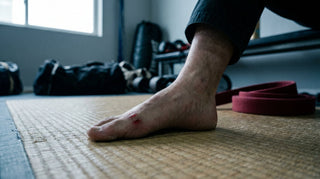
The classic sign is that golden-yellow, honey-coloured crust sitting over a sore or a patch of broken skin. The NHS says the patches "look a bit like cornflakes stuck to your skin", which is the most useful description anyone has come up with. It often appears around the nose and mouth but can turn up anywhere the skin has been broken, including the spots grapplers tend to get knocked about. It can be itchy, and scratching carries it to new areas and to whoever you grab next.
What it can look like


Real photos of impetigo, shared under open licences. Every case looks a bit different, and on brown and black skin the redness is often much less obvious than the crust. None of these replace a clinician looking at your skin.
Is it impetigo? A quick self-check
Nobody should diagnose skin from a blog. But these are the questions a clinician asks, and running through them tells you whether to get it seen today or keep an eye on it.
- Did it start as a small red sore or blister that burst? Impetigo usually does. A boil starts as a hard, painful lump and stays one.
- Is there a golden or honey-coloured crust? That colour is the single most recognisable feature. Cold sores crust darker and start with tingling; ringworm has no crust at all, just a scaly ring.
- Is it spreading or multiplying? New sores appearing near the first one, or on the other hand or arm, is typical of impetigo and a sign it's being carried by fingers.
- Itchy rather than painful? Impetigo is often itchy with little pain. That's why people train through the early stage without noticing. Pain, heat and swelling point more towards a staph boil or cellulitis.
- Where is it? Nose, mouth, hands, forearms and anywhere the skin was already broken. On wrestlers, the face and neck take the lock-up contact; on BJJ athletes, forearms, knees and the backs of hands.
Two or more yeses means a pharmacist or GP today, and no mats until then. One yes on a spot that's clearly settling down is worth a photo and a check tomorrow.
What to do if you think you've got it
Three priorities, in this order:
- Get it assessed. A pharmacist or GP can confirm it and advise on management. The NHS lists hydrogen peroxide cream as a first option, then antibiotic cream or tablets (NHS: Impetigo). Impetigo usually needs proper treatment to clear and to stop spreading, rather than hygiene alone.
- Stay off the mats until you're cleared. Because it's so contagious, training with active impetigo risks handing it straight to your partners. The NHS is blunt: do not go to the gym or play contact sports until it stops being contagious. There's more on the etiquette in when to stay off the mats, and on how competition organisers handle visible skin issues in pre-competition skin checks.
- Tell your coach early. Nobody enjoys that message. Every coach would rather have it on day one than find out on day five with three more cases in the room. In the meantime, keep it covered where you can, wash your hands well, and don't share towels or kit. That's a stop-gap, not a substitute for treatment.
Two things not to do: don't pick or scratch the crusts, which spreads it, and don't put anything on it that a clinician hasn't recommended. The tea tree oil folklore that circulates in every gym is not a treatment for an established infection.
Impetigo, cold sore, ringworm or staph? Telling the lookalikes apart
"Impetigo or cold sore" is one of the most searched questions about it, and on a wrestler the answer matters, because the sport treats them differently. This is the quick comparison; each row links to the full guide.
| Condition | Caused by | What it usually looks like | Where on an athlete | Off the mats? |
|---|---|---|---|---|
| Impetigo | Bacteria (strep, staph or both) | Red sores or blisters that burst and dry to honey-coloured crusts. Itchy more than painful | Nose, mouth, forearms, hands, knees, anywhere the skin was broken | Yes. NHS: until 48 hours after treatment starts. US wrestling rules: 72 hours of treatment and no weeping sores |
| Cold sore | Virus (HSV-1) | Tingling first, then a cluster of small blisters that crust darker | Lip edge, around the mouth | Yes. Covering it doesn't count under NFHS rules. Herpes gladiatorum guide |
| Herpes gladiatorum | Virus (HSV-1) | Clusters of 6 to 10 blisters on a red base, sometimes with fever or swollen glands | Head, face and neck, from the lock-up position | Yes, minimum 10 days for a first outbreak under NFHS rules. Full guide |
| Ringworm | Fungus | A round, scaly patch with a raised, redder edge and a paler middle. No crust | Arms, torso, neck, scalp | Yes, until treatment has started, then covered per your doctor and gym. Ringworm in BJJ |
| Staph boil or abscess | Bacteria (S. aureus) | A hot, painful, swollen lump that fills with pus and grows | Anywhere, often thighs, buttocks, armpits, forearms | Yes, until seen and treated. Staph in grappling |
| Mat burn | Friction, not infection | A raw graze, stinging, no crust unless it gets infected | Knees, elbows, feet, face | No, if it's clean and covered. How to treat mat burn |
Impetigo and staph can be the same bacteria. When a staph boil is picked open and the surface gets infected, or when impetigo goes deeper, the two blur into each other. That's one more reason a clinician, not a training partner, makes the call.
Why wrestlers and grapplers get it so often
It comes up constantly, and the answer is not that wrestlers are dirty. It's that the sport stacks every risk factor at once.
- Skin contact is the sport. Folkstyle, the style of US high school and college wrestling, is built on riding, mat returns, tie-ups and scrambles: constant skin-to-skin contact. BJJ adds chest-to-chest pressure, collar ties and crossfaces that put your face and forearms against a partner's skin for minutes at a time.
- Broken skin is routine. Mat burn, gi friction and fingernail scratches create the tiny breaks the bacteria need. A room full of people with micro-abrasions is a room full of open doors.
- Weekend tournaments stretch the exposure. Several opponents from different teams in a day, on mats every team in the building shares, sometimes with no chance to shower until you get home. The NFHS recommends showering after each match at tournaments (NFHS: Preventing skin infections in wrestling).
- The locker room adds a second route. The NHS notes impetigo also spreads through things that have touched infected skin, like towels and bedding, so a shared towel matters on top of skin contact on the mat.
- Sweat and heat. A warm, damp environment keeps bacteria viable on skin and gear for longer.
That's why the NFHS says skin checks must be done every day before practices and meets, and that all wrestlers must shower immediately after practices and meets. Under NFHS wrestling rules, a wrestler suspected of having a contagious skin condition must bring written clearance from a health-care professional to weigh-in, unless an on-site meet health-care professional examines them (NFHS: Wrestler skin lesion release form).
Impetigo in wrestling and rugby: what the outbreaks show
Impetigo outbreaks in sport are well documented, and three cases show how one uncovered sore becomes a squad problem.
Arizona, 2014: one wrestler, twelve cases of impetigo
A two-day high school tournament in Maricopa County brought together 168 wrestlers from 24 schools. Two weeks later the county health department was fielding reports of skin lesions. The investigation found 47 cases (37 confirmed by a physician or a lab). Impetigo was the most common diagnosis at 17 cases, with herpes simplex second at 11, then ringworm and MRSA at two each. One wrestler had competed with uncovered impetigo lesions on his head and neck. In the 3 to 14 days after the tournament, eight wrestlers who had been there developed impetigo, and then four of their teammates who hadn't wrestled at all caught it back at their own gyms. The health department's response: exclude anyone with visible, uncovered lesions, disinfect mats between every match, and put third-party clinicians on skin checks before each wrestler competed. Source: Williams C et al., MMWR 2015;64:559-60.
London, 1984: "scrum kidney"
Five front-row players in the St Thomas' Hospital rugby team developed impetigo after a match against a side that was in the middle of its own outbreak. The strain, a group A streptococcus, passed to two front-row players of a third team a week later, and to two of the players' girlfriends a month after that. One player went on to develop acute glomerulonephritis, a kidney inflammation that can follow streptococcal skin infection. The Lancet's conclusion was that teams should not field players with skin sepsis, and that traumatised skin should be treated after the match. Source: Ludlam H, Cookson B. Lancet 1986;2:331-3.
Tehran, 2007: half the room in a year
A survey of 411 wrestlers from clubs across Tehran found that 52% had a physician-diagnosed skin infection in the previous year, and the authors flagged "a significant potential for an outbreak of impetigo" alongside the ringworm they had already seen. Source: Kordi R et al., J Sports Sci Med 2007;6(CSSI-2):39-44.
The pattern is the same every time: the infection isn't the problem, the uncovered, unreported sore is. Skin checks, cover-or-sit-out rules and prompt reporting are what stopped each of these.
How impetigo actually spreads round a gym
Knowing the route is what makes prevention feel less like a lecture. Impetigo needs two things to move: contact with the sore, or with something that touched it, and a bit of broken skin to land in. In a gym that looks like:
- Partner to partner. The main route. Your face on their forearm, their forearm on your neck. A crust that gets knocked off in a scramble is loaded with bacteria.
- Hands. Scratching an itchy sore, then gripping a collar, a wrist, a water bottle, a door handle.
- Towels, gis and headgear. The NHS advice is not to share flannels, towels, sheets or pillowcases. In a gym, add gis, rashguards, headgear and knee pads. Staphylococcus aureus survives on dry surfaces for weeks to months, so a shared or unwashed item stays a risk long after the session.
- Mats. Part of the picture, and the reason mats need cleaning daily, but a smaller route than skin contact. The Arizona investigators still recommended disinfecting between every match at tournaments.
- Home. The Arizona and London cases both spread to people who never set foot on the mat: teammates and partners at home. Bedding and bathroom towels carry it out of the gym.
The golden window: the first hour after training
After hard training you are carrying your partners' sweat, whatever was on the mats and a handful of fresh micro-abrasions you have not noticed yet. The longer that mix sits on your skin, the more time bacteria has next to a way in. No study gives a minute count; the CDC's advice from its review of sports outbreaks is to shower with soap after every practice or tournament, the NFHS says immediately, and the sooner the better. We've written about a training partner who did everything right on the mats and still picked up a staph infection on the drive home; the lesson is the same for impetigo.
When there is no shower at the gym:
- Cleanse before you leave. A rinse-free skin cleansing spray over your arms, neck, face and the skin around any scrapes, then a clean towel. It keeps skin feeling clean until you can shower; it is not the shower.
- Get the wet kit off you. A dry rashguard or T-shirt for the drive. Do not sit in the sweaty singlet or gi.
- Shower with soap as soon as you are home, with real lather and real friction, not a rinse. Wash the areas that were under the gi or singlet first.
- Thirty-second skin check after the shower: face, forearms, hands, legs. You are looking for anything new. Catching impetigo on day one instead of day four is the difference between you missing a few sessions and your whole team missing two weeks.
Headgear, knee pads and the kit bag
Wrestlers guard their skin and then put a sweat-soaked headgear back in a zipped bag, where it stays warm and damp until the next session. Headgear is the item that matters most in wrestling, because it sits on the face and neck, exactly where impetigo and herpes gladiatorum turn up. Knee pads, singlets, gis, rashguards and the bag itself are the same problem.
- Singlet, gi, rashguard, belt and towel: into the wash the same day, at the hottest temperature the label allows, and dried fully before they go near the bag again. The CDC's sports guidance is to launder towels and supporters after each use.
- Headgear, knee pads, gloves and the bag: these cannot go in a hot wash. Wipe or spray them with an equipment spray made for kit, such as Gear Guard, and let them dry in the open before the drive home rather than sealing them in wet. The CDC's recommendation for shared equipment is cleaning "at least once a week but ideally after each use".
- Your own headgear, always. Borrowed headgear is a face-to-face handover of whatever the last wearer had.
- Two rashguards or singlets. One to train in, one dry one for afterwards. A damp one reused the next day is the classic mistake.
- Wash the bag weekly. Most are machine washable. If yours is not, empty it, spray it and leave it open to dry.
Mat burn and open skin: the ten-minute rule
Impetigo mostly gets in through broken skin, so the mat burn you picked up in the last round matters more than anything on the mats. Deal with it in the first ten minutes, not when you get home.
- Rinse it under running water to get grit and sweat out, then pat dry with a clean towel.
- Cover it. A washproof plaster for small grazes, a hydrocolloid dressing for larger mat burns. Keep it covered while it heals and change the dressing daily or when it gets wet. The CDC's rule for athletes is cover cuts and wounds with clean, dry dressings until healed.
- Keep sprays and soap for the intact skin around it. Cosmetic skin sprays are for cleansing skin, not for treating wounds; do not spray anything into an open graze.
- If it won't stay covered through a roll, sit the session out. An open graze on the mat is an invitation.
- Watch the trajectory. A graze that develops a honey-coloured crust, spreads or starts weeping has stopped being a graze. That's a pharmacist or GP that day.
Carrying a small kit means step two happens at the gym instead of "when I find a plaster". The full guide to treating mat burn covers the dressings and the mistakes.
The wrestling and grappling hygiene kit
Everything in this guide that isn't a habit, in one place
A rinse-free skin cleansing spray for the gap between mat and shower, a proper soap for when you get there, dressings for broken skin, an equipment spray for headgear and pads, your own towel, tape and clippers. None of it treats or prevents impetigo. It's the kit that keeps skin clean, broken skin covered and shared gear dry.

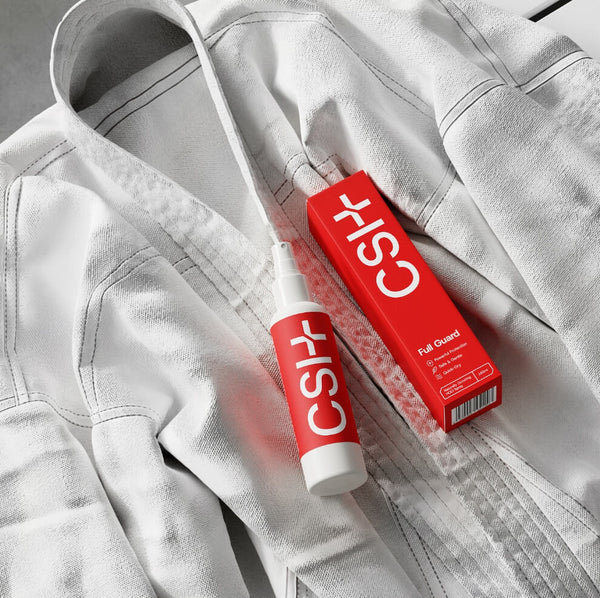
Full Guard Spray
Rinse-free skin cleansing spray for straight after training. £16.49

Athlete Soap Bar
The post-training shower, done properly. £8.49

Personal First Aid Kit
Washproof and hydrocolloid plasters, saline wipes, tape. £26.99

Mat and Turf Burn Kit
Built for the grazes that let infection in. £14.89

Gear Guard
For headgear, knee pads, gloves and the bag. £16.49

Sports Towel
Your own, washed after every session. £3.99
See the full hygiene kit collection →
Full Guard and the soap bars are cosmetics for cleansing the skin. First aid kits are CE/UKCA marked wound-care items, not medicines. Gear Guard is an equipment cleaner; use biocides safely and read the label. Nothing here prevents or treats impetigo: see a pharmacist or GP.
How to prevent impetigo in wrestling and BJJ: a before, during and after checklist
Most of this is boring, which is the point. Impetigo is prevented by habits, not products.
| When | Do this | Why it matters |
|---|---|---|
| Before | Thirty-second skin check: face, hands, forearms, knees | A sore you spot at home stays at home |
| Before | Clean and cover every graze, mat burn and cracked knuckle | Broken skin is the front door for impetigo |
| Before | Nails short, clean kit, your own headgear | Scratches and shared headgear both add risk |
| During | Flip-flops off the mat, bare feet on it | Keeps floor dirt off the mats |
| During | Your own water bottle and your own towel | The NHS: don't share towels. Sharing is an easy way to pass it on |
| During | Don't scratch. Tell a coach if you notice something on a partner | Fingers move it; good gyms make the conversation normal |
| After | Shower with soap as soon as you realistically can | The sooner sweat and mat grime come off, the better |
| After | Kit straight into a hot wash, not left balled up in the bag | Warm, damp kit is a breeding ground |
| After | Clean and cover any new scrapes, and re-check your skin | Today's mat burn is tomorrow's way in |
| Weekly | Wash the belt, knee pads and bag; spray the headgear after every use | The kit everyone forgets |
At gym level: mats cleaned every day, a clear "stay off the mats" rule for skin problems, daily skin checks in season, and coaches who check skin before competitions. Our guide on when to stay off the mats covers the rules, and the post-practice locker room guide covers the routine.
If someone in your gym has it
One case handled well stays one case. The NFHS guidance is that once a student has been identified with impetigo, "all team members should be carefully screened for similar infections on a daily basis by a knowledgeable coach or appropriate health-care professional" (NFHS position statement, 2018).
- They stay off the mats until a pharmacist or GP clears them. No exceptions for competition camps.
- Everyone else steps up: shower immediately after training, daily skin check, nothing shared.
- Mats disinfected daily with a product used per its label, and between matches at events.
- Headgear, pads and shared kit cleaned and dried after every use, not once a week.
- If more than one person has it, the NFHS advises contacting the local health department. In the UK, ask your GP practice.
Handled this way, a single case stays a single case. Ignored, it becomes an outbreak that empties your competition roster.
A note for parents
Impetigo is especially common in children, so parents of young grapplers are worth keeping in the loop on what to watch for and when to keep a child off the mats. There's general, practical guidance in a parent's guide to kids' BJJ hygiene. As with adults, the safe default is: if in doubt, get it checked before training. Kids' classes are where impetigo spreads fastest, and a child who scratches will carry it to the bathroom towel and the family bedding, which is how it turns up in siblings a week later.
Coming back: when can you wrestle or roll again?
The question every grappler asks is not "what is impetigo", it is "when can I train". The honest answer follows the treatment, not the calendar on your wall, and it depends on whose rules you compete under.
- NHS: impetigo stops being contagious 48 hours after you start using hydrogen peroxide cream or antibiotics. Without treatment it can take between 7 and 21 days. Until then, no gym and no contact sports (NHS: Impetigo).
- NFHS (US high school wrestling): the athlete is removed from practice and competition and treated. For non-MRSA infections, return to contact may occur after 72 hours of treatment, provided the infection is not actively draining, and the site is then covered with a bio-occlusive dressing. All lesions are considered infectious until each has a well-adherent scab without any drainage or weeping (NFHS position statement, 2018). The model release form adds no new lesions in the preceding 48 hours (NFHS skin lesion form).
- Rugby: the RFU and World Rugby return-to-play criteria are covered in impetigo in rugby.

| Stage | Typical guidance |
|---|---|
| Honey-coloured crusts spotted | Off the mats straight away and see a pharmacist or GP. Treatment is usually a prescribed cream or antibiotics. It spreads easily through skin-to-skin contact and shared towels |
| First 48 hours of treatment | Still off. The NHS says impetigo stops being contagious 48 hours after starting prescribed treatment, and not to go to the gym or play contact sports while it is contagious. Wrestling return rules ask for longer |
| 72 hours of treatment | The NFHS minimum for US high school wrestling, provided nothing is draining and every lesion has a dry, well-stuck scab. Cover the site with a bio-occlusive dressing to compete |
| Return to contact | Only with a clinician's clearance and your competition's rules met. Wash everything that touched the area, kit, towels and bedding, on a hot cycle before it goes near the gym again. Tell your coach it's your first session back |
Taping over an active sore doesn't get you on the mat either: under NFHS rules, covering a communicable condition doesn't make a wrestler eligible, although once a lesion is no longer contagious it can be covered to allow participation. Treat the timeline as a floor, not a target. Coming back a session early is how one person's minor infection becomes a mat-wide outbreak.
When to see a doctor
See a pharmacist or GP promptly if you notice crusted, weeping or spreading sores, if a sore isn't improving, or if you're simply not sure what it is. Seek further advice if it's widespread, keeps coming back, or you also feel unwell. Go the same day if there's increasing redness, warmth or swelling around a sore, or a fever or swollen glands, which can mean the infection is going deeper. Impetigo is one of the clearer "act quickly" cases, purely because of how readily it travels from person to person.
Impetigo FAQs
Is impetigo contagious?
Very. It spreads by direct contact with the sores and through anything that has touched them: towels, bedding, headgear, a gi. The NHS says it stops being contagious 48 hours after treatment starts, or after 7 to 21 days without treatment. In a grappling gym, treat every case as contagious until a clinician says otherwise.
How long is impetigo contagious for?
Impetigo stays catching until it's properly clearing, which is why getting it assessed and managed matters, and why training through it is a bad idea. The NHS says it stops being contagious 48 hours after you start a treatment prescribed by a pharmacist or GP, and that without treatment it can take between 7 and 21 days. Until then, cover it where you can, keep your hands washed, and don't share towels or kit.
How do you get impetigo from wrestling or BJJ?
Skin contact with a partner's sore, or with a towel, headgear or gi that touched one, landing on skin that's already broken by mat burn, a scratch or a shaving nick. The Arizona outbreak traced twelve cases of impetigo back to one wrestler who competed with uncovered sores on his head and neck.
Can I wrestle or roll with impetigo if it's covered?
No. The NHS says not to go to the gym or play contact sports while it's contagious, and under NFHS wrestling rules covering a communicable condition doesn't make a wrestler eligible. Sweat soaks through dressings, and a crust knocked off in a scramble is loaded with bacteria. Once a lesion is no longer contagious it can be covered to compete.
Can adults get it, or is it just a kids' thing?
Adults absolutely get it. It's most common in young children, which is where "school sores" comes from, but a warm, sweaty, high-contact gym is a perfectly good setting for it at any age. Don't dismiss a golden-crusted sore just because you're not five.
What's the difference between impetigo and a cold sore?
They're different things. Impetigo is a bacterial infection with a honey-coloured crust; cold sores are caused by a virus (the same one behind herpes gladiatorum), start with tingling and crust darker. They can both crust over, which is one more reason not to diagnose by eye and to let a clinician confirm what you're dealing with. The sport treats them differently too: herpes means a longer time out.
Are impetigo and staph the same thing?
Sometimes the same bacteria, not the same infection. Impetigo can be caused by Staphylococcus aureus, group A strep, or both, and sits on the surface of the skin. A staph boil or abscess sits in the tissue underneath and is hot, painful and swollen. Impetigo that goes deeper, or a boil that's picked open, can turn into the other. Our staph guide covers the deeper infections.
What is "mat herpes" in wrestling?
"Mat herpes" is the nickname for herpes gladiatorum, a skin infection caused by herpes simplex virus type 1 (HSV-1), the virus that also causes cold sores. The NFHS guidelines say it spreads skin-to-skin, that most outbreaks appear on the head, face and neck because of the lock-up position, and that a first outbreak shows as a raised rash with clusters of 6 to 10 blisters. For US high school wrestling, a first outbreak means treatment and at least 10 days out (14 days with fever or swollen lymph nodes), and a recurrent outbreak treated with antivirals means at least 120 hours out. It's not impetigo, but it's the other thing a honey-coloured crust on a wrestler's face gets mistaken for.
How long does impetigo last?
With treatment, the sores usually heal within a week to ten days and stop being contagious after 48 hours. Without treatment it can rumble on for two or three weeks and keep spreading the whole time. If it's not improving after a few days of treatment, or new sores keep appearing, go back to the pharmacist or GP.
Does hypochlorous acid help with impetigo?
Not as a treatment you can buy off the shelf. Hypochlorous acid is used in some wound-care products under clinical supervision, but a cosmetic skin spray is for cleansing intact skin and is not a treatment for impetigo. The NHS's first-line options are hydrogen peroxide cream or antibiotics from a pharmacist or GP. Use skin sprays and soap on the unbroken skin around a covered sore, never on the sore itself.
Why do wrestlers get staph infections?
Because the sport stacks up the risks. The CDC notes that athletes have repeated skin-to-skin contact, may have cuts and abrasions that can let MRSA (a type of staph) in if left uncovered, share items and surfaces that touch skin, and are sometimes not able to shower or wash their hands after exercise (CDC: MRSA prevention for athletes). Mat burn is exactly that kind of abrasion. There's more in our staph guide.
How long after impetigo can a wrestler return to the mat?
That's your clinician's call and your competition's rules. The NHS says 48 hours after treatment starts. The NFHS, which writes US high school wrestling rules, asks for 72 hours of treatment with nothing draining, every lesion scabbed over, no new lesions in the preceding 48 hours, and the site covered with a bio-occlusive dressing to compete. If new lesions keep appearing or draining after 72 hours, MRSA should be considered.
The bottom line
Impetigo is common, highly contagious, and, caught early and treated by a clinician, a short interruption rather than a season-ender. Know the honey-coloured crusts, get it seen the day you spot it, stay off the mats until you're cleared, and let your doctor and your ruleset make the return call. Between sessions, your job is simple: shower fast, cover broken skin, wash your kit hot, keep your headgear and towel to yourself, and say something the moment you see a crust on anyone in the room.
This article is general educational information and not medical advice. The products it mentions are cosmetic skin cleansers, first aid and equipment-care items; none of them prevent or treat impetigo. If you're worried about your skin, contact a GP, pharmacist or dermatologist.
Wrestling Hygiene
Good hygiene is the best foundation for healthy training. Explore the everyday hygiene routine, kit and guides for wrestling athletes, all in one place. Explore the Wrestling hygiene hub →
Keep reading
- Impetigo in rugby: the RFU and World Rugby return-to-play criteria.
- Staph infections in grappling: the deeper infection from the same bacteria.
- Herpes gladiatorum: the other crusted face infection, and why the rules are stricter.
- Ringworm in BJJ: the fungal one every grappler should recognise on sight.
- When to stay off the mats: the decision checklist for tonight.