PPM Explained: The Right Strength of HOCl for Skin
Educational information only – read the full notice
If you've shopped for a hypochlorous acid product, you'll have seen a number quoted in PPM: 50, 100, 200, sometimes much higher. It's one of those figures that sounds technical and gets glossed over, but it genuinely matters when the product's going on your skin. So here's what PPM means and why the strength is a balancing act.
Plain English, fact-checked with our medical team.
What PPM actually means
PPM is "parts per million", a way of expressing a very small concentration. 100 PPM means 100 parts of the active substance per million parts of solution. For hypochlorous acid it tells you how concentrated the HOCl in the bottle is.
More is not automatically better. With a skin product you're balancing two things: enough active to do its cosmetic job, but gentle enough to be comfortable on skin you might use it on every day, sometimes over grazes and scuffs.
HOCl PPM to Percentage: Conversion Chart
Some brands quote PPM, some quote a percentage. They're the same thing written differently. To convert PPM to a percentage, divide by 10,000.
| PPM | Percentage | Roughly the same as |
|---|---|---|
| 50 ppm | 0.005% | 50 mg per litre of water |
| 100 ppm | 0.01% | 100 mg per litre |
| 150 ppm | 0.015% | 150 mg per litre |
| 200 ppm | 0.02% | 200 mg per litre |
| 250 ppm | 0.025% | 250 mg per litre |
| 500 ppm | 0.05% | 500 mg per litre |
| 1,000 ppm | 0.1% | 1 g per litre |
| 10,000 ppm | 1% | 10 g per litre |
Why HOCl is usually quoted in PPM: the percentages are so small that they're awkward to read. "200 ppm" is easier to compare at a glance than "0.02%".
For water-based solutions, 1 ppm is approximately 1 mg per litre.
What Does PPM Mean in Skincare?
PPM stands for parts per million. 200 ppm means 200 parts of an ingredient in every million parts of the product. It's a way of writing very small amounts, and it isn't only used for hypochlorous acid.
Where else PPM matters in skincare:
- Fragrance allergens. UK and EU cosmetics rules require certain fragrance allergens to be named in the ingredients list once they go above 0.001% (10 ppm) in leave-on products, and 0.01% (100 ppm) in rinse-off products. That's why you'll sometimes see names like linalool or limonene near the end of a list.
- Very low-dose ingredients. Some ingredients work at tiny amounts, so a brand may quote them in ppm rather than as a percentage that looks like zero.
The key point: a PPM figure only tells you how much of something is in the bottle. It tells you nothing about whether that amount suits your skin. That depends on the ingredient, the formula and what the product is made for.
Sources: Cosmetic Products Regulation (EC) No 1223/2009, Annex III
The skin-friendly window
For everyday skin use, a moderate concentration, broadly in the low hundreds of PPM, tends to be the sweet spot: substantial enough to be worthwhile, mild enough to stay gentle and non-stinging. Very high, industrial-strength concentrations belong to surface and equipment uses, not your face and forearms; very weak ones may not be worth much. The goal is the comfortable middle.
It's worth remembering HOCl is also a dynamic molecule that fades over time, so the figure on a fresh bottle and an old, light-damaged one aren't the same. That's the subject of shelf life.
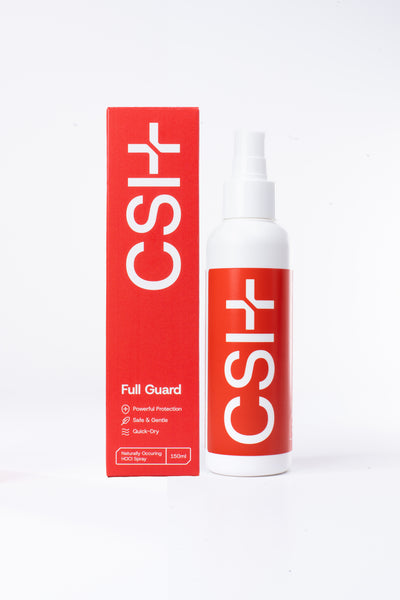
From the CSH range
Full Guard HOCl Hygiene Spray · £16.49
If you have read this far, you care about the numbers. Full Guard is made at a skin-appropriate strength and pH for everyday cosmetic use, in a bottle sized to be used while it is fresh.
PPM in context: putting the number in perspective
Parts per million is a way of describing very small quantities, and a couple of everyday comparisons make it less abstract. One part per million is roughly a single drop in a large drum of water, or one second in around eleven and a half days. So when a skin mist is described as a low-hundreds-of-PPM solution, we're talking about a genuinely dilute active in a lot of water, which is exactly what you want for something you might mist over your face and forearms regularly. High-PPM industrial solutions live in a different world; they're formulated for surfaces and equipment, not for skin you use daily.
Why more isn't better for skin
With a lot of products there's a "stronger equals better" instinct, and with a skin mist it's misleading. The job of a cosmetic skin product is to be effective and comfortable for everyday use, sometimes over grazes and scuffs. Push the concentration too high and you trade gentleness for strength you don't need on skin, which can mean irritation rather than benefit. Push it too low and there's not much there to do anything. The sensible target is the comfortable middle: dilute enough to stay kind, substantial enough to be worthwhile. It's the same balance-not-extremes principle that runs through how we think about soap (see when strong soaps backfire).
Reading a label honestly
A few things worth knowing when you compare products:
- PPM is the starting concentration, not the whole story. Storage, light and age all affect what's actually in an older bottle (see shelf life).
- Higher PPM isn't a quality marker for skin. For a skin mist, a comfortable mid-range is the point, not the maximum.
- Match the product to the job. A skin product and a surface product are different things at different strengths; don't judge one by the other's numbers.
Treat PPM as one useful spec among several, read in context, rather than a leaderboard where the biggest number wins.
100, 200 or 500 PPM: Reading Strengths on HOCl Labels
Shopping for HOCl, you'll see a wide spread of numbers. This is how to make sense of them without a chemistry degree.
Why the numbers differ so much
- Products are made for different jobs. Some HOCl products are cosmetics for skin, and some are designed for cleaning surfaces. They're regulated under different rules, and their strengths aren't directly comparable.
- Labels measure different things. Some quote the hypochlorous acid content. Others quote "free chlorine" or "available chlorine", which isn't quite the same measurement.
- Stability varies. A figure printed at manufacture tells you the starting strength. How the product is made, packaged and stored affects what's still in the bottle months later.
What to check on a label
| Check | Why |
|---|---|
| What it's for: skin, eyes, surfaces or wounds? | Use a product only in the way it's labelled for. A surface product isn't a face mist. |
| The strength, and what's being measured | Hypochlorous acid ppm and "free chlorine" ppm aren't always the same thing |
| The pH | pH decides how much of the chlorine is present as HOCl rather than hypochlorite |
| A date or open-jar symbol | HOCl breaks down over time, so freshness matters |
| Directions and warnings | These tell you how the manufacturer intends it to be used |
Is a higher PPM safe on skin? It's the wrong question to answer in general terms. The right answer is the product's own: use a product only for what it's labelled for, follow its directions, and patch test anything new on a small area first.
A sensible buyer's checklist
If PPM is just one spec among several, what should actually guide a purchase? A short, honest checklist beats chasing a single number:
- Is it formulated for skin? A cosmetic skin product at a comfortable strength, not an industrial-strength surface solution pressed into service.
- Is it fragrance-free and gentle? For everyday use on possibly-scuffed skin, mildness matters more than a big PPM figure.
- Is it well-packaged? Opaque or UV-protected packaging protects the active: freshness is as important as starting strength (shelf life).
- Is there a sensible date on it? A realistic shelf life shows the maker understands the molecule is dynamic.
- Does it suit your skin? The only test that ultimately matters: patch-test, use it, see how your skin responds.
Notice that "highest PPM" doesn't appear on that list. For a skin product, the goal is a gentle, well-made, comfortable mist at a sensible strength, not the biggest number on the shelf. Buy on the whole picture, not a single metric, and you'll end up with something you actually enjoy using day to day rather than an industrial-strength solution that was never meant for your face.
What is the best hypochlorous acid PPM for skin?
Cosmetic skin sprays typically run somewhere between 100 and 300 PPM, and anywhere in that band is a sensible place to be.
What matters more than the headline number is whether the formulation is stable and where the pH sits. A well-stabilised spray at the top of that range is comfortable for daily use on the face. A poorly made one carrying the same figure on the label may already have drifted well below it by the time it reaches your bathroom. The number only means something if the bottle can hold on to it.
Above that band, roughly 500 PPM and upwards, you are into surface and equipment cleaning territory. That is a different job from skincare, and it is not what you want on your face.
Where Full Guard fits
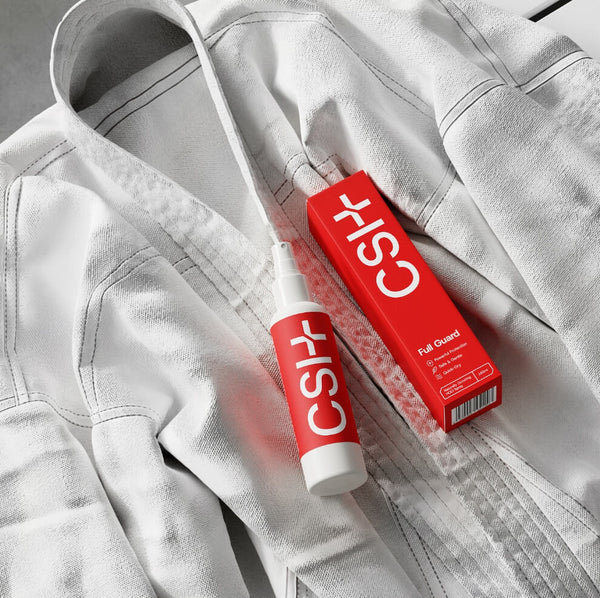
Full Guard sits at 200ppm, stabilised and pH-balanced, which is why it can be this simple: water, salt, hypochlorous acid, nothing else on the label. Fine mist, pH-balanced, fragrance-free, alcohol-free. No sting, dries fast, leaves nothing behind. 100ml, £16.49, made in Britain. Strong enough to be worth carrying, gentle enough to use on your face every day.
Full Guard Hypochlorous Acid Spray, 100ml
More on using hypochlorous acid in a normal skincare routine: our hypochlorous acid skincare guide.
FAQ
Should I just buy the highest PPM I can find?
Not for skin. Very high concentrations are meant for surfaces and equipment, and can be harsher than you want on skin used daily. For a skin mist, a comfortable mid-range is the point.
Does a higher PPM last longer?
Concentration and shelf life are different things: storage, light and heat affect how long a product holds its strength, regardless of where it started. See shelf life.
Is a gentle strength still useful?
Yes. For the cosmetic job of keeping skin clean and fresh, a comfortable, skin-friendly strength is exactly what you want.
How does PPM relate to a percentage?
It's a straightforward conversion: 10,000 PPM equals 1%, so a skin mist in the low hundreds of PPM is a fraction of a percent: genuinely dilute. For example, 200 PPM is 0.02%. That perspective is useful when a product quotes a percentage instead of PPM, or when you're comparing across labels that use different units. It also drives home why "high PPM" for a skin product isn't the flex it sounds like: even a few hundred PPM is a small amount of active in a lot of water, which is exactly what you want for something gentle enough to use on skin regularly.
Keep reading
- Shelf life: why HOCl fades over time.
- HOCl for reactive skin.
- How hypochlorous acid works.

Our HOCl mist
Full Guard Hypochlorous Acid Spray
An ultra-pure, fragrance-free HOCl mist made in the UK. Rinse-free, no alcohol and no sting, it dries in a minute or two and leaves skin feeling clean and fresh, the perfect freshen-up when a shower isn't happening yet.
- 95% pure hypochlorous acid, skin-friendly pH 5.5-6.5
- Fragrance-free and non-stripping, kind to sensitive skin
- Rinse-free, dries fast, fits any bag or desk drawer
- UK-made to ISO 22716 (GMP) standards
Want the full picture on Full Guard? See what makes our hypochlorous acid spray different, for sport and for skin.
Full Guard is a cosmetic skin cleansing spray registered under the UK Cosmetic Products Regulation. It is not intended to treat, cure, prevent or diagnose any skin condition. For any active skin concern, consult a GP, dermatologist or pharmacist.

For females with fight
The face spray for after the gym
Full Guard started on the mats. A fine, fragrance-free mist that cleanses and freshens post-workout skin in seconds, with no rinse and no residue.
See the face spray · £16.49