The Science of Smell: How HOCl Breaks Down Odours
Educational information only – read the full notice
Deodorant masks. Air freshener covers. Most of the things we reach for to deal with a bad smell just pile a nicer smell on top of it. Hypochlorous acid takes a different route: it goes after the odour molecules themselves. To understand why that's a better idea, you need a quick tour of what a smell actually is.
Plain-English chemistry, fact-checked with our medical team.
A smell is a molecule
Every smell you've ever noticed is your nose detecting airborne molecules: volatile organic compounds light enough to drift up and reach your scent receptors. Stale gym kit, sweat, that gone-off gym-bag funk: each is a specific set of small organic molecules produced as sweat and other material is broken down (the body side of that is in the anatomy of combat odour).
What Does Hypochlorous Acid Smell Like?
Less than most people expect.
Many HOCl products have little or no smell at all. Some carry a faint, clean, swimming-pool note that you notice as you spray and that fades as it dries. Full Guard is formulated to be virtually odourless.
If you're expecting the sharp smell of bleach, you won't get it from a well-made HOCl mist. The two are chemical relatives, but they behave very differently (more on that in our guide to hypochlorous acid vs bleach).
Why the "swimming pool" smell isn't what you think: the strong smell you notice at an indoor pool mostly isn't chlorine on its own. It comes largely from chloramines, which form when chlorine reacts with sweat and other things people bring into the water. So a strong "pool" smell is a sign of chlorine reacting with something, not a sign of how much chlorine is there.
Sources: CDC Healthy Swimming: preventing eye irritation from pool chemicals
Why Does My Hypochlorous Acid Smell Like Bleach, or Smell Bad?
A change in smell is worth paying attention to. This is what it can point to.
| What you notice | What it might mean | What to do |
|---|---|---|
| A faint pool-like note that disappears as it dries | Normal for some HOCl products | Nothing. Carry on. |
| A strong, lingering bleach smell | It may be a stronger product, or one made for surfaces rather than skin | Check the label and its intended use. Don't use a surface product on your face. |
| No scent at all from a product that used to have one | It may have broken down with age, heat or light | Check the date on the bottle and how it's been stored |
| A sour, musty or "off" smell | Possible contamination, for example from being decanted or the nozzle touching skin | Stop using it and replace it |
| A strong smell after spraying on sweaty kit or skin | The product reacting with what's already there | Normal, and it should fade as it dries |
How to keep it smelling the way it should: store it cool and out of the light, keep the cap on, don't decant it, and use it within the date on the pack. Our shelf life and storage guide has the detail.
Oxidation changes the molecule
Because hypochlorous acid is an oxidiser, it reacts with those organic odour molecules and alters their structure (the chemistry is in how hypochlorous acid works). Change the molecule and you change, or remove, the smell. Crucially, you're not adding a competing fragrance; you're dealing with the thing that smelled in the first place.
That's why a fragrance-free approach can leave kit and skin genuinely fresh rather than "vanilla-scented over stale." No perfume cover-up, no clashing smells.
Why some smells are so persistent
Anyone who's tried to get a stubborn smell out of training kit knows some odours just won't quit, and the chemistry explains why. The molecules behind gym-bag funk aren't all the same: some are light and disperse quickly, others are heavier, oilier and cling to fabric and skin for ages. The persistent ones embed themselves in porous materials and keep releasing their scent slowly over hours or days. That's why a quick spritz of air freshener does nothing lasting: it adds a competing smell for a few minutes while the original molecules carry on quietly doing their thing underneath. To actually deal with a persistent odour you have to address the molecules themselves, not just float a nicer one over the top.
Masking versus eliminating, in practice
The difference is easy to feel in real life. Masking is the body spray over a stale base: for ten minutes you smell of fragrance, then you smell of fragrance-plus-stale as the cover-up fades and the original reasserts itself. Tackling the odour molecules is different: deal with them and there's simply less there to smell, so what's left is genuine freshness rather than a layered cover-up. For combat-sports kit and skin, where the smell is generated fresh every session, the masking approach is a treadmill you never get off. Working on the odour itself, session after session, is what actually keeps things fresh long-term.
The kit angle, revisited
Your skin is only half the odour story; your gear is the other half, and it's the half people forget. Gloves, pads, rash guards and the bag all soak up sweat and keep generating odour long after you've showered (the detail is in freshening gloves and pads and your kit bag is an incubator). A fragrance-free approach is especially handy here, because the last thing you want is a different artificial scent fighting with stale kit inside a closed bag. Freshen the gear and the bag the same way you'd freshen skin: deal with the odour, don't perfume over it.
Realistic expectations
It's worth being honest about what any of this achieves. New sweat means new odour compounds, so freshness is a habit you maintain, not a one-time fix you apply and forget. Tackling odour molecules keeps you genuinely fresh; it doesn't make you immune to ever smelling again. The win is that you step off the mats clean rather than perfumed-over-stale, and your kit stops carrying last week's sessions around with it. Manage it consistently, body and gear, and the whole stale-kit problem fades into the background of your training life.
The freshness habit, summed up
If there's one mental model to take away, it's this: stop thinking about odour as something to cover and start thinking about it as something to clear. Covering is a short-term loop you never escape: spray, fade, re-spray, all the while the original smell carries on underneath. Clearing means dealing with the odour molecules themselves, so there's simply less there to smell, and then keeping on top of it as new sweat creates new molecules. In practice that's a simple rhythm: wash your skin properly after training, freshen the high-sweat zones, and give your kit and bag the same treatment rather than leaving them to brew. Do that consistently and you're working with the chemistry instead of against it. The contrast with the masking approach is stark once you've felt it: instead of a wardrobe of body sprays fighting a losing battle, you've got genuinely fresh skin and kit because you tackled the cause. None of it is hard or time-consuming; it's just a shift from perfuming-over to clearing-out. Pair that habit with a fragrance-free product that won't add its own competing scent, stay on top of both your skin and your gear, and the stale-changing-room smell that so many people just accept as part of training quietly stops being your problem. It's one of those small changes that, once it clicks, you wonder why you didn't make years ago.
FAQ
Why is fragrance-free better for odour?
Added fragrance only masks: the original smell is still there underneath, often clashing. A fragrance-free approach that works on the odour molecules themselves leaves things actually fresh.
Does it work on gear as well as skin?
A light mist helps freshen porous kit too: the same mist-and-dry approach works for gloves, pads and other gear.
Will it remove a smell permanently?
It tackles the odour molecules present now; new sweat means new odour, so it's a habit, not a one-off. That's just how freshness works.
Keep reading

Our HOCl mist
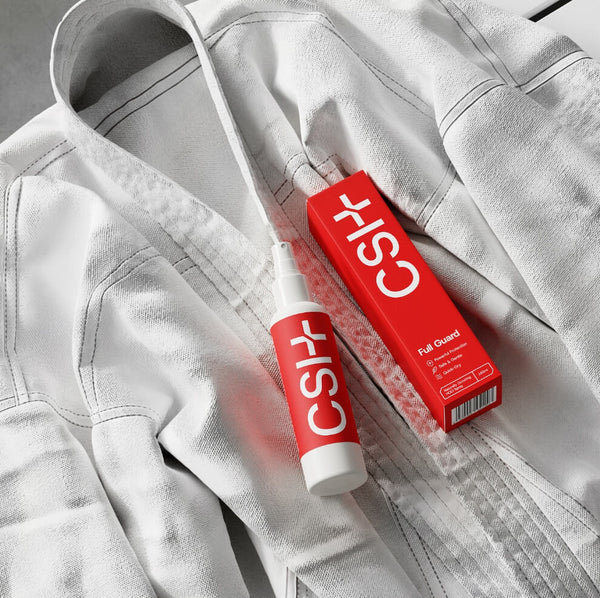
Full Guard Hypochlorous Acid Spray
An ultra-pure, fragrance-free HOCl mist made in the UK. Rinse-free, no alcohol and no sting, it dries in a minute or two and leaves skin feeling clean and fresh, the perfect freshen-up when a shower isn't happening yet.
- 95% pure hypochlorous acid, skin-friendly pH 5.5-6.5
- Fragrance-free and non-stripping, kind to sensitive skin
- Rinse-free, dries fast, fits any bag or desk drawer
- UK-made to ISO 22716 (GMP) standards
Want the full picture on Full Guard? See what makes our hypochlorous acid spray different, for sport and for skin.
Full Guard is a cosmetic skin cleansing spray registered under the UK Cosmetic Products Regulation. It is not intended to treat, cure, prevent or diagnose any skin condition. For any active skin concern, consult a GP, dermatologist or pharmacist.