How Long Does Hypochlorous Acid Last? Shelf Life, Storage and Signs It Has Expired
Educational information only – read the full notice
Hypochlorous acid is one of the few skincare ingredients where storage genuinely changes what is in the bottle.
Most products go off slowly and obviously. HOCl is different: it is inherently unstable, and it degrades towards plain salt water given enough time, heat or light. That is not a flaw in any particular brand, it is the chemistry of the molecule, and it is why HOCl products carry storage instructions that read more strictly than the average toner.
Here is the practical version: how long it lasts, what makes it degrade faster, how to store it, and how to tell whether the bottle in your gym bag is still worth using.
⚡ 60-Second Summary
- Core issue: HOCl degrades over time towards salt water. Heat, light and pH drift speed it up.
- Shelf life: varies by manufacturer and packaging. The date and period-after-opening symbol on your own bottle are the only figures that apply to it.
- Storage: cool, dark, sealed, upright. Not a hot car, not a sunny windowsill, not decanted into a clear spare bottle.
- Signs it is past it: stored badly, well beyond its date, or the faint characteristic scent has gone completely. When in doubt, replace it.
How long does hypochlorous acid last?
There is no single number, and any article that gives you one without asking what you have bought is guessing. Shelf life for an HOCl product depends on how it was manufactured and stabilised, what concentration it is, what the packaging is made of, and how it has been stored since it left the factory. Two bottles that both say "hypochlorous acid" can behave quite differently over a year on a shelf.
What is consistent is the direction of travel. From the moment it is made, an HOCl solution is slowly reverting towards salt water. Good manufacturing slows that down a great deal; poor manufacturing means a product can arrive already well on its way. This is why stabilisation is talked about so much in this category, and why the price gap between HOCl products is often a packaging and process gap rather than a marketing one.
The two numbers that actually apply to your bottle are printed on it: the best-before or expiry date, and the period-after-opening symbol, the little open-jar icon with a figure such as 6M or 12M inside it. That symbol tells you how long the manufacturer expects the product to remain suitable once opened. If your bottle has one, that is your answer, and it overrides any general rule of thumb from the internet, including this article.
How Long Does Hypochlorous Acid Last After Opening?
Opening a bottle doesn't flip a switch, but it does start the clock running faster. Every time you use it, the product meets a little more air, light and warmth, and the nozzle can pick up whatever's on your skin or in your bag.
Start with what's printed on the pack. UK cosmetics rules give you one of two things:
| What you'll see | What it means |
|---|---|
| A "best before end of" date, often next to an hourglass symbol | The product is expected to last 30 months or less, so a date is printed. Use it before that date. |
| An open jar symbol with a number, such as 6M or 12M | The product lasts longer than 30 months unopened. The number is how many months it's good for once opened. |
What shortens the life of an opened bottle:
- Leaving the cap off, or the pump or nozzle open
- Keeping it somewhere warm: a hot car, a sunny windowsill, next to a radiator
- Touching the nozzle to your skin, or letting it sit in a damp, dirty bag pocket
- Topping it up or decanting it into another container (see below)
What helps it last: close it straight after use, keep it cool and out of direct light, and use it regularly rather than letting one bottle sit half-used for a year.
Sources: Cosmetic Products Regulation (EC) No 1223/2009, Article 19
Why hypochlorous acid degrades: the short chemistry
HOCl exists in a balance with other chlorine species in water, and that balance is delicate. Three things push it out of shape.
- Light, particularly UV, provides energy that drives the breakdown. This is the single biggest reason HOCl is sold in opaque or tinted bottles rather than clear glass.
- Heat. Higher temperatures accelerate the reaction, which is why a bottle left in a car in July is treated so differently from one in a bathroom cabinet.
- pH drift. Hypochlorous acid is only the dominant species within a fairly narrow, mildly acidic band. Drift out of that band and the chemistry shifts towards other compounds. Holding the pH steady is a large part of what stabilisation means in practice.
Time does the rest on its own, even under ideal conditions. The background chemistry is covered in the plain-English explainer on what hypochlorous acid actually is.
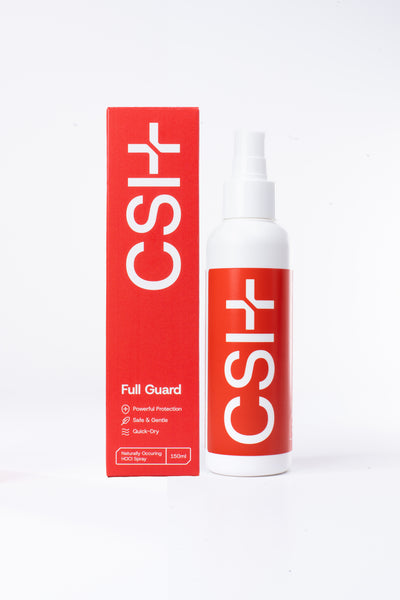
From the CSH range
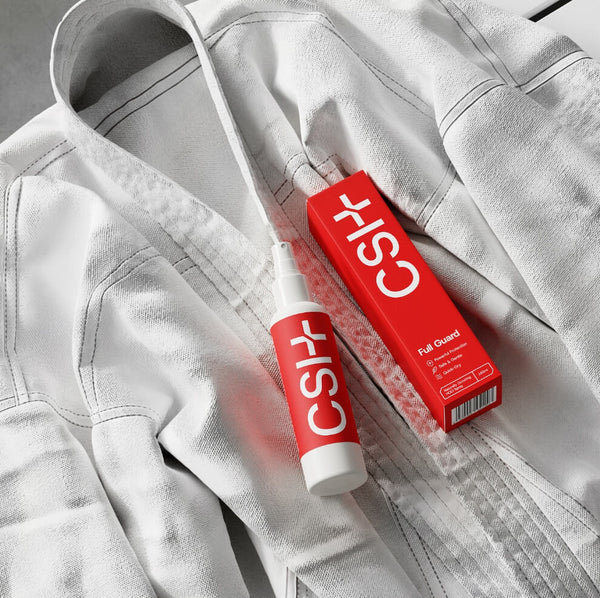
Full Guard HOCl Hygiene Spray · £16.49
Freshness is the whole game with HOCl, which is why Full Guard comes as a 100ml bottle matched to its use window of a month or two rather than a big bottle that sits going stale on a shelf.
Does it need to be in a dark bottle?
Given that light drives degradation, opaque or tinted packaging is doing a real job rather than a decorative one. This has two practical consequences.
First, be wary of decanting. Moving an HOCl spray into a clear travel atomiser for a weekend away removes the light protection the manufacturer designed in, and introduces whatever was in the atomiser before. If you want a smaller bottle for the gym bag, buy a smaller bottle.
Second, storage location matters as much as the bottle. Opaque packaging slows light exposure, it does not make a product immune to a sunny windowsill or a hot dashboard. Keep the container out of direct sun regardless of what it is made of.
How to store hypochlorous acid properly
- Cool. Room temperature or below. Avoid airing cupboards, radiators, cars in summer and windowsills.
- Dark. A cupboard, drawer or bag pocket beats an open shelf in a bright bathroom.
- Sealed and upright. Cap on properly after each use, both to limit air exchange and to avoid leaks.
- In its own bottle. No decanting, no topping up, no mixing with anything else.
- Not in the freezer or the fridge door, unless the label specifically says so. Follow the label rather than improvising.
For a bottle that lives in a gym bag, the realistic version is simple: keep it in a pocket rather than loose on top, do not leave the bag in the car in summer, and replace it in line with the period-after-opening figure rather than using one bottle for years.
Clear Bottles, Decanting and Hot Cars: What Actually Damages It
Hypochlorous acid breaks down faster with heat and light, so most storage questions come down to those two.
| The situation | What happens | Verdict |
|---|---|---|
| Clear bottle | Light gets straight to the product and speeds up breakdown | Avoid. Keep it in its original opaque packaging. |
| Decanting into a travel bottle | Most travel bottles are clear, and pouring adds air and a chance of contamination | Avoid. Buy a travel-sized bottle instead. |
| Left in a car | A parked car heats up fast, even on a mild day with some sun | Don't leave it in the car. Take it in with you. |
| Gym bag | Fine if the bag isn't left in the sun or a hot car | OK. Use an inside pocket. |
| Bathroom shelf | Fine if it's out of direct sun | OK, away from the window |
| Sunny windowsill | Direct light and heat together | Avoid |
| Cupboard or drawer | Cool and dark | Ideal |
Does it need a dark bottle? It needs protecting from light, which in practice means an opaque or dark bottle, or keeping it in its box. That's why well-made HOCl products don't come in clear packaging.
How to tell if hypochlorous acid has gone off
This is the awkward part: a degraded HOCl solution looks exactly like a fresh one. It is clear and colourless either way, so there is no visual test. What you have to go on is a shorter list.
- The date and the period-after-opening symbol. The most reliable signals you have.
- How it has been stored. A bottle that spent a heatwave in a car boot should be treated as suspect regardless of its printed date.
- The scent. Fresh HOCl products typically have a very faint, clean, slightly pool-like note, far milder than bleach. Because degradation moves the solution towards salt water, a product that once had that faint characteristic scent and now smells of nothing at all has probably moved on. Treat this as a rough indicator rather than a test, and never as a reason to keep using something well past its date.
The honest bottom line is that HOCl is a product to replace on schedule rather than to squeeze the last drops from. If a bottle is old, has been stored badly, or you simply cannot remember when you opened it, replace it. It is an inexpensive product and there is no way to verify at home what state the solution is in.
Does hypochlorous acid expire?
Yes, because it is an unstable molecule that gradually reverts towards salt water. Every bottle has a working life whether you have opened it or not.
Unopened and stored sensibly, cosmetic HOCl sprays are generally dated in months rather than years, and the date printed on the bottle is the one to go by. Once opened, the period-after-opening symbol is your clock: the small open-jar icon with a figure such as 6M or 12M inside it.
Storage decides whether a bottle reaches that date. Cool, dark and sealed. Not a sunny windowsill, not a hot car in August.
The signs it is past its best are quiet ones. The faint clean smell fades to nothing much, and it stops feeling like it is doing anything at all. If you cannot remember when you opened it, replace it.
Where Full Guard fits
Shelf life is a formulation problem, and it's the one we spent the longest on. Full Guard is made and bottled in Britain with a stabilised formula and a marked expiry on every bottle, so you're not guessing. Fine mist, pH-balanced, fragrance-free, alcohol-free. No sting, dries fast, leaves nothing behind. 100ml, £16.49, made in Britain. Buy it, use it, replace it when the label says so. That's the whole system.
Full Guard Hypochlorous Acid Spray, 100ml
More on using hypochlorous acid in a normal skincare routine: our hypochlorous acid skincare guide.
Common questions
Does hypochlorous acid expire?
Yes. It degrades over time towards salt water, which is why these products carry expiry dates and period-after-opening symbols. Storage conditions can make that happen faster than the printed date suggests, and no home test can confirm the state of a solution, so the date plus common sense about how it has been kept is the approach to take.
How long does it last after opening?
Follow the period-after-opening symbol on your bottle, the open-jar icon with a figure such as 6M or 12M. That figure is set by the manufacturer for that specific formulation and packaging, and it is more meaningful than any general rule.
What does hypochlorous acid smell like?
Typically a very faint, clean note that some people describe as slightly like a swimming pool, and much milder than household bleach. A strong bleach smell is not what you should expect from a cosmetic HOCl mist. Fragrance-free products have no added scent to mask it, so the faint characteristic note is simply what it is.
Can I store it in the fridge to make it last longer?
Follow the label. Cool storage suits the chemistry in general, but manufacturers specify conditions for their own formulation and packaging, and a fridge introduces its own considerations such as condensation and being stored next to food. Cool, dark and sealed at room temperature is the standard answer unless your product says otherwise.
Is a cloudy or discoloured HOCl spray unsafe?
Any cosmetic product that has changed in appearance, developed a new smell, or been contaminated by decanting or topping up should not be used. Dispose of it and replace it. If a product has caused any skin reaction, stop using it and speak to a pharmacist, GP or dermatologist.
This article is general educational information about the chemistry of hypochlorous acid and how to store it. It is not medical advice and makes no claims about treating, curing or preventing any condition. Always follow the storage and usage instructions on your own product's label. For any skin concern, contact a GP, pharmacist or dermatologist.

Our HOCl mist
Full Guard Hypochlorous Acid Spray
An ultra-pure, fragrance-free HOCl mist made in the UK, stabilised at skin-friendly pH and supplied in light-protective packaging. Rinse-free and no sting, it dries in about a minute. Store it cool, dark and sealed, and follow the date on the bottle.
- 95% pure hypochlorous acid, skin-friendly pH 5.5-6.5
- Fragrance-free and non-stripping, kind to sensitive skin
- Rinse-free, dries fast, fits any bag or desk drawer
- UK-made to ISO 22716 (GMP) standards
Keep reading
- What is hypochlorous acid? - the plain-English explainer behind the chemistry above.
- HOCl mist for post-workout face hygiene - where a rinse-free mist actually fits.
- Using HOCl with retinol - the layering order, and why storage matters for both.