Mimicking the Body: How Your Cells Make HOCl
Educational information only – read the full notice
Here's the fact that makes hypochlorous acid genuinely interesting: it isn't some foreign chemical invented in a lab. Your own body makes it. Right now, inside you, white blood cells are producing hypochlorous acid as a normal part of how your immune system works. That's not marketing. It's textbook immunology.
Let's unpack how that works, in plain English, fact-checked with our medical team.
The oxidative burst
Among your white blood cells are neutrophils, the immune system's rapid responders. When a neutrophil engulfs something it needs to deal with, it triggers a process often called the oxidative burst, a rapid chemical reaction that, through an enzyme called myeloperoxidase, produces hypochlorous acid on the spot.
In other words, your body has been manufacturing and using HOCl as part of its natural defences for your entire life. The molecule in a modern hypochlorous acid mist is the very same one, which is why it's often described as biomimetic: it mirrors something your biology already does.
Why that matters for a skin product
The appeal of a molecule your body already produces is simple: it's inherently skin-compatible. It sits at a near-neutral pH, it's fragrance-free, and once it's done its work on a surface it breaks back down into little more than mild saline (the chemistry is in how hypochlorous acid works). That's a very different proposition to a harsh synthetic.
Inside the neutrophil
It's worth slowing down on the neutrophil, because it's a genuinely remarkable bit of biology. Neutrophils are the most common type of white blood cell and the immune system's first responders, arriving fast wherever they're needed. When one engulfs a particle it needs to deal with, it ramps up oxygen use in a sudden spike known as the respiratory or oxidative burst. An enzyme called myeloperoxidase then uses the products of that burst to manufacture hypochlorous acid, right there on the spot, as part of the cell's normal toolkit. In other words, your body has a dedicated, evolved machinery for producing HOCl, and it's been running quietly inside you your whole life. That's the kind of detail that reframes HOCl from "a chemical" to "something biology already relies on."
Why biomimetic matters for tolerability
The word "biomimetic" (mimicking biology) isn't just a nice marketing angle; it has a practical upshot for how skin reacts. Ingredients that closely resemble what your body already makes tend to be well tolerated, because your skin isn't encountering something alien. Hypochlorous acid is about as biomimetic as it gets: it's not like something your body makes, it is what your body makes. That's a big part of why a well-formulated HOCl mist is so often described as gentle and non-stinging, and why it suits reactive skin (the subject of HOCl for reactive skin). Jojoba works on a similar principle for oils, mimicking your skin's own sebum, covered in jojoba esters.
Lab-made versus body-made: the same molecule
A reasonable question is whether HOCl made in a lab is really the same as the stuff a neutrophil produces. Chemically, yes. Hypochlorous acid is hypochlorous acid, a single small molecule, regardless of whether it's synthesised by an immune cell or produced by passing a current through salt water (the manufacturing route is in electrolysed water 101). What differs between products is concentration, pH and stability (the formulation) not the identity of the molecule. So the appeal is genuine: a skin mist built around a molecule your own biology already manufactures.
The bigger picture for skincare
The neutrophil story is a neat example of a broader idea that's quietly reshaping skincare: working with the skin's biology rather than against it. For a long time the dominant approach was brute force (strip, scrub, sanitise, attack) and we've seen across this blog where that leads (dry, irritated, over-stripped skin). The more thoughtful direction is to reach for ingredients the body already recognises: hypochlorous acid that mirrors what your immune cells make, jojoba that mimics your own sebum (jojoba esters), humectants like the natural glycerine your skin appreciates (the humectant factor). The thread running through all of them is biomimicry: choosing things that fit your skin's own chemistry rather than overriding it. For an athlete putting their skin through a lot, that's a genuinely sensible philosophy: clean and care for your skin with things it tolerates well, and you avoid the cycle of damage-and-repair that harsh products create. HOCl is one of the cleaner examples of the idea, which is a good part of why it's caught on. None of it replaces a doctor for an actual problem, but as an everyday approach, working with your biology beats fighting it.
FAQ
My body already makes it, so why use a product?
The point isn't to replace your immune system; it's that a skin mist based on a molecule your body already recognises tends to be gentle and well-tolerated, which makes it pleasant for everyday hygiene.
Is lab-made HOCl really identical to the body's?
Hypochlorous acid is hypochlorous acid: the same small molecule whether a neutrophil makes it or it's produced by electrolysing salt water, as covered in electrolysed water 101.
Does this mean it's completely harmless?
At cosmetic strengths it's formulated to be gentle, but "natural to the body" doesn't mean "use without thought": follow the product directions, and see a professional for any real skin concern.
If my body already makes HOCl, can a product give me "too much"?
It doesn't really work like that. The hypochlorous acid your neutrophils produce works internally, in tightly controlled, microscopic amounts as part of your immune system. A cosmetic mist is a separate thing entirely: a dilute, skin-friendly solution applied to the surface of your skin, used as directed. They're not pooling into one big tally. The "your body makes it too" point is about the molecule being biocompatible and well-tolerated, not about topping up an internal supply. Use a skin product as a skin product, follow the directions, and leave your immune system to get on with its own quite separate job.
Keep reading
- How hypochlorous acid works: the oxidation chemistry.
- Electrolysed water 101: how it's made from brine.
- HOCl for reactive skin.

Our HOCl mist
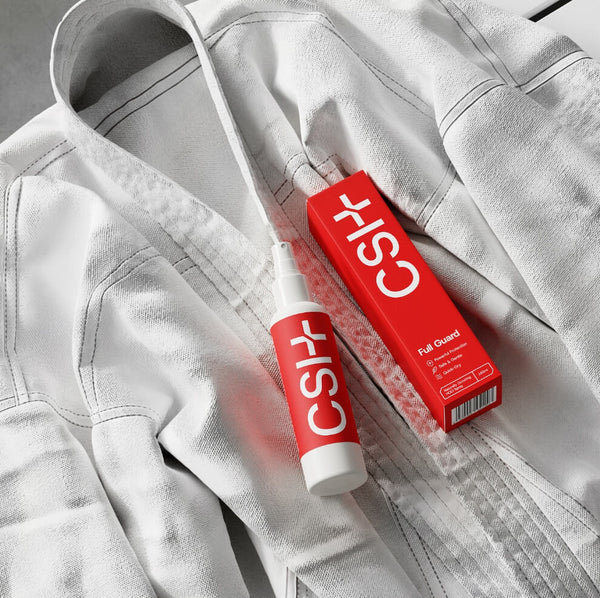
Full Guard Hypochlorous Acid Spray
An ultra-pure, fragrance-free HOCl mist made in the UK. Rinse-free, no alcohol and no sting, it dries in a minute or two and leaves skin feeling clean and fresh, the perfect freshen-up when a shower isn't happening yet.
- 95% pure hypochlorous acid, skin-friendly pH 5.5-6.5
- Fragrance-free and non-stripping, kind to sensitive skin
- Rinse-free, dries fast, fits any bag or desk drawer
- UK-made to ISO 22716 (GMP) standards
Want the full picture on Full Guard? See what makes our hypochlorous acid spray different, for sport and for skin.
Full Guard is a cosmetic skin cleansing spray registered under the UK Cosmetic Products Regulation. It is not intended to treat, cure, prevent or diagnose any skin condition. For any active skin concern, consult a GP, dermatologist or pharmacist.