How to Prevent Ringworm in Wrestling (Tinea Gladiatorum): A Guide for Wrestlers and Coaches
Educational information only – read the full notice
Share
The short answer: ringworm in wrestling is a fungal skin infection that spreads by skin contact and from mats, headgear and towels. You lower the risk by showering straight after practice, drying yourself properly, cleaning your headgear and kit every time, never sharing towels, checking your skin before you wrestle, and treating anything suspicious early instead of wrestling through it.
What is ringworm in wrestling (tinea gladiatorum)?
Despite the name, there's no worm. Ringworm (tinea corporis) is a fungal infection of the skin. In wrestlers it's common enough to have its own name, tinea gladiatorum, and it tends to show up on the head, neck, face and arms: exactly the places that spend most of a session pressed against someone else or against the mat. It's the same infection that turns up in BJJ, judo and MMA; our guide to ringworm in BJJ covers it from the jiu jitsu side.
It usually starts as a small, slightly raised, scaly patch that grows outwards into a ring, redder or darker at the edge with clearer skin in the middle. It can itch. On wrestlers it's sometimes less of a perfect ring and more of a patchy, scaly area, which is why it gets mistaken for mat burn or eczema.
Why wrestlers get ringworm
The fungi behind ringworm love warmth and damp, and they can survive on surfaces for a long time. A wrestling room has both. Add constant skin-to-skin contact, shared headgear and ear guards, towels passed around and mats that don't always get cleaned properly between sessions, and it moves through a squad quickly. One case untreated can become five in a fortnight.
How to prevent ringworm before practice
Do a skin check. Head, neck, face, arms, chest, back. Use a mirror or ask a teammate to check your back. Any new scaly patch, ring or itchy rash you can't explain: don't wrestle on it.
Clean kit. Singlet, shorts, rashguard and socks washed since last time. A singlet worn twice is a singlet carrying last session's fungus into this one.
Your own headgear and ear guards. Never borrow them.
Nails short and skin unbroken where you can manage it; cover any scratches or grazes.
During practice
Your own towel and water bottle. Never share either.
Footwear off the mat. Wrestling shoes on the mat only; sandals or flip-flops in the changing room. Athlete's foot is the same kind of fungus, and bare feet carry it from the changing-room floor straight onto the mat.
After practice: shower, dry, wash
Shower straight away. Not after the drive home, straight after. Use your own soap, scrub properly, and pay attention to your head, neck and arms. Our post-training shower routine goes step by step.
Dry yourself thoroughly. This matters more for ringworm than almost anything else. Fungus thrives on damp skin, so dry properly, especially your neck, behind the ears, in skin folds and between your toes, before you get dressed.
Kit in the wash the same day. Singlets, shorts, socks, rashguards and towels, as hot as the care label allows, and dried fully. A damp kit bag is a fungus incubator. More on washing training kit.
Clean your headgear and ear guards after every session. They sit on the exact area ringworm likes most and they can't go in the washing machine. Spray with a tested disinfectant, leave for the contact time on the label, wipe and air dry fully before they go back in the bag.
Clean the bag too. Once a week, empty it and let it air out; spray the lining.
What the club should be doing
Mats cleaned after every session with a disinfectant that's tested against fungi, at the right dilution, and left wet for its contact time. Skin checks before practice, ideally by a coach who knows what to look for. A clear rule that anyone with a suspicious lesion sits out until it's been seen. And shared kit, the club's headgear and pads, cleaned after every use rather than once a term. Coaches can take our free coaches hygiene course, and clubs that put all of this in place can join CSH Safe Gym.
If you think you've got ringworm
Stop wrestling and cover it. Tell your coach.
See a pharmacist. Most ringworm on the body is treated with an antifungal cream from a pharmacy. Use it for the full course they recommend, not just until it looks better.
See a GP if it's on your scalp, it's spreading, it isn't clearing with treatment, or you've had it more than once.
Check your club and competition rules before you go back. Many require a period of treatment, often at least 72 hours, with the area covered, or clearance from a health professional. Some competitions won't let you wrestle with a visible lesion at all. Return when a professional says it's safe, not when it looks better.
Wash everything you wore while it was there, clean your headgear, and let the club know so the mats get a proper clean.
Check the rest of the house. Ringworm can come from pets, especially cats and dogs. If it keeps coming back, it's worth a vet check too.
Ringworm prevention checklist for wrestlers
- Skin check before every practice; don't wrestle on anything you can't explain
- Shower straight after, with your own soap
- Dry thoroughly, especially neck, ears, folds and feet
- Kit washed and fully dried after every session
- Headgear and ear guards cleaned every time
- Own towel, own bottle, own headgear. Never share
- Sandals off the mat, wrestling shoes only on it
- Suspect it? Off the mat, pharmacist, full course of treatment
Questions wrestlers ask
Can you wrestle with ringworm if it's covered?
Not straight away. Most clubs and competitions want a period of treatment first, often at least 72 hours, and the lesion covered once you're back, or clearance from a health professional. A dressing alone isn't enough on an untreated patch.
Can you get ringworm from wrestling mats?
Yes. The fungi can survive on mats, headgear and towels, which is why mats need cleaning after every session with something tested against fungi. Direct skin contact with someone who has it is still the most common route.
How long does ringworm last?
With treatment it often clears within a few weeks. Keep using the treatment for as long as the pharmacist or GP says, which is usually beyond the point it looks clear, or it can come back.
Is it ringworm or mat burn?
Mat burn appears straight after friction, looks raw or grazed and starts healing within days. Ringworm appears days later, is scaly, often itchy and grows outwards. If you're not sure, get it looked at; our guide to treating mat burn shows what a normal one looks like.
Can you get ringworm on your scalp from wrestling?
Yes, and that's a GP job rather than a pharmacy one, because scalp ringworm usually needs tablets rather than cream.
Related: how to prevent staph infection in BJJ and MMA, herpes gladiatorum (mat herpes) explained, and the full Hygiene Library.
Kit for the routine
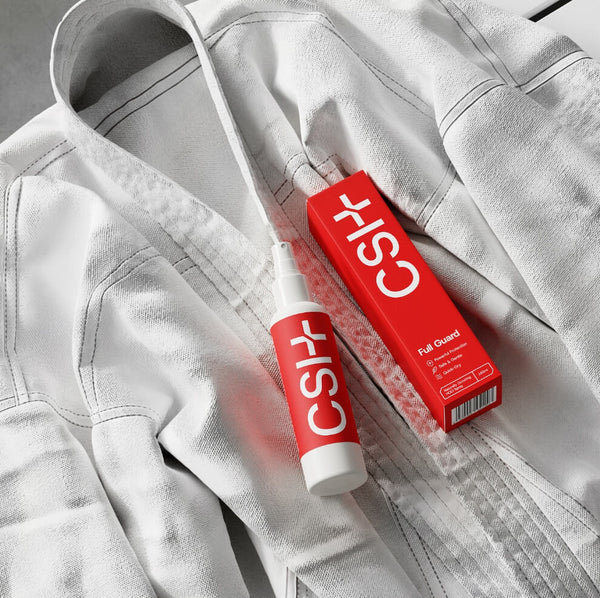
No soap or spray prevents ringworm. Showering, drying properly and keeping kit clean are what reduce the risk; the right kit just makes those habits easier. Our Wrestling and Grappling Hygiene Kit collection has what the routine needs: handmade soap bars for the shower, Full Guard for cleansing your skin straight off the mat, Gear Guard for headgear, ear guards and the kit you can't wash, the mat cleaner for the club, towels that are yours, and nail clippers.
See the Wrestling and Grappling Hygiene Kit →
This article is general guidance and not medical advice. If you're worried about a skin problem, see a pharmacist or GP. Full Guard and our soaps are cosmetic products for cleansing the skin and do not treat or prevent any condition. Gear Guard and the mat cleaner are biocidal products: use biocides safely and always read the label and product information before use.