How to Treat Mat Burn Fast (And Why Old-School Advice Slows You Down)
Educational information only – read the full notice
Mat burn happens to every grappler eventually - the tops of the feet, the knees, the elbows, occasionally a cheekbone after a long round of shoulder pressure. Most people ignore it, train on it raw, and only start paying attention when it is weeping through a gi trouser leg. Here is the straightforward version: what mat burn actually is, the old-school advice that makes it worse, and how to dress it so you can keep training without turning a graze into something a doctor needs to look at. As always, this is general information rather than medical advice, and broken skin that looks angry, spreads or will not settle needs a pharmacist or GP, not a blog.
TL;DR
- Mat burn is a friction abrasion: the mat sands off the top layer of skin. Treat it as a wound, not a bruise.
- Skip the old myths. Hydrogen peroxide and "let it dry out and scab" both slow healing on a joint that moves.
- Modern approach: clean it promptly, keep it in a moist healing environment (hydrocolloid), and tape it properly for training.
- Weeping or uncovered? Stay off the mats. Covered and sealed? Most people can train carefully.
What exactly is mat burn?
Mat burn is a friction burn - an abrasion. It is not a cut and it is not quite a heat burn, although it can feel like one. High-traction tatami grips your skin while your bodyweight drags across it, and the top layer (the epidermis) gets physically sanded away. That is why it loves the places where bone sits close to the surface and skin gets dragged: tops of the feet and toes, knees, elbows and the side of the face.
The part worth taking seriously is not the sting. It is that an open graze on a surface shared with forty sweaty training partners is a fast track to trouble - grappling gyms are exactly where staph infections circulate, and broken skin is the front door. Treat the graze well and you close that door.
Mat Burn From Wrestling
Wrestlers get mat burn worse than most grapplers, and it's not just in their heads.
- Singlets leave more skin exposed than a gi or rashguard: arms, legs and upper back all take direct contact with the mat.
- Shots, sprawls and scrambles drag skin across the surface at speed and under bodyweight.
- The usual spots: forehead, cheekbones, elbows, knees and the tops of the feet.
- Long seasons with daily practice mean the same patch gets reopened again and again, which is how a small graze becomes a big, slow one.
Real-world data: wrestling and skin infections
In a statewide survey of Nebraska high schools, reported MRSA infections among wrestlers rose from 19.6 to 60.1 per 10,000 wrestlers in a single year, between 2006 to 2007 and 2007 to 2008. Wrestling and American football had the highest rates. Broken skin from mat burn is one of the ways bacteria get in, which is why wrestling programmes take covering and caring for it seriously.
The wrestler's version of the four treatment steps below: clean it the same day, cover it for practice, and never wrestle with it open and weeping. Our wrestling hygiene hub and the guide to college wrestlers and mat burn skin care cover the rest of a wrestling season.
Stop doing this: the biggest mat burn mistakes
Two pieces of changing-room wisdom refuse to die, and both keep grapplers off the mats longer than the injury deserves.
- Myth 1: pour hydrogen peroxide or rubbing alcohol on it. The fizz feels like it is doing something. What it is actually doing is damaging the healthy tissue at the wound edge along with everything else, which is why modern wound-care guidance moved on from it years ago. Clean water or a sterile saline wipe does the cleaning job without the collateral damage.
- Myth 2: "let it breathe so it scabs over." A scab is not a badge of healing - it is a crust that cracks every time the joint underneath it bends. Toes, knees and elbows never stop bending, so the wound re-opens on every session and the healing clock resets to zero. Wounds kept in a clean, moist environment heal noticeably faster than wounds left to dry out, which is the entire logic behind modern dressings.
Watch: the doctor's version
Dr Asoka Wijayawickrama on the degrees of turf and mat burn, healing times and the optimal treatment route.
How to treat mat burn in four steps
- Clean it straight away. Not when you get home - at the gym, before the sweat dries into it. A sterile saline wipe over the graze takes seconds. In the shower afterwards, wash it gently with a mild soap and rinse well. No scrubbing; you are rinsing debris off, not exfoliating.
- Create a moist healing environment. Skip the standard plaster - it peels off in minutes on a foot or elbow. A hydrocolloid dressing is the upgrade: it sticks properly, absorbs the fluid the graze produces, cushions like a second skin and stops the crack-and-restart cycle. If you have nothing else in the house, a thin layer of plain petroleum jelly under a non-stick dressing beats letting it dry out.
- Secure it for the roll. A hydrocolloid patch alone will survive drilling but not always a hard round. Cap it with a wrap of zinc oxide sports tape so friction hits the tape rather than the dressing edge. Anchor the tape on dry skin either side, no creases over the wound itself. Our finger tape guide covers taping technique in more detail.
- Post-training care. Peel the tape off slowly (against its own direction, low and flat - ripping it upward takes dressing and skin with it), wash the area again, and if the graze has stopped weeping let it breathe overnight. Fresh dressing before the next session.

The shortcut: one kit that covers all of it
First aid, gym-bag sized
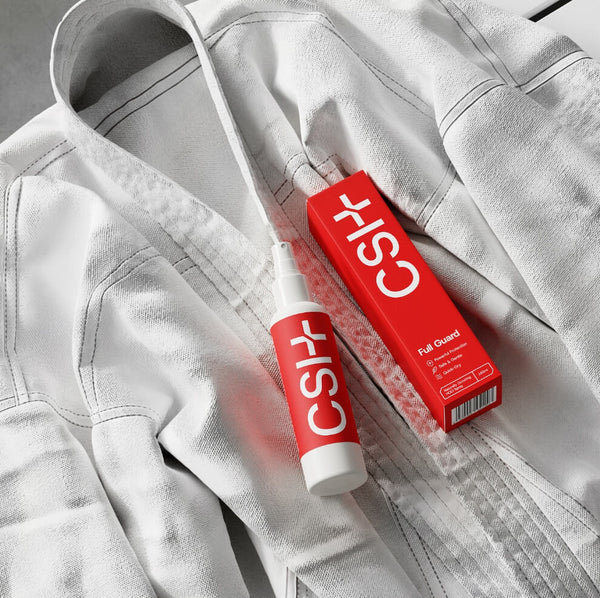
Rather than buying saline wipes, hydrocolloid patches and sports tape in three separate trips to the pharmacy, we put the lot in one pouch. The CSH Turf & Mat Burn First Aid Kit (£14.89) lives in your gym bag and covers the clean, dress and tape steps above in one go, so a graze does not cost you a round. Components are CE/UKCA marked wound-care items from a UK medical supplier.
A first aid kit for minor grazes, not a medicine. It will not treat an infection - if a wound is hot, spreading or not improving, see a pharmacist or GP.
Training more than a couple of times a week, or looking after a squad? The full BJJ and MMA first aid rundown covers what belongs in a bigger kit.
Infected Mat Burn: Warning Signs and When to See a GP
Most mat burn heals without any trouble. But it's an open wound on a surface shared by everyone in the gym, so it's worth knowing what "not healing normally" looks like.
| Healing normally | Getting infected |
|---|---|
| Sore for a few days, then less sore each day | Getting more painful, not less |
| Pink around the edges, and that pink stays the same size | Redness spreading outwards from the wound |
| Clear or slightly yellow fluid in the first day or two | Thick pus, or a bad smell |
| Skin around it feels normal | Skin around it feels hot and swollen |
| You feel fine | You feel unwell, shivery or have a high temperature |
| Starts to heal within a few days | Golden-brown crusts appear (this can be impetigo) |
What to do:
- Swollen, red, getting more painful, or pus coming out: the NHS says to get urgent medical help. Contact your GP or NHS 111.
- Golden-brown, crusty patches: these can be impetigo. See a pharmacist. The NHS says it stops being contagious 48 hours after treatment starts, so stay off the mats until then.
- Very high temperature, a fast heartbeat or breathing, purple patches, confusion or feeling faint: call 999 or go to A&E. The NHS lists these as signs of a serious complication.


Real-world case: how one wrestler's skin infection spread through a tournament
In January 2014, 168 high school wrestlers from 24 schools competed at a tournament in Arizona. Health officials later traced 47 cases of skin infection back to it. Of the 37 confirmed cases, 17 were impetigo, 11 were herpes, 2 were ringworm and 2 were MRSA. One wrestler had competed with uncovered impetigo on their head and neck, and went on to infect 8 other wrestlers at the tournament and 4 teammates. Arizona responded by bringing in independent skin checks before competition.
Sources: NHS: cuts and grazes; NHS: cellulitis; NHS: impetigo
Can you still train with mat burn?
Usually, yes - if it is properly covered. The rule of thumb every coach will back:
- Weeping, bleeding or uncovered: stay off the mats. Blood and plasma on a shared mat is a biohazard for everyone, and an open graze in that environment is a risk to you. Our guide on when to sit a session out covers the judgement calls.
- Clean, sealed under hydrocolloid and taped: most people can train carefully. Modify around it - if the burn is on the top of your foot, spend the session on top game or upper-body drilling instead of shooting and sprawling on it.
Is It Mat Burn or Mat Rash?
"Mat rash" gets used for anything red that appears after training. Some of it is mat burn. Some of it is something else entirely, and needs different care.
| What you've got | When it appears | What it looks and feels like | What to do |
|---|---|---|---|
| Mat burn | During or straight after a session | Raw, shiny graze where you were dragged. Stings. | Clean it, cover it, let it heal |
| Ringworm | Days to a couple of weeks later | Round patch with a scaly, raised edge and paler middle. Itches. | Pharmacist for antifungal treatment. Off the mats until you've started. See Ringworm in BJJ. |
| A reaction to mat cleaner | After contact with freshly cleaned mats, often after a change of product | Itchy, red, sometimes bumpy rash on the skin that touched the mat | Tell the gym what changed. See contact dermatitis from mats. |
| Folliculitis | A day or two after friction or shaving | Small spots around hairs | Keep it clean, and see a GP if it's spreading or painful. See folliculitis from grappling. |
| Impetigo | A few days after contact | Sores that burst and leave golden-brown crusts | Pharmacist. Off the mats until 48 hours after treatment starts. |

The rule of thumb: mat burn shows up immediately and gets better. If a "mat rash" shows up days later, or gets bigger instead of smaller, it probably isn't mat burn.
How to prevent mat burn
- Look after the skin itself. Dry, tight skin tears and sands far more easily than supple skin. Our piece on friction and skin care for grapplers covers the day-to-day routine side of the same problem.
- Cover the contact points. Spats under the gi, rash guards, grappling socks or knee pads for the areas you burn repeatedly. Fabric takes the friction so your skin does not.
- Fix the technique leak. "Dead toes" - dragging the tops of your feet across the mat as you move - is where most toe and foot burns come from. Training with live toes (toes curled under, gripping the mat) protects the skin and gives you more drive in your wrestling anyway. Burn patterns are feedback.
Common questions
How long does mat burn take to heal?
Kept clean and in a moist healing environment under a hydrocolloid dressing, a typical mat burn settles in about 3 to 7 days. Left to dry out and scab on a moving joint, the crack-and-restart cycle can stretch the same graze to two or three weeks.
Does Vaseline help mat burn?
As a stop-gap, yes. A thin layer of plain petroleum jelly under a non-stick dressing keeps the wound surface moist and stops a rigid scab forming. A hydrocolloid patch does the same job better and stays put during training.
Is mat burn a first-degree burn?
It mimics one - the redness and sting are similar - but technically it is a friction abrasion: skin removed by rubbing, not by heat. That is why it is treated like a graze (clean, moist, covered) rather than like a thermal burn.
This article is general educational information written by a grappler, and reflects mainstream wound-care guidance at the time of writing. It is not medical advice and no product mentioned here is a medicine. If a graze is deep, hot, spreading, weeping pus or simply not improving, see a pharmacist, GP or dermatologist promptly.