Why Cold Water Washing Fails to Kill Sports Bacteria (And How to Fix It)
Educational information only – read the full notice
Share
Why Cold Water Washing Fails to Kill Sports Bacteria (And How to Fix It)
Modern eco-wash cycles are good for the planet and bad for your rugby kit. A 30°C wash with standard detergent will shift most of the visible dirt, but it leaves behind a population of bacteria and fungal spores that's large enough to cause problems at your next training session. If your kit smells clean coming out of the machine but reeks within 20 minutes of putting it on, this is why - and here's how to actually fix it.
What Survives a Standard 30°C Wash
The short answer: more than you'd want.
Staphylococcus aureus - the bacterium responsible for skin boils, impetigo flare-ups, and MRSA - survives standard low-temperature detergent cycles reliably. Studies on healthcare laundry have demonstrated that S. aureus remains viable after 30°C washes even with detergent present. The same applies to the gram-negative bacteria that produce that distinctive post-training kit smell.
Fungal spores are even more resistant. The dermatophytes responsible for ringworm and athlete's foot - Trichophyton species - can survive repeated low-temperature washes and remain viable in the fabric of socks, shorts, and base layers. This is how a single infected player can re-infect themselves or, if kit gets mixed up, spread it to teammates through nothing more sinister than shared laundry.
The issue is that modern detergents are designed as surfactants - they lift and suspend dirt and oils. At low temperatures they do this reasonably well. What they don't reliably do at 30°C is kill. The mechanical action of the wash cycle reduces bacterial load, but "reduced" is not the same as "safe."
Temperature: What Actually Works and What Damages Your Kit
Heat is the most reliable pathogen killer in a domestic washing machine. At 60°C, both bacteria and most fungal spores are destroyed within the wash cycle. The problem is that 60°C is too hot for a large proportion of modern rugby kit.
What tolerates 60°C: cotton base layers and natural fibre training tops. Check the care label - if it says 60°C is permitted, use it for these items after a high-risk session.
What doesn't: polyester match jerseys, elastane-blend shorts, compression leggings, and most technical training kit. Repeated 60°C washing degrades elastane, causes polyester to pill and fade, and breaks down the bonding on printed squad numbers. Check the care label, but assume anything with stretch in it should stay at 40°C maximum.
The practical upshot: you can't solve the whole problem with temperature alone unless you're willing to destroy your kit. You need a chemical solution that works at the temperatures your fabrics can handle.
Laundry Sanitiser Additives: The Fix That Works at 40°C
Laundry sanitisers - distinct from standard detergents - are formulated to kill bacteria and fungi at lower wash temperatures. Two categories work well for sports kit:
Sodium percarbonate-based products (oxygen-based sanitisers) release hydrogen peroxide when dissolved in water. At 40°C and above they're effective against a broad range of bacteria and fungi, and they're safe for colours. Products like Dettol Laundry Sanitiser, Napisan, or own-brand oxygen bleach sachets all work on this principle. Add them to the drum with your detergent - they're not a detergent replacement.
Quaternary ammonium compound (QAC) products work at even lower temperatures and are found in some specialist sports laundry additives. If you're using a sanitiser that claims effective action at 20°C, it's likely QAC-based. These work, but check the label for fabric compatibility, particularly with technical synthetics.
Avoid chlorine bleach as a standard go-to for kit. It's effective at killing bacteria but will strip colour and degrade synthetic fibres rapidly.
The Tumble Dryer Advantage
Air drying your kit after washing leaves it in a damp state for an extended period - sometimes hours if airflow is poor. This extended damp phase allows any surviving bacteria to recolonise and is particularly friendly to mould and fungal spores.
Tumble drying at medium heat (not high) is more effective than air drying for pathogen reduction for two reasons: heat, even at medium settings, adds another thermal kill step after the wash, and the fast drying removes the damp window entirely. Many technical fabrics tolerate tumble drying on low or medium - check the label, but for cotton and most jersey materials it's fine.
If you must air dry (delicate fabrics, no tumble dryer access), dry in good airflow or outside in sunlight. UV light has a real, if modest, antimicrobial effect on surface bacteria. Never pack kit away while it's still damp.
The Fabric Softener Trap
Fabric softener is actively counterproductive for sports kit and it's worth cutting it entirely.
Softeners work by depositing a thin waxy coating on fabric fibres. This is what gives laundered clothes that soft, fresh feel. The problem is that coating does three unhelpful things to sports kit:
- It reduces the moisture-wicking performance of technical fabrics by partially blocking the pores in the weave.
- It creates a film on the fibres that traps bacteria and odour-causing compounds between wash cycles.
- It reduces the effectiveness of detergent penetration on the next wash - the very mechanism you need working properly.
The result is kit that feels soft when it comes out of the machine, smells fine for an hour, then reeks as soon as you start sweating. That smell isn't new sweat - it's the bacterial residue that fabric softener helped protect from the previous wash reactivating in warm, humid conditions. Drop the softener and you'll notice a difference within two or three wash cycles.
The Minimum Viable Protocol
If you take nothing else from this article, use this as your baseline for every kit wash after a contact session:
- Temperature: 40°C (not 30°C eco, not 60°C for synthetics)
- Detergent: enzyme-based (look for "biological" on the label - enzymes break down protein and fat residue that bacteria feed on)
- Sanitiser: add a laundry sanitiser additive - sodium percarbonate or QAC-based - to every sports wash
- Inside-out: turn kit inside out before washing so the detergent and sanitiser hit the sweat-contact surface directly
- No fabric softener
- Fully dry before storing: never ball up damp kit into a bag or drawer
This protocol won't cost you more time and the additive cost per wash is minimal. What it will do is meaningfully reduce the bacterial load you're putting back on your skin session after session.
For the full picture on keeping your kit clean - including how to deal with the jersey specifically and what to do with kit between sessions - see Why Your Rugby Kit Smells and How to Fix It and The Ultimate Rugby Kit Bag Hygiene Checklist.
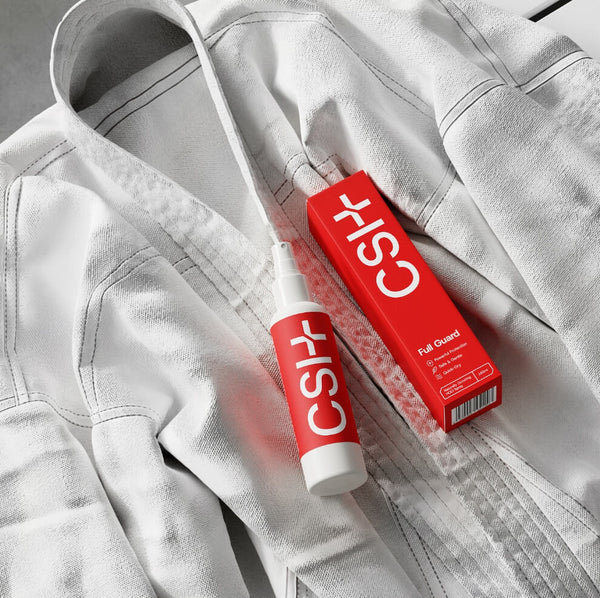
The Athlete Soap Bar and Full Guard HOCl Spray work on the skin side of this equation - but clean kit is the foundation. Get the laundry right and you're removing one of the main sources of re-exposure between sessions.
Related Guides
- The Ultimate Rugby Kit Bag Hygiene Checklist
- Why Your Rugby Kit Smells and How to Fix It
- How to Remove Rugby Grip Spray From Kit
- How to Sanitise a Rugby Ball
- Ringworm in Rugby: What It Is and How to Deal With It
- Staph, Boils and MRSA in Rugby: What Players Need to Know
Full Guard is a cosmetic skin cleansing spray registered under the UK Cosmetic Products Regulation. It is not intended to treat, cure, prevent or diagnose any skin condition. For any active skin concern, consult a GP, dermatologist or pharmacist.
Written by Eddie Bye, Founder of Combat Sports Hygiene.
The rugby bag, sorted
First aid kits built for grass and astro burns, a rinse-free cleansing spray for after training, handmade soap for the shower, and the spray for scrum caps and shared kit. For players, parents and clubs, with the season written up in order.
See the rugby hygiene and first aid collection →