Best Disinfectant Spray for Boxing Gloves, Shin Guards and MMA Gloves (2026)
Educational information only – read the full notice
Share
The short answer: the best disinfectant spray for gloves, shin guards and pads is one that kills what's living in the foam without wrecking the kit. That rules out most of what's sold for the job. Alcohol sprays dry out leather and evaporate before they've finished working. Fragrance sprays cover the smell and remove nothing. Bleach corrodes zips and stitching and needs rinsing. Hypochlorous acid does the killing, leaves no residue and is kind to leather, foam and synthetics, which is why it's what we use in Gear Guard. Here's the science, and how each type stacks up.
Why gloves smell the way they do
A boxing glove is a warm, damp, sealed box with a hand in it for an hour. Sweat soaks into the foam and lining, the glove goes back into a bag with no air, and the bacteria and fungi that arrived on your hand get everything they need to grow. The smell is what they produce. By the time you can smell it from across the room, the glove lining is a colony, and no amount of airing out or fragrance changes that. Shin guards, MMA gloves, headgear and Thai pads all work the same way. They're the kit you can't put in a washing machine, so whatever's in them stays in them until something kills it.
The four types of spray, and what they actually do
Alcohol sprays and wipes
Isopropyl or ethanol at 60 to 70 per cent. They do kill bacteria, quickly, which is why they're everywhere. The problem is what they do to kit. Alcohol strips the natural oils out of leather, which is why gloves go stiff and crack at the flex points after a few months of wiping. It dries and shrinks foam padding. And it evaporates in seconds, often before it's had the contact time it needs to work properly on a porous surface like a glove lining. Fine for a phone screen. Wrong tool for a £120 pair of gloves.
Fragrance and deodoriser sprays
Most "glove deodorisers" are a fragrance in a solvent, sometimes with a mild antibacterial thrown in at a level that does very little. They make the glove smell of something else for a session. Nothing is removed. The bacteria producing the smell carry on, the fragrance fades, and you're back where you started, usually with a sticky residue on top. This is masking, not cleaning, and it's the category most people are wasting money on.
Bleach and chlorine cleaners
Sodium hypochlorite works, and it's cheap. It's also corrosive. It attacks metal zips and eyelets, weakens stitching, discolours padding and leather, and leaves a residue that has to be rinsed off, which you can't do with a glove. The fumes aren't something you want in a kit bag or a small changing room either. Right for a floor, wrong for anything you wear.
Hypochlorous acid
This is the one built for the job. It kills at the same level as bleach, without the corrosion, the fumes, the rinsing or the damage. The rest of this page explains why.
The science of hypochlorous acid
Hypochlorous acid, HOCl, is a weak acid made of hydrogen, oxygen and chlorine. Your own immune system produces it: white blood cells make it to destroy the bacteria they engulf. Manufactured HOCl is the same molecule, made by running an electric current through salt water, and stabilised so it stays effective in the bottle.
How it kills. HOCl is a powerful oxidiser. It attacks the outer wall of a bacterial cell and the proteins inside it, breaking them down until the cell can't function. Fungi and enveloped viruses are destroyed the same way. Because it works by oxidation rather than by targeting a specific process, microbes don't develop resistance to it the way they can to some antibiotics and antiseptics.
Why it's better at getting in. This is the detail that matters for porous kit. Bleach in solution is mostly hypochlorite, which carries a negative charge. Bacterial cell walls also carry a negative charge, so the two repel each other and bleach has to work harder to get through. Hypochlorous acid has no charge. It passes through the cell wall easily, which is why it's effective at much lower concentrations than bleach, and why it works on the fibres and foam that make up a glove lining rather than just the surface.
Why it doesn't damage kit. At the concentration used in a kit spray, HOCl is close to neutral pH, contains no alcohol and no solvent, and breaks down into salt water once it's done its job. There's nothing left to dry out leather, nothing to shrink foam, nothing to corrode a zip, and nothing to rinse off. You spray it, it works, it disappears.
Why the concentration and formulation matter. HOCl is unstable by nature; it wants to break down into water and chlorine. A good product is formulated to hold its strength on the shelf, with a stated concentration and a stated shelf life. A cheap one degrades in the bottle and may be doing nothing by the time you use it. Look for the parts-per-million figure on the label and for test data behind the claims.
What "tested to BS EN standards" actually means
Anyone can put "kills 99.9% of germs" on a bottle. The standards are what make it mean something. In the UK and Europe, disinfectants are tested against a set of British and European Standards, each covering a specific thing:
- BS EN 13727: bactericidal activity. Does it kill bacteria, and how fast.
- BS EN 1650: fungicidal activity. Does it kill fungi and yeasts.
- BS EN 13697: activity on non-porous surfaces. Does it still work on a real surface rather than in a test tube.
Gear Guard is tested to all three: it kills 99.999% of bacteria and 99.99% of fungi in 60 seconds. The 60 seconds is the tested contact time, and it's the part most people skip. Spray it, wait a minute, then wipe. A spray that's wiped off after five seconds hasn't been given the chance to do what it was tested to do.
How to use it on each piece of kit
Boxing gloves and MMA gloves. After every session. Open the glove as wide as it goes, spray inside until the lining is visibly wet, spray the outside, wait 60 seconds, wipe the outside with a clean cloth and leave the gloves open somewhere with air until dry. Don't zip them into a bag wet.
Shin guards. Spray the inside face and the straps, wait, wipe, dry. Once a week is enough for most people; after every session if you're training daily.
Headgear. Spray the inside padding and the chin strap, which is where most of the sweat ends up. Wait, wipe, air dry. Weekly.
Thai pads, focus mitts and shields. Shared kit gets the most use and the least cleaning. Spray the striking face and the arm side, wait, wipe. After every club session.
The kit bag. Once a month, spray the lining and leave it open to dry. It's where everything else picks up what it lost.
What it's not for
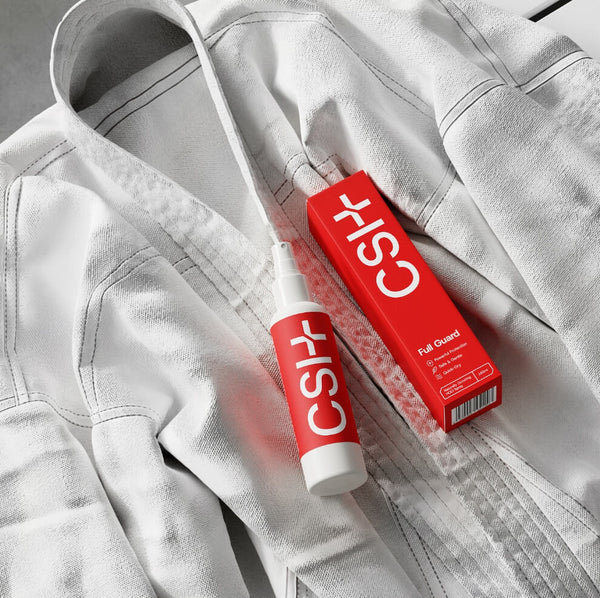
Fabric. Gis, rashguards, hand wraps and shorts go in the washing machine, and that's where they should go. A kit spray is for the things that can't be washed. And it's not for skin. Gear Guard is a surface biocide; for your skin after training, the product is Full Guard, a cosmetic cleansing spray made for exactly that.
The comparison
| Alcohol | Fragrance | Bleach | HOCl | |
|---|---|---|---|---|
| Kills bacteria and fungi | Yes, if given time | Barely | Yes | Yes, tested |
| Safe on leather | No, dries and cracks | Yes | No | Yes |
| Safe on foam | No, dries and shrinks | Yes | No, discolours | Yes |
| Needs rinsing | No | No | Yes | No |
| Residue | None | Sticky | Yes | None |
| Fumes | Some | Fragrance | Yes | None |
| Removes the cause of the smell | Partly | No | Yes | Yes |
Our pick
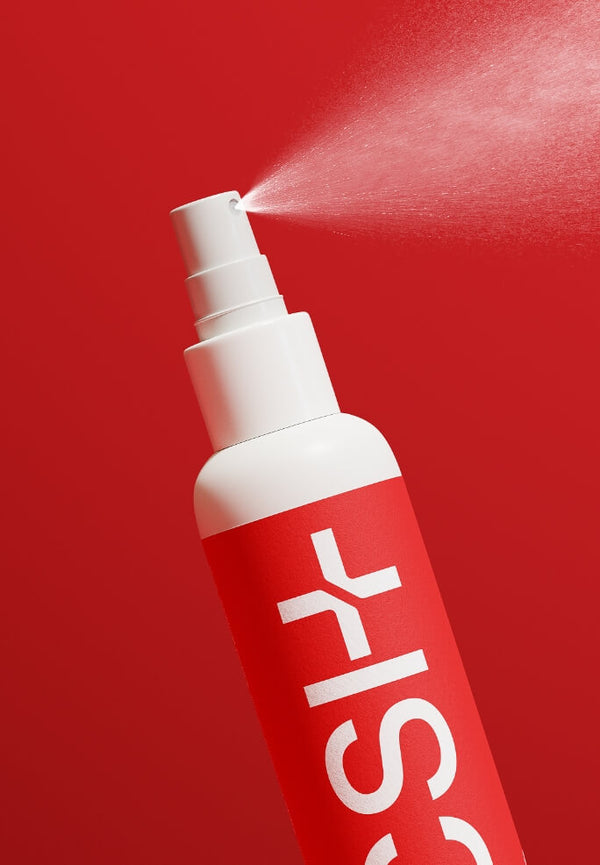
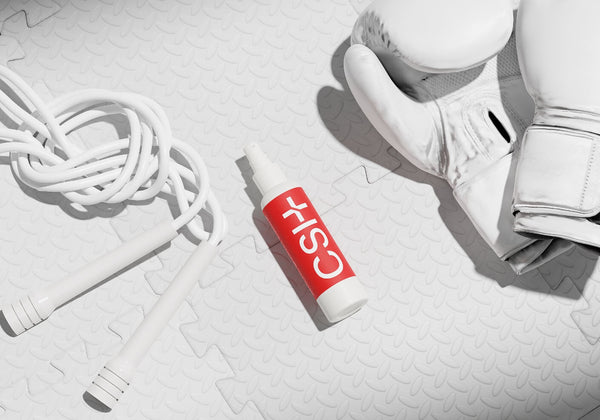
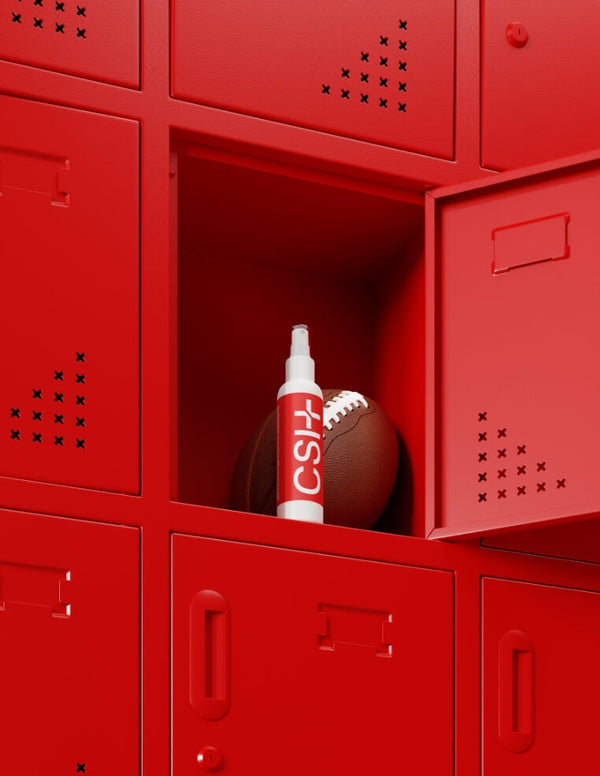
Gear Guard is a 100ml hypochlorous acid kit spray, made in the UK, tested to BS EN 13727, 1650 and 13697. Kills 99.999% of bacteria and 99.99% of fungi in 60 seconds. No alcohol, no fragrance, no residue. A few sprays per glove, so a bottle lasts months. £16.49, or the 3-bottle pack for the gym bag, the pad cupboard and the car.
Questions people ask
Can I use hand sanitiser on my gloves?
It's alcohol, so it'll dry out the leather and crack the foam over time, and it evaporates too fast to do much inside the lining. Use it on your hands.
Can I use Dettol or a household antibacterial spray?
Most are formulated for hard kitchen surfaces and carry fragrance and surfactants that leave a residue on foam and leather. Some also contain alcohol. Check what's in it, and check whether it's been tested on the surfaces you're using it on.
How often should I spray my gloves?
After every session for gloves. Weekly for shin guards and headgear. Monthly for the bag. The rule is: if it went on your body and got wet, it gets sprayed before it goes in the bag.
Will it get rid of the smell for good?
It removes what's causing the smell, so yes, until you put a sweaty hand back in. Which is why it's an after-every-session habit rather than a one-off fix.
Is hypochlorous acid safe to breathe?
At kit-spray concentrations, yes. It has no fumes and no fragrance. It's used in hospitals and in wound care at higher concentrations than this.
Gear Guard is a biocidal product. Use biocides safely. Always read the label and product information before use. Not for use on skin or fabric.