What Is Actually Living in Your Unwashed Kit
Educational information only – read the full notice
Kit that has been trained in does not just smell of sweat. Sweat itself is close to odourless when it leaves you. What you can smell at the bottom of a gym bag is everything else that comes with it, plus what happens to that mixture over the following hours and days. Here is what accumulates in a rashguard, a gi or a pair of shorts, why it gets worse over repeated wears, and what genuinely shifts it.
What is actually in there
Four things go into training kit every session, and they behave differently once they are in the fibres.
Sweat salts and other solids. Sweat is mostly water, and the water evaporates. What stays behind is the dissolved fraction: sodium chloride, urea, ammonia, lactate, trace minerals. That is the crusty, slightly stiff texture on a dried-out rashguard, and the faint white tidemarks on the collar of a gi. Salt is hygroscopic, so it pulls moisture back out of the air. A garment that feels dry can rehydrate itself in a humid changing room or a zipped bag.
Sebum. This is the one people forget, and it is the one that causes the long-term problem. Sebum is the oil your skin produces. It is not water soluble, so plain water does nothing to it and a cold, short wash does very little. It transfers to fabric anywhere the garment sits against skin under pressure: collars, cuffs, the chest and back panel of a rashguard, the inside of a headguard, the palm side of a glove.
Skin cells and general debris. Grappling in particular is a shedding sport. Add mat dust, chalk, tape residue, whatever else is on the floor.
Bacteria. Skin has a normal resident population of bacteria, and some of it transfers onto clothing along with everything else. These organisms do not create the smell by existing. They create it by feeding.
Why it smells: the odour compounds
The smell is a by-product. Bacteria metabolise components of sweat and sebum and release small volatile molecules that your nose is extremely good at detecting.
Broadly, three families do most of the work. Short chain fatty acids give that sour, stale, cheese-adjacent note. Sulphur compounds, particularly thioalcohols, give the sharp oniony hit you get off a rashguard the moment you peel it off. Ammonia and its relatives give the flat, acrid smell that comes off kit that has sat wet in a bag.
The important point: those compounds are produced continuously as long as there is food and moisture. Take a damp rashguard, roll it in a ball and zip it into a bag at room temperature, and you have built a small, warm, humid, well-fed environment. Nothing dramatic happens. It just keeps producing.
Why synthetics are worse than cotton
Polyester is oleophilic. It attracts and holds oil, and it absorbs very little water, which is why it wicks so nicely and why it is a nightmare for odour. Cotton absorbs water readily and releases oils reasonably well in a wash. Nylon behaves differently again: it takes up considerably more moisture than polyester, so it holds damp for longer, but the oil-loving problem is really a polyester one.
Synthetic fibres are also often extruded with channels and micro-texture to help moisture move, and modern performance fabric is knitted at very high density. That gives an enormous internal surface area, and detergent has to physically reach every bit of it to lift the residue out.
A gi is different again, but not immune. Heavy cotton weave holds a lot of water and dries slowly, and thick collars and lapels are the last thing to dry properly.
Biofilm, and why it builds up over repeated wears
When bacteria settle on a surface they can produce a matrix of polysaccharides and proteins around themselves. That matrix is a biofilm, and it is understood to act as a physical barrier that water and detergent do not penetrate easily. That is the usual explanation for why rinsing alone does not simply carry it off the fibre.
So the cycle goes: wear, deposit sebum and salts, wash inadequately, leave a residue behind, wear again, deposit more onto a surface that is now easier to stick to. Each cycle adds a little to the load. Eventually you reach the point every grappler knows, where a garment comes out of the machine, smells acceptable while dry, and then reactivates the moment you sweat into it. That is not new smell. That is the existing residue rehydrating and the population getting back to work.
I had a blue gi that did exactly this for months. It came out of the wash smelling of nothing at all. Ten minutes into warm-ups it announced itself, and my training partners were far too polite about it. The gi was clean by any normal test and still had a full history sat in the weave.
Myths and hacks that do not work
A lot of the standard advice does nothing, and some of it actively adds to the load.
- Fabric softener. The single worst thing for technical kit. It works by depositing a waxy cationic film on the fibres. That film traps existing residue underneath it, repels water on the next wash, and ruins wicking. Never use it on synthetics.
- Doubling the detergent. A machine can only rinse out so much. Excess detergent stays in the fabric as residue, and that residue holds soil. More is not stronger, it is just more left behind.
- Boil washing to fix everything. Elastane degrades with heat. Run technical fabric at 90 and you will kill the stretch, distort the panels and delaminate the seam tape long before you have solved anything.
- Neat bleach on technical fabric. It attacks elastane and nylon, strips colour unevenly and can leave the fibre weakened and rough. It is not a fabric refresher.
- Freezing kit. Popular and useless. Cold slows biological activity, it does not remove sebum, salt or biofilm. The residue is exactly where you left it, and it warms up.
- Tumble drying to bake the smell out. Heat sets oily soil into the fibre. If it smells before it goes in the dryer, you have just made it much harder to shift.
- Deodorant, body spray or aftershave on kit. Adds more oil and fragrance on top of an existing load. Two smells, not zero.
- Soaking in vinegar for days. A short acid soak has a place for mineral and salt build-up. Days of soaking mostly weakens elastic and gets you a garment that smells of chips. Never mix or follow vinegar with bleach.
What actually works
The whole game is: get the residue out, and do not give it time to sit wet.
- Unpack the bag the moment you get home. This is the highest-value habit on the list and it costs nothing. If you cannot wash immediately, hang the kit somewhere airy rather than leaving it balled up.
- Wash at 30 or 40 degrees. Warmer water shifts sebum better than cold, and 40 is safe for almost all technical kit. Check the label, but 40 is the sensible default for a rashguard, and a cotton gi is generally happy there too. There is more on the trade-off between fabric safety and wash performance in the piece on why washing temperature matters.
- Turn synthetics inside out. The dirty face is the inside. Present it to the water.
- Do not overload the drum. Mechanical action does a lot of the work. Kit needs room to move. A drum crammed to the top gets a poor wash whatever you put in it.
- Use a proper dose of an enzyme detergent, and skip the softener. Enzyme detergents typically include protease, and some include lipase, which act on protein and oily soil.
- Get it out of the machine promptly. Clean wet fabric sat in a warm drum for six hours is just a new starting point.
- Air dry, ideally with airflow. Skip the tumble dryer for anything with elastane. Hang it so air can reach both faces, not folded double over a radiator.
- Run an empty maintenance wash now and then. Hot cycle, no clothes. Machines that only ever run cool washes build up their own film in the drum and the seal, and that transfers.
Where a dedicated gear spray fits
Two categories of problem do not have a laundry solution. Gear that cannot go in a machine: gloves, shin pads, headguards, belts, mouthguard cases, the inside of the bag itself. And garments that have crossed the line where a normal wash no longer resets them.
For both, one option is a hypochlorous acid (HOCl) spray formulated for gear and hard surfaces. It sits in a routine as a step between washes, and it is the step some people use on gear that never sees a wash cycle: the inside of gloves and pads after training, and the bag. Whatever product you use, follow its label and only use it on the surfaces the label covers.
It is not a replacement for washing, and it is not a rescue for kit you have neglected for a season. It is a maintenance step. It fits into a routine, it does not substitute for one.
It is also worth being clear about what it is not. HOCl also appears in skincare products, and those are an entirely different thing: different formulations, different regulatory category, different job. A gear spray is for fabric, pads, bags and hard surfaces, not for use on skin. The two are not interchangeable in either direction. If your question is about skin rather than kit, that belongs with a pharmacist or GP, not with a gear product.
Shared equipment deserves its own thinking too, since the problem there is not only your own kit. There is a separate piece on shared kit and towels that covers it.
True
FAQ
Why does my kit smell clean until I start sweating?
Because the residue is still in the fibre, just dry and inert. Sebum and biofilm survive an inadequate wash, and warmth and moisture start the process off again. The fix is not more fragrance, it is the wash routine above.
Can I get away with airing out a rashguard and wearing it twice?
You can, and everyone has. Understand the trade though: airing removes water, not sebum or salt. The second wear starts from a higher baseline and deposits on top of it. Doing it occasionally is fine. Doing it habitually is how you get a garment that never fully comes back.
Does washing a gi at 60 degrees fix a persistent smell?
Higher temperature does help remove oily soil, but a cotton gi at 60 will shrink and the colour will fade faster, and any garment with elastane should not be there at all. Better to attack it with mechanical action, a decent enzyme detergent, a proper dose and no softener, than to cook the garment.

Gear Guard: the spray built for the kit that can't be washed
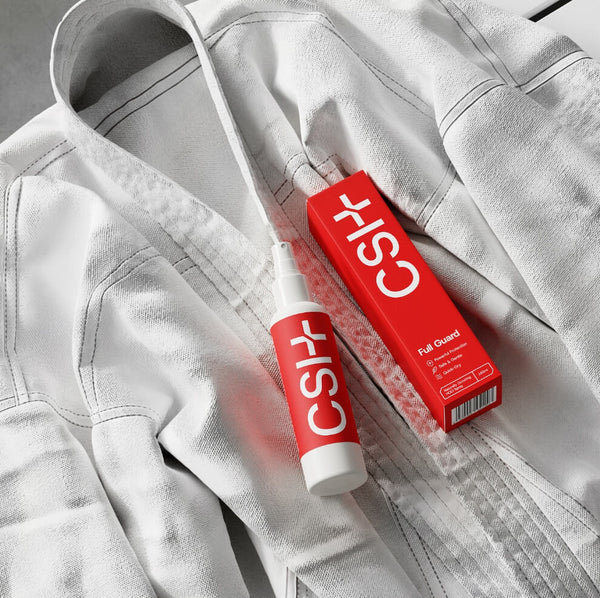
Kills 99.999% of bacteria and 99.99% of fungi in 60 seconds, tested to BS EN standards. No fragrance, no residue, kind to leather and foam. 100ml, UK made, £16.49.
Use biocides safely. Always read the label and product information before use.

For the gear that can't be washed
Gear Guard Equipment Cleaner Spray
A targeted HOCl surface spray for the kit no washing machine can help: gloves, pads, headgear, boots and bag linings. Spray until visibly wet, wait 60 seconds, wipe, and let it air dry.
- Independently tested surface biocide (BS EN 13727, BS EN 1650)
- One-minute contact time, then wipe and air dry
- No fragrance, dries clear, nothing left behind once dry
- 100ml fine mist, hundreds of targeted sprays, UK-made
Use biocides safely. Always read the label and product information before use. Gear Guard is for equipment, not skin. Fabric kit goes in the washing machine.