Your Washing Machine Is the Problem: Drum Biofilm, Seals and Service Washes
Educational information only – read the full notice
You wash your kit properly. It comes out of the machine and it still smells. Not badly, not immediately, but twenty minutes into a session it comes back like it never left.
Most people respond by buying stronger detergent. That is usually the wrong move, because the problem is not the wash. It is the machine doing the washing.
This post covers why washing machines start producing smelly clothes, what is growing in there, and how to fix it with a service wash and a few habits that cost nothing.
What is actually happening inside your machine
A washing machine is warm, damp and full of organic residue. That is a very good environment for bacteria and mould, and over time they build a biofilm: a slimy layer that sticks to the inside of the drum, the outer tub you cannot see, the sump, the drain hose and the detergent drawer.
Biofilm is stubborn. It is not loose dirt that rinses away, it is a structure that holds onto surfaces and shrugs off a short cold cycle. Once it is established, every wash pushes water through it, and your clothes come out carrying some of what is in there.
Three things feed it:
- Undissolved detergent and softener residue. Especially in the drawer and the rubber parts, where it never gets properly flushed.
- Body soil. Sweat, sebum and skin from your kit. Combat sports kit carries an unusual amount of it because you are rolling on mats and against other people.
- Standing moisture. A door left shut after a wash keeps the drum humid for hours.
The door seal
On a front loader, pull back the rubber gasket at the bottom of the door and look in the fold. If you have never done this, prepare yourself. In my experience that fold is the first place to go wrong: it traps water, hair, grit off mat shoes and detergent gunk, and it is where the black speckling starts.
The detergent drawer
Pull the drawer right out. Most models release with a catch in the middle of the siphon section. Behind it there is a housing that almost nobody cleans, and every one I have pulled out has been coated in a grey or pink film.
Low temperature washing culture
We have all been trained to wash cold, and for the environment and for your clothes that is largely sensible. But modern detergents plus 30 degree cycles plus a machine that never sees anything hotter creates a system where nothing is ever knocked back. The machine slowly accumulates.
This is the same reason low temperature washing struggles with sports kit: temperature is only one lever, and if it is the only one you are pulling, you are not pulling it hard enough.
Hard water and limescale
If you are in a hard water area, limescale builds on the heating element and inside the drum. Scale is rough and porous, which can give biofilm somewhere to anchor. It also means your detergent works less efficiently, because some of it is busy dealing with the minerals in the water instead of your kit.
The gi I nearly binned
I once washed a white gi three times in a row trying to shift a smell. Normal wash, then a wash with extra detergent, then a wash on a longer cycle. It smelled of nothing in the kitchen and exactly like a wet dog twenty minutes into a session.
I was convinced the gi was finished. Then I pulled the door seal back on the machine and found a fold of black-flecked water and a piece of somebody's hair that had clearly been in there for months. I cleaned the seal, ran a hot empty cycle, and washed the gi a fourth time. Fine. Completely fine, and still fine now.
The gi was never the problem. I had been laundering it in dirty water.
Myths and hacks that do not work
- Fabric softener. It works by depositing a waxy coating on fibres, which traps odour compounds, and it gums up the drawer and hoses on its way through. It makes both problems worse.
- Doubling the detergent. More detergent than the machine can rinse out means residue, and residue is food. You get a short term perfume and a long term smell.
- Assuming the machine cleans itself. It washes clothes. Nothing in a normal cycle scrubs the seal, the drawer housing or the filter, and those are the parts that go wrong.
- Freezing kit. Cold does not remove the residue that causes the smell. Put it back in a warm room and the smell comes back with it.
- trying to fix everything with heat. A boil wash with a load in it does not fix a machine problem. Save 90 degrees for the empty service wash, not for your kit.
- Spraying deodorant or aftershave on kit. You are adding a second smell on top of the first. Everyone can tell.
How to run a service wash
A service wash is an empty hot cycle whose only job is to clean the machine. Do the manual bits first, or you are just circulating the gunk.
- Clean the door seal. Peel the fold back all the way round and wipe it out with a cloth. Get right into the bottom of the fold where the water sits.
- Remove and wash the detergent drawer. Soak it in hot water, scrub the siphon, and use an old toothbrush on the housing it slots into.
- Clean the filter. Switch the machine off at the wall and let it cool first, because water released after a hot cycle can scald. Then open the small hatch at the bottom front, with a towel and a shallow tray down, because water will come out. Expect coins, hair and worse.
- Run the hottest cycle the machine offers, empty. Many machines have a drum clean or maintenance programme. If yours does not, use a 90 degree cottons cycle with no clothes in it.
- Use one product per cycle, and follow the label. Either a machine cleaner or a dose of soda crystals, not both. If you are in a hard water area and need to descale, run the descaler as a separate cycle on its own. Never combine machine cleaner, descaler, soda crystals or bleach, and keep fabric softener away from all of it.
- Leave the door and drawer open afterwards so the drum dries out.
Do this monthly if you are washing kit several times a week, or every two months for lighter use. Once it is under control it is about fifteen minutes of hands-on work, plus the cycle time.
Habits that stop it coming back
- Get kit out of the drum as soon as the cycle ends. Wet kit sitting in a warm drum for six hours is how a clean wash turns into a smelly one.
- Air dry where you can, ideally somewhere with moving air rather than a closed bathroom.
- Do not overload. Kit needs room to move for the water to actually flush through it.
- Dose for your water hardness, not by habit. Check the pack.
Where a gear spray fits
Some kit cannot go through a wash cycle at all. A dedicated hypochlorous acid (HOCl) spray made for gear is a textile and equipment product for exactly those items: pads, gloves, liners and bag interiors. Spray, allow to dry fully, and air the item as usual.
Two things to be clear about. It is not for use on skin: HOCl also appears in skincare products, but those are formulated for a completely different job and the two are not interchangeable in either direction. And it is one step in a routine, not a substitute for one: clean, dry, rotated kit remains the foundation.
Use biocides safely. Always read the label and product information before use.
FAQ
How often should I run a service wash?
Monthly if you train regularly and wash kit several times a week. Every couple of months for lighter households. If you can smell the machine when you open the door, you are overdue regardless of the calendar.
Will a service wash fix clothes that already smell?
It stops them getting worse. Existing kit usually needs one or two normal washes afterwards in the now-clean machine before it fully comes back. If it does not come back after that, the fabric has genuinely reached the end.
Do top loaders and washer dryers have the same problem?
Top loaders have less rubber seal to trap water but still develop residue in the tub and dispensers. Combined washer dryers are often worse, because the drum stays humid for longer. The same routine applies: clean the accessible parts and run an empty hot cycle.
A clean machine looks after everything made of fabric. The gear that never goes in it, like gloves, pads and headgear, needs a different approach.

For the gear that can't be washed
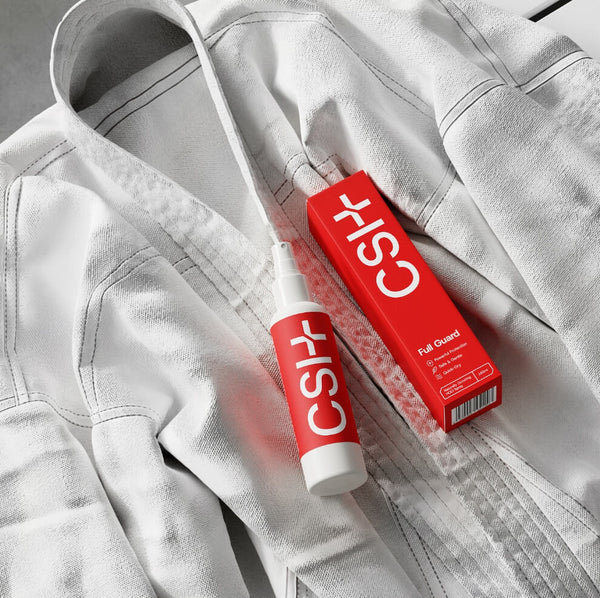
Gear Guard Equipment Cleaner Spray
A targeted HOCl surface spray for the kit no washing machine can help: gloves, pads, headgear, boots and bag linings. Spray until visibly wet, wait 60 seconds, wipe, and let it air dry.
- Independently tested surface biocide (BS EN 13727, BS EN 1650)
- One-minute contact time, then wipe and air dry
- No fragrance, dries clear, nothing left behind once dry
- 100ml fine mist, hundreds of targeted sprays, UK-made
Use biocides safely. Always read the label and product information before use. Gear Guard is for equipment, not skin. Fabric kit goes in the washing machine.