Laundry Stripping, Vinegar and Bicarb: What Actually Shifts Sports Odour
Educational information only – read the full notice
Share
Your kit comes out of the machine smelling clean, dries on the airer, and then twenty minutes into the next session it smells like a wet dog in a sauna. That is the specific problem this article is about, and it is the reason people end up on YouTube at midnight watching someone dissolve their gym leggings in a bathtub.
I learned the delayed-reveal thing the hard way. Drove home after training with a rashguard that smelled completely fine when I rolled it up. Twenty minutes later, windows down in February, my passenger silently opened her window too. It had passed the sniff test in a cold gym and failed spectacularly in a warm car.
Laundry stripping, vinegar and bicarbonate of soda are the three big home remedies. Two of them are genuinely useful in narrow circumstances. One of them is mostly theatre. Here is what each actually does, where it fits, and where it does nothing at all.
What laundry stripping actually is
Stripping is a long hot soak, usually in a bath, with some combination of powdered detergent, washing soda and borax substitute. You leave the kit in it for several hours, stir it occasionally, then rinse and run a normal wash with no detergent. Treat the soak with respect: wear gloves, keep children and pets away from a filled bath, and never add bleach or any other cleaning product to the mix.
The famous bit is the water going brown. People assume that is sweat and skin. Mostly it is not. It is accumulated detergent residue, fabric softener build-up, limescale from hard water, and whatever dye and finish the fabric has been quietly shedding. In other words, stripping is a reset for a build-up problem, not a deep clean for a dirt problem.
When stripping is worth doing
- Kit that has had years of fabric softener or over-dosed detergent and now feels slightly waxy or repels water instead of absorbing it.
- Towels that have gone stiff and stopped drying you properly.
- Cotton items in a hard water area that feel crunchy no matter what you do.
When stripping is pointless or actively harmful
- Anything with elastane, Lycra or spandex. That is most rashguards, compression gear, leggings and technical tees. Hours in very hot water degrades the elastic fibres. You will get one clean garment and one that has lost its shape.
- Anything with a printed or sublimated design or taped seams. Long hot soaks lift adhesives and stress prints.
- Kit that smells because it was washed badly last week. Stripping is a once or twice a year reset at most. If the smell comes back within two sessions, the problem is your routine, not decades of build-up.
If you strip anything, strip cotton and towels, do it rarely, and keep synthetics out of the bath entirely.
Vinegar: what it genuinely does
White vinegar is a weak acid. In a wash that gives you two real benefits. It helps dissolve alkaline detergent residue and limescale that has bonded into the fabric, and it works as a rinse aid so the final rinse leaves less behind. On kit that has been washed with too much detergent for too long, that is a noticeable improvement.
What it does not do is degrease. Body oils and sebum are the actual fuel for gym odour, and vinegar barely touches them. It is not a disinfectant and should not be treated as one, and it is not a substitute for detergent.
How to use it: about 120ml of plain white vinegar in the fabric softener drawer, occasionally, not every wash.
How not to use it: do not leave kit sitting in a vinegar solution for days. People do this and then wonder why the elastic waistband has gone slack and the colour has gone patchy. A soak of thirty minutes to an hour is the outer limit, and even that is unnecessary for most items. Never mix vinegar with bleach.
Bicarbonate of soda: what it genuinely does
Bicarb is a mild alkaline booster, and it is genuinely good at absorbing odour in dry environments. A small open tub of it in a kit bag between sessions does more than most people expect.
What it does not do is act as a cleaning agent on its own. Bicarb in a bowl of water is not a wash. It also cannot fix fabric that still has oils sitting in it.
And here is the one that annoys me: combining vinegar and bicarb. The fizzing looks impressive and it is the sound of both of them cancelling out. You end up with salty water. Use one or the other, in separate washes, for separate reasons.
Myths and hacks that do not work
The general laundry myths, fabric softener, doubling the detergent, boil washing and the rest, are dealt with in full in the washing machine guide, so this list sticks to the ones specific to stripping, vinegar and bicarb.
- Stripping synthetics as routine maintenance. Hours in very hot water is exactly what elastane hates. Stripping is a rare reset for cotton and towels, not a monthly fix for rashguards.
- Vinegar as a disinfectant. It is a weak acid that shifts residue and limescale. Treat it as a rinse aid, nothing more.
- Vinegar plus bicarb in one wash. An acid and an alkali neutralise each other. The fizz is the sound of both stopping working.
The routine that actually fixes it
- Get kit out of the bag the moment you are home. Not later. Later is how a bag becomes identifiable from across the changing room.
- Hang damp kit to air rather than dropping it in a sealed basket.
- Wash sports kit at 40 rather than 30 when the care label allows it, with a proper enzyme detergent dosed correctly for your water hardness. Temperature does real work here, and why wash temperature matters covers where the limits are.
The rest of the weekly habits, sensible drum loading, getting kit out of the machine promptly, air drying, live in that same guide, so there is no need to repeat them here.
If one specific garment is still the problem child, that usually needs its own approach, and getting the smell out of a rashguard is worth reading on its own.
Where a gear spray fits
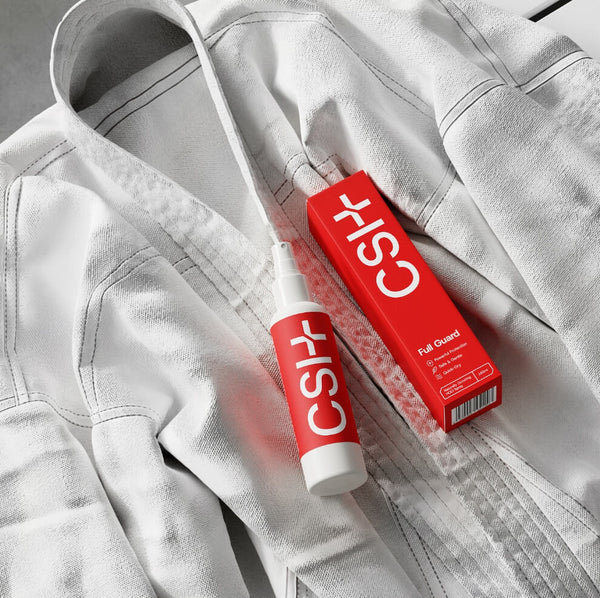
Some kit cannot go through a wash cycle at all. A dedicated hypochlorous acid (HOCl) spray made for gear is a textile and equipment product for exactly those items: shin pads, gloves, headgear and bag interiors. Spray, allow to dry fully, and air the item as usual.
Two things to be clear about. It is not for use on skin: HOCl also appears in skincare products, but those are formulated for a completely different job and the two are not interchangeable in either direction. And it is one step in a routine, not a substitute for one: clean, dry, rotated kit remains the foundation.
Use biocides safely. Always read the label and product information before use.
FAQ
How often should I strip my laundry?
Rarely. Once or twice a year at most, and only for cotton and towels with genuine build-up. If your synthetic kit needs stripping regularly, something in the weekly routine is wrong: usually softener, over-dosing, or leaving damp kit sealed in a bag.
Can I use vinegar and bicarb in the same wash?
You can, but there is no point. They neutralise each other. Pick one based on the problem: vinegar for residue and limescale, bicarb as a mild booster or as a dry odour absorber in the bag.
Will stripping ruin my rashguard?
It can. Rashguards are mostly polyester or nylon blended with elastane, and hours in very hot water degrades the elastic fibres and stresses sublimated prints. Keep rashguards, compression gear and leggings out of the stripping bath and sort them through the normal wash routine instead.