Sports Bras and Women's Training Kit: Washing, Mould and Elastane
Educational information only – read the full notice
Share
If one item in your kit bag is going to smell, it is the sports bra. Not the leggings, not the socks, not even the rashguard. The bra. It comes out of the machine looking clean, then twenty minutes into a session it announces itself again.
This is fixable. Most of it comes down to how bras are built and how they are washed. Here is what actually works, what does not, how to stop the padding going mouldy, and when a bra is simply finished.
Why sports bras hold odour more than the rest of your kit
It is mostly construction, not fabric. Your leggings are one or two layers of knit. A sports bra is a dense sandwich: an outer shell, a lining, often a moulded foam cup or a removable pad, elastic under the bust, a wide band, plus binding and seam channels where several layers meet.
All of that means three things. It holds far more sweat per square centimetre than anything else you own. It takes much longer to dry. And detergent struggles to flush right through the middle of a moulded cup, so residue and sweat sit in the core of the padding where nothing reaches them.
Add the fact that it sits directly against skin, under a rashguard or a gi, in the warmest and least ventilated part of your body, and you have the worst case in the bag. For the wider picture on how synthetic training kit behaves generally, and the washing, drying and rotating principles that sit underneath all of this, read Rashguard Hygiene: Wash, Dry, Rotate. Everything below is the bra-specific version of that.
The bag is where it actually goes wrong
My partner came back from a comp weekend and her bag sat in the hallway until Wednesday. Warm flat, bag zipped, kit rolled up. The bra she had trained in on the Saturday was at the bottom of it, still rolled inside a pair of leggings, with the pads bunched up inside the lining. When she pulled it out, the smell had genuinely changed character. It was not sweat any more. It was something else, sweeter and sharper, and it had got into the bag lining, which meant the bag itself was a problem for weeks afterwards.
The point is that the damage happened in the bag, not in the wash. By the time kit reaches the machine, the job is already harder than it needed to be.
Get the bra out of the bag when you get home. Not into the wash necessarily, just out, unrolled, pads pulled free, over the back of a chair. It costs nothing and it is the step most people skip.
Myths and hacks that do not work
- Fabric softener. It works by depositing a waxy film on fibres. On a sports bra that film coats the elastane in the band, blocks moisture moving through the cup, and traps the smelly residue underneath it. Skip it entirely.
- Boil washing or 90 degrees to fix everything. Hot washes are hard on elastane, so the band and straps go slack far sooner, and moulded foam can warp permanently. You will have a bra that smells slightly less and supports considerably worse.
- Doubling the detergent. More detergent than the machine can rinse out means residue, and residue in a thick cup is exactly what feeds the smell. Under-dose rather than over-dose on kit.
- Neat bleach on technical fabric. It attacks elastane, wrecks colour unevenly and can leave the fabric weakened in a way you do not see until a strap goes. And never mix bleach with vinegar or any other acidic cleaner. That combination releases chlorine gas.
- Freezing your kit. Cold does not remove anything. The residue is still there when it thaws, and so is the smell.
- Tumble drying to bake the smell out. Residue plus heat tends to mean the kit smells again as soon as it warms up on you, and the heat is hard on elastic. Air dry.
- Spraying deodorant or perfume on it. You are layering one smell on another and adding oils and alcohol that the fabric will keep.
- Soaking in vinegar for days. A short soak is harmless. Leaving elastic sitting in acid for two days is not, and it does not work better for the extra time.
How to actually wash a sports bra
- Rinse it the same day if you can. Cold water, thirty seconds under the tap, squeeze, hang.
- Fasten the hooks before washing so they do not shred everything else in the drum.
- Use a mesh wash bag. It stops straps tangling with other garments in the drum and stretching out, keeps hooks off everything else, and protects moulded cups from being crushed.
- Wash at 30 or 40 degrees on a delicate or sports cycle, with a low spin. Sports detergents work fine, ordinary non-bio works fine, just use less than the box says.
- Add a rinse. An extra rinse does more for odour than a hotter wash.
- Get it out of the drum promptly. Kit left sitting in a warm damp machine for hours undoes the wash. This is the single most common reason clean bras smell.
- Air dry flat or over a bar, not pegged by one strap, and never on a radiator.
Underwire and moulded cups
Underwire bras and structured moulded cups are the ones worth hand washing. Lukewarm water, a small amount of detergent, work it gently through the cup with your fingers, rinse twice, press the water out between a towel. Do not wring or twist. Twisting is what pushes wires out through the casing.
Reshape moulded cups with your hands while they are wet and dry them cup up, not folded inside each other. A cup that dries folded keeps that crease.
Removable pads and mould
Removable pads are the usual source of a musty rather than sweaty smell. They get put back in damp, or they migrate inside the lining and dry slowly in a bunched-up ball.
Mould is a damp problem, not a dirt problem. It needs moisture and time, and a foam pad shut inside a bra lining or a zipped bag gives it both: the pad can stay wet for days when the outer fabric feels dry to the touch. Drying is the whole answer. Take pads out before washing, wash them separately, dry them fully flat and in open air, and only reinsert once both parts are properly dry. If a pad has visible dark speckling that does not wash out, replace the pad.
Where a dedicated gear spray fits in
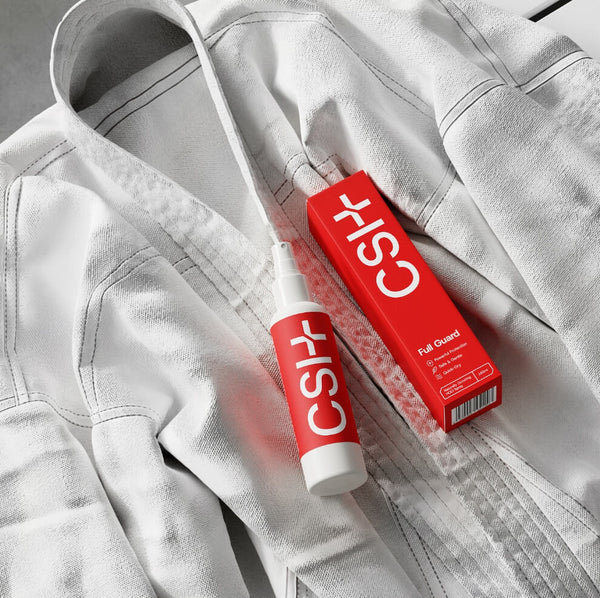
Some kit cannot go in a machine at all: gloves, shin guards, foam pads, the bag itself. That is the ground a gear spray formulated for fabric and equipment covers. It is a textile and equipment product, applied to fabric, padding, foam, hard surfaces and the lining of a kit bag.
It is one step in a routine alongside washing, not a replacement for it. In practice that means the bag lining after a weekend like the one above, foam pads once they are dry, and the parts of your kit the machine never reaches. Whichever one you use, follow its label exactly. The label tells you what it is for, where it can be used and how.
Two things to be clear about. These are gear products and are not for use on skin. And although HOCl also turns up in skincare, those are different products formulated for a different job and the two are not interchangeable. Do not reach for a gear spray because something on your skin is bothering you. That is a conversation for a pharmacist or GP.
TrueWhen to replace it
Support comes from the elastic, and elastic has a finite life. Signs a bra is done: the band rides up at the back, you have moved to the tightest hook and it still feels loose, the straps no longer recover after you stretch them, the cup has lost its shape, or the smell survives a correct wash more than once.
Rotating three or four bras rather than hammering one makes each of them last much longer, because elastic needs recovery time between wears.
FAQ
Can I just wear my sports bra twice between washes?
For a light session, rinse and dry it properly and it is fine. For anything sweaty, no. If breakouts under tight kit are your issue rather than the kit itself, that is covered separately in Acne Mechanica: Friction Breakouts from Rashguards.
Why does my clean bra smell as soon as I warm up?
Usually detergent residue left deep in the padding, which tends to smell again once the bra is warm and damp on you. Drop your detergent dose, add an extra rinse, and make sure it is bone dry before it goes in a drawer.
Is hand washing genuinely better?
For underwire and structured cups, yes. For simple compression bras, a mesh bag and a 30 degree delicate cycle is fine and far more realistic week to week.
Use biocides safely. Always read the label and product information before use.