Synthetic Kit Care: Polyester, Elastane and Compression
Educational information only – read the full notice
Share
Synthetic kit is the best fabric ever made for training and the worst fabric ever made for surviving a normal laundry routine. Polyester dries fast, moves with you and survives being dragged across a mat a thousand times. It also holds on to odour in a way cotton never does, and it quietly falls apart if you wash it the way your nan washed towels.
This is the fabric guide: what polyester and elastane actually are, why they behave the way they do, and how to wash and dry them so they last.
Why synthetics hold odour and cotton does not
Cotton is a natural fibre that absorbs water. Sweat soaks into it, and so does everything dissolved in that sweat. It gets heavy, it takes ages to dry, but a normal wash flushes it out fairly well because water goes where the sweat went.
Polyester fibres are hydrophobic, which is the whole point: they push moisture off the skin and out to the surface so it can evaporate. Sweat itself is mostly odourless. The smell comes from bacteria breaking down the oils and proteins in it, and polyester has a strong affinity for oils. They cling to the fibre surface and sit in the tiny spaces between filaments where water and detergent struggle to reach.
So you get the classic situation: a shirt that looks clean, feels clean, smells fine on the hanger, and then goes off the moment your body heat and a bit of fresh sweat hit it. The oily film is still there, and the bacteria that feed on it get going again as soon as it is warm and damp. You are not usually fighting dirt on synthetic kit. You are fighting residue.
Elastane, heat, and how long kit should last
Almost nothing you train in is pure polyester. Compression tops, shorts, leggings, rashguards and spats are typically polyester or nylon blended with a small percentage of elastane, also sold as spandex or Lycra. Check the composition label on the garment and it is usually well under a quarter of the blend. That small percentage does all the stretch and all the recovery.
Elastane is far less heat tolerant than polyester. Hot water, hot dryers and hot radiators degrade it. It does not fail dramatically, which is why people get away with it for a while. It fails as a slow loss of snap: the waistband stops gripping, the cuffs go slack, the compression top that used to feel like a second skin starts bagging at the small of your back. Once that elasticity is gone it does not come back.
Chlorine, high pH cleaners and body oils all chip away at it too. So does friction, which you cannot avoid in grappling. What you can control is heat, and heat is doing more damage than anything else in a typical kit routine.
Practically: wash at 30 or 40 degrees, and never tumble dry anything with stretch in it if you can avoid it. Treated that way, a good rashguard or compression top will give you many seasons of washing. Washed hot and tumble dried, you can lose the fit inside a season. The stretch outlasts the polyester only if you keep the heat off it, which tells you exactly where to spend your attention: temperature, drying and detergent load.
Detergent choice for technical fabric
Most household detergent is formulated around cotton and around visible stains. Technical kit needs something slightly different.
- A liquid detergent, not powder. Powders often contain insoluble fillers and oxygen bleach systems that need heat to work properly. At 30 degrees they can leave gritty residue in tight synthetic weaves.
- Enzymes are useful. Lipase and protease target fats and proteins, which is exactly what you are trying to shift off polyester.
- Use less than you think. Doses are set for a full load of cotton in hard water. Synthetic kit is light, so a full cap for four rashguards is overdosing, and overdosing is a very common cause of the smell coming back.
- A sports or technical wash is a reasonable buy if you train a lot. They are built to lift oils at low temperatures without leaving a coating behind. Not magic, but formulated for the right problem.
Also load the machine properly. Kit needs room and mechanical action to get clean. Cramming the drum means nothing moves and nothing rinses.
Myths and hacks that wreck fabric
Fabric softener. The worst thing you can put near technical fabric. It works by depositing a waxy film on fibres. On cotton towels that feels soft. On polyester it clogs the weave, kills the wicking and gives bacteria a greasy layer to live in. Softened kit smells worse over time, not better.
Boil washing to fix everything. The fastest way to wreck good kit. Elastane cooks, seam tape lifts, printed panels crack and compression garments go permanently slack. You will have destroyed the garment before you have solved anything.
Neat bleach on technical fabric. It yellows polyester, attacks elastane and eats the elastic in waistbands. Not a wash additive for training kit.
Just double the detergent. Understandable and completely backwards. Excess detergent cannot be rinsed out of a low water, low temperature wash, so it stays in the fabric and holds oils. If your kit smells, the fix is usually less detergent and better rinsing.
Long vinegar soaks. Prolonged low pH soaking degrades elastane, so this is not a free hack. More importantly, never combine vinegar or any acid with a chlorine based product, including an HOCl spray, on kit or anywhere else. Keep the two apart entirely.
Odour hacks like freezing kit, tumble drying to bake the smell out or spraying deodorant on it are a separate problem, and we deal with them properly in the piece on getting the smell out of a rashguard.
The fabric specific bits of the wash
Turn compression and printed items inside out. The dirty side is the inside, and it protects the print from abrasion. Skip the softener. Keep the heat off, in the machine and on the airer, because a radiator is just a slow tumble dryer. For the rest of it, the timing, the rinsing and the rotation, follow the full rashguard wash, dry and rotate routine.
The compression top I cooked
I had a compression top I liked more than any other bit of kit I owned. One winter I got lazy about the airer and started slinging it in the tumble dryer with everything else, low heat, nothing dramatic. It looked exactly the same coming out. Same colour, same print, no damage anywhere you could point at.
Then one session I noticed I was pulling the hem down between rounds. The waist had stopped gripping, the sleeves had gone soft at the cuff, and the whole thing sat on me like a normal t shirt. Nothing had torn. The elastane had just given up, quietly, over about six weeks of convenience. That garment did not wear out. I cooked it.
Where an HOCl gear spray fits
There is a category of HOCl spray made specifically for gear and textiles, and it is worth understanding what it is for rather than treating it as a cure all.
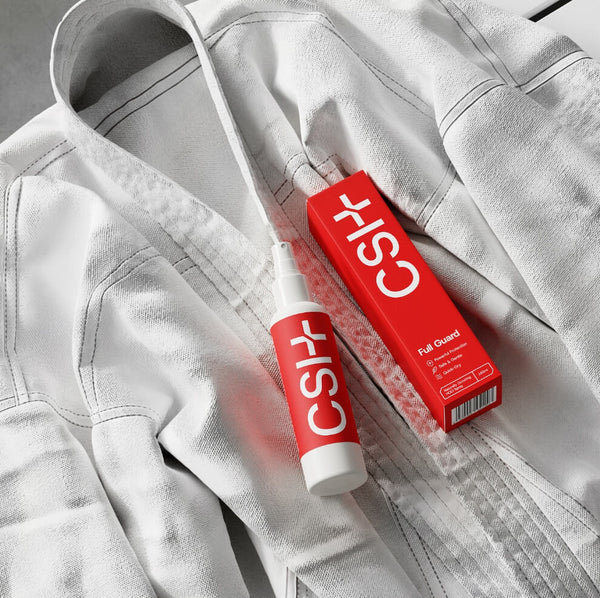
It is a gear and hard surface product. The obvious use case is everything that cannot go in a washing machine: shin pads, gloves, headgear, the inside of a bag, mat shoes, mouthguard cases, the boot of the car if it has become a kit graveyard. Some people also use it on kit alongside washing rather than instead of it. Whatever you use it on, use it exactly as directed on the label, and treat it as a deodorising and freshening product, which is what the label will tell you it is.
Two things to be clear about. First, a gear spray of this type is not for use on skin. Second, HOCl also appears in skincare products, and those are a completely different category with different formulations and intended uses. They are not interchangeable in either direction. A gear spray is for gear.
TrueFAQ
Can I wash synthetic kit with my normal laundry?
You can, as long as the whole load is going at 30 or 40 degrees, there is no fabric softener involved, and you are not mixing it with heavy items like jeans or towels. Towels shed lint that lodges in technical weaves, and heavy items stop lighter kit moving in the drum.
Is hand washing better for compression gear?
Not usually. Hand washing is gentle but it rinses poorly, and poor rinsing is what causes residue in the first place. A cool machine wash with an extra rinse beats a sink most of the time. Hand wash only for items with delicate trims or anything the label specifically demands it for.
Is a mesh laundry bag worth using?
For anything with straps, hooks, silicone grippers or fine mesh panels, yes. It stops those parts snagging on zips and Velcro, which is a common way compression gear dies early. Do not overfill it, though, because kit still needs to move to rinse properly.
The short version
Buy the fabric for what it does well, then stop treating it like cotton. Low temperature, liquid detergent, less of it, no softener, inside out, and air dry. Nearly every ruined rashguard and bagged out compression top I have seen died of heat or of detergent that never rinsed out, and both of those are entirely within your control.
Use biocides safely. Always read the label and product information before use.