The Complete BJJ and Judo Gi Care Guide
Educational information only – read the full notice
Share
A gi is the most expensive bit of kit most grapplers own, and the one most likely to be ruined by its owner rather than by training. Shrunk in a hot wash. Gone grey. Patches curling off at the corners. Or worst of all, clean on paper and still faintly sour when you pull it out of the bag on Tuesday.
This guide covers the bits people usually get wrong: what the weave actually means for how a gi behaves, how to keep white white and blue blue, how to stop patches lifting, and how to tell when a gi is genuinely finished rather than just old. The basic wash routine has its own article, so I will point you there rather than repeat it.
Cotton weaves, explained without the marketing
Gi jackets are almost always cotton or a cotton blend, and the weave is just how that cotton is constructed. It affects weight, how much water the jacket holds, how it shrinks and how long it takes to dry.
- Single weave. The lightest and thinnest. Dries fastest, packs smallest, wears out soonest at the shoulders and collar. Common in judo club kit and in summer BJJ gis.
- Double weave. Roughly twice the density of a single weave, going by the weights suppliers quote. Heavy, stiff, very hard to grip, standard in a lot of competitive judo. Holds a huge amount of water and takes an age to dry properly.
- Pearl weave. The BJJ default. A textured, slightly bobbled surface that gives a good strength to weight ratio. Usually quoted in gsm, and most jackets sit somewhere around 350 to 550.
- Gold weave. A middle ground between single and double: softer than double, thicker than pearl, and it tends to relax with wear.
Trousers are a separate question and usually cotton drill, ripstop or a twill. Ripstop is thin, dries quickly and shrinks less. Heavy drill trousers behave more like a double weave jacket once they are wet.
What the weave actually changes
Two practical things. First, drying time. A double weave or a heavy pearl weave jacket left folded in a damp pile is where odour problems start, because the inner layers never dry. Second, shrinkage. Denser weaves have more cotton to contract, so heat punishes them harder. Unbleached or raw cotton gis shrink more than pre-shrunk ones, and the label will usually tell you which you have.
The wash itself is a separate job with its own guide. The step by step gi wash routine covers temperatures, timings, detergent choice and getting the gi out of the drum, so I will not go over it again here.
Colour care
White gis go grey rather than dirty. That grey is usually a mix of detergent residue, transferred dye from black rashguards and belts, and hard water minerals. Keep whites away from coloured kit, and give the machine itself an empty hot maintenance wash every month or so if you use it hard, because a stale drum will grey a white jacket on its own.
Blue and black gis have the opposite problem: they fade. Heat and sunlight are the two culprits. Dry in shade or indoors rather than on a south facing line in July. A black gi that has gone charcoal at the shoulders has been sunbleached, not worn out.
New coloured gis will bleed for the first few washes, so wash a new blue or black gi on its own the first two or three times. Everyone has a story about a white gi that came out of the machine a soft, permanent lavender.
Patches, and why they lift
Most gi patches are embroidered and stitched, and stitched patches are fine with ordinary washing. The problems come from heat and agitation. Tumble drying is the main killer: the patch backing and the cotton around it shrink at different rates, so the edges pucker and then lift. Hang a patched gi instead.
A few things that help:
- Turn the gi inside out. It keeps patches off the drum and it slows fading on coloured gis at the same time.
- Do not iron directly over a patch. If you must press the jacket, go around it or use a cloth.
- If a corner starts to lift, get it restitched early. A lifted corner catches a grip and tears the jacket fabric, which is a much worse repair.
Myths and hacks that do not work
Fabric softener. It works by coating fibres in a waxy film. On a gi that film traps sweat residue and stops detergent reaching the cotton, so the gi feels lovely and smells worse over time. Skip it entirely.
Doubling the detergent. Extra detergent does not rinse out. It sits in the weave, holds moisture, and feeds the exact odour you were trying to remove. Use the dose on the bottle for your water hardness.
Washing at 90 degrees to fix everything. This wrecks the garment. Heavy shrinkage, collar distortion, patch damage, and on trousers with any elastane in the drawstring casing you destroy the stretch permanently.
Neat bleach. On cotton it weakens the fibre and yellows it over time. On any technical fabric, rashguards and spats included, it is a straightforward way to ruin a garment.
Freezing kit. Popular and useless. Cold does not remove the organic residue causing the smell, it just pauses things. The smell returns as soon as the kit warms up.
Tumble drying to bake the smell out. Heat sets odour into fabric rather than removing it. Once it is baked in it is very hard to shift.
Deodorant or aftershave on the gi. You now have two smells instead of one, and everybody within grip range can identify both.
Soaking in vinegar for days. A short soak is harmless. Days of it degrades cotton and stitching, and the gi ends up smelling of chip shop.
Where a gear spray fits
I once left a gi in the boot of the car after a Friday session and did not find it until Sunday evening. It went through the machine, came out clean by every visible measure, and about ten minutes into warm ups on Monday it announced itself again. The answer there was dull: another wash, and this time a proper dry with air moving around it rather than a jacket folded over a radiator.
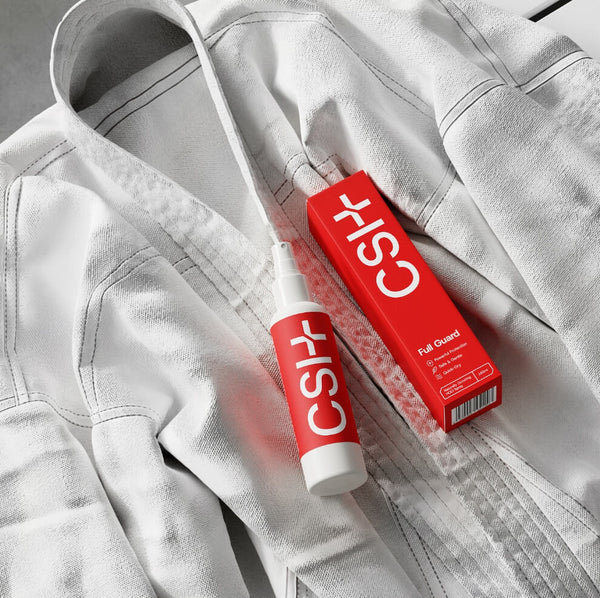
The harder problem is the kit that cannot go in a machine at all. Bags, shin pads, headgear, gloves, boot liners. For those items, one option is a HOCl-based spray made for kit and equipment, sold for use on personal gear between washes. These are gear products, not skincare. They are not for use on skin.
Worth being clear on one thing, because it confuses people: HOCl also appears in some skincare. Those are different products, formulated and regulated for a different job, and they are not interchangeable with a gear spray in either direction.
Treat a gear spray as one step in a routine rather than a rescue. Dry the kit out first, spray, let it dry fully, and keep washing whatever can be washed. If skin itself is the concern rather than the fabric, that is a question for a pharmacist or GP, not a spray bottle.
True
Lifespan, and when a gi is finished
A decent pearl weave gi trained in two or three times a week and looked after will typically give you somewhere in the region of two to four years before it starts feeling tired. Signs of genuine end of life:
- The collar has gone soft and floppy, or the filling has compressed to nothing.
- Thinning or splitting at the underarm gussets and across the shoulders.
- Skirt vents tearing upward into the body panel.
- Trousers gone see through at the seat or knee.
Fading, grey patches and a slightly rough hand feel are cosmetic. Structural failure at the collar, gussets or seat is not, and a gi that tears mid roll is a nuisance for your partners as well as you. Retire it to a drilling gi and buy a replacement.
None of this matters if the gi does not make it out of the bag dry. Unpack it the same night, every night. That habit fixes more problems than any wash trick, and it is part of the same basic courtesy as mat etiquette and turning up clean.
FAQ
How much will a new gi shrink?
It depends on whether it is pre-shrunk and how dense the weave is. A pre-shrunk pearl weave should barely move. A raw or unbleached cotton gi, and heavier weaves generally, have far more cotton to contract and will noticeably tighten in the sleeves and trouser length. Buy raw cotton a size up if the brand tells you to, and check the label before you assume.
How long does a heavy gi take to dry?
Longer than most people allow for. Hang it on a wide hanger with the shoulders supported, somewhere with moving air, and open the jacket out so the inner layers are exposed. A heavy double weave can take the better part of two days in a cold flat, which is exactly why two gis in rotation is worth the money.
Is a higher gsm gi better?
No, just different. Heavier jackets are harder to grip and last well, but they hold more water, dry slower and are miserable in a warm gym. Lighter gis are more comfortable and dry quickly, at the cost of wearing through sooner at the shoulders and collar. Competition rules on weight matter more than the number on the label.
Use biocides safely. Always read the label and product information before use.
More kit care
- How to Stop a Gi Shrinking (and Rescue One That Already Has)
- Getting Blood, Mat Stains and Grass Out of a White Gi
- Washing a BJJ Belt: What the Rules Say and What the Superstition Says
- Synthetic Kit Care: Polyester, Elastane and Compression
- Cleaning Combat Sports Gear That Cannot Go in the Washing Machine