Washing a BJJ Belt: What the Rules Say and What the Superstition Says
Educational information only – read the full notice
Ask a room full of grapplers whether you should wash your belt and you will get a lecture about tradition, a shrug, and at least one person quietly admitting theirs has never been near a machine. Meanwhile the belt is the one piece of kit that spends the entire session being dragged across the floor.
So here is the plain version: no rulebook we have seen forbids washing your belt, the superstition is a story rather than a rule, and a belt can be washed without turning it into a faded, curled, unstitched mess. Below is where the myth came from, what competition rules actually care about, and how to clean one properly.
Where the superstition comes from
The belief is that a belt holds your knowledge, your hours, your rolls, and that washing it rinses all of that away. It is a nice idea. It is also almost certainly a modern gym legend rather than anything handed down from Japan or Brazil.
Traditional martial arts had plenty of reverence for the belt, and older cotton belts genuinely did not survive repeated washing well, especially dyed ones that bled colour everywhere. Practicality turned into folklore. Somewhere along the line "washing it ruins it" became "washing it erases what you learned", and the sentence was too good not to repeat. It also helps that the myth is a convenient excuse, because not washing your belt requires no effort at all.
What the rules actually say
Competition rulebooks treat the belt as an item of uniform. The IBJJF uniform rules cover things like colour, width and the rank bar, and require the uniform to be clean and dry. Nothing in there rewards you for a belt that has never been washed. If anything, the cleanliness requirement points the other way.
Academies are the same. Plenty of gyms have a line in their rules about turning up in clean kit, and the awkward conversation is a familiar one. The belt is part of the uniform. The unwashed belt is a personal choice, not a compliance one, and if it has reached the point where people notice it, the choice has been made for you.
The hygiene reality
Think about what a belt does for an hour. It sits at the exact height that mops the floor during guard retention. It gets stood on. It absorbs sweat from you and from whoever you just spent five minutes underneath. Then it goes into a bag, damp, folded, in the dark.
Cotton belt weave is thick and slow to dry, which is the worst combination for odour. Smell is not a mystery, it is residue: sweat salts, skin oils, detergent that never rinsed out, and everything the mat had on it that day. Hold on to that, because it explains why most of the popular smell hacks fail. If the residue is still in the weave, the smell comes back. If you want the unglamorous detail on that last part, we covered what is actually on the mats and how often a floor really gets cleaned.
My own reminder came from a bag rather than a belt. I left a full kit bag in the boot after a Friday session and forgot about it until Monday afternoon. Everything went in the machine and came out fine, except the belt, which I had left rolled up because I did not want to fade it. I could smell it in the car with the windows down. That was the end of my belt superstition.
Myths and hacks that do not work
- Fabric softener. It works by coating fibres. On thick cotton and on any technical fabric it leaves a film that holds onto odour compounds and stops water and detergent reaching the fibre next time. It makes the problem worse over several washes, not better.
- Freezing kit. Putting a belt or a rashguard in the freezer does nothing useful. It thaws and smells the same.
- Tumble drying to bake the smell out. Heat sets odour into fabric rather than removing it, and it is rough on stitching and on anything with elastane. Air dry instead.
- Doubling the detergent. More detergent than the drum can rinse out simply stays in the weave. Use the normal dose.
- Washing at 90 degrees to fix everything. It will shrink and stiffen cotton belt weave, and it will destroy elastic fabrics outright. A boil wash is a way to ruin kit, not clean it.
- Neat bleach. On a coloured belt it will strip the dye unevenly and weaken the fibres and stitching. On technical fabric it is worse. And never mix bleach with vinegar or any other cleaner.
- Deodorant or aftershave on kit. Masking a smell adds a second smell. Everyone can tell.
- Soaking in vinegar for days. A short soak is harmless. Days of it swells and weakens fibres, loosens stitching, and leaves you with a belt that smells of chip shop.
How to wash a belt without ruining it
- Untie it and lay it flat rather than washing it coiled. A coiled belt does not get properly wet on the inside and does not properly rinse.
- Wash at 30 or 40 degrees on a normal cycle with normal detergent. No softener.
- Wash a new coloured belt on its own the first couple of times. Dyed belts, especially blue and purple, can bleed. After that it is fine with like colours.
- Skip the high spin if your machine lets you. Hard spinning is what twists and creases the weave.
- Get it out of the drum promptly. Kit left sitting damp in a machine picks up that stale smell within hours, and you have undone the wash.
- Air dry flat or hung straight, out of direct strong sunlight if you care about colour. It will take longer than you expect, which is exactly why belts get skipped. Give it a full day.
- Do not iron the rank bar. Heat on stitching and on any embroidery is how belts start unravelling at the tip.
If your belt has genuinely gone stiff and misshapen, that is usually the result of a hot wash or a tumble dryer, not of washing as such.
Where a gear spray fits
Some kit cannot go in a machine. Grappling dummies, wrestling shoes, headgear, shin pads, the inside of a kit bag, a mouthguard case, the boot of the car. That is the gap a gear spray is designed to sit in.
The honest framing is this: it is a step in a routine, not a replacement for washing and not a miracle. It is for the items that never see a wash cycle, and for freshening kit between sessions. Spray the surface evenly, let it dry fully, and put the kit away dry rather than damp.
Two things to be clear about. A gear spray of this kind is for fabric, pads, hard surfaces and bags. It is not for use on skin. And although HOCl also turns up in skincare products, those are different formulations made for a different job. They are not interchangeable, and you should not treat one as a substitute for the other. Anything to do with your skin is a question for a pharmacist or GP, not for a kit bag spray.
TrueFAQ
How often should I wash my belt?
There is no rule, but treating it like the rest of your kit is sensible. If you train several times a week, washing it every week or two is reasonable. If it has been rained on, dropped in a puddle, or sat damp in a bag, wash it then regardless.
Will washing fade my belt?
Cool washes and air drying cause very little fading. What fades belts is hot water, tumble drying, bleach based products and long spells drying in bright sun. A slightly softer looking belt after a few washes is normal wear, not damage.
Will people at my gym judge me for washing it?
Someone might make a joke. No one is getting pulled off the mat for a clean belt. If you want the wider version of turning up in a way that does not make you the person others avoid rolling with, our guide to mat etiquette covers the rest of it.
Your belt holds nothing except sweat. Wash it at 30, hang it up, tie it on next session, and get on with training.
Use biocides safely. Always read the label and product information before use.
A belt can go in the machine. The gloves, pads and bag lining it travels with can't, so they need a different approach.

For the gear that can't be washed
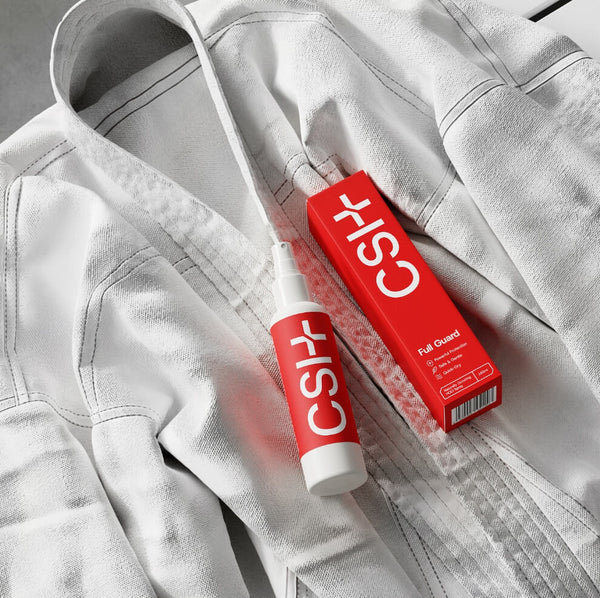
Gear Guard Equipment Cleaner Spray
A targeted HOCl surface spray for the kit no washing machine can help: gloves, pads, headgear, boots and bag linings. Spray until visibly wet, wait 60 seconds, wipe, and let it air dry.
- Independently tested surface biocide (BS EN 13727, BS EN 1650)
- One-minute contact time, then wipe and air dry
- No fragrance, dries clear, nothing left behind once dry
- 100ml fine mist, hundreds of targeted sprays, UK-made
Use biocides safely. Always read the label and product information before use. Gear Guard is for equipment, not skin. Fabric kit goes in the washing machine.