How to Look After Your BJJ Rashguard (So It Doesn't Look After Itself)
Educational information only – read the full notice
Your rashguard has a rough life. It gets gripped, stretched, dragged across the mat and soaked in 20 people's sweat most nights of the week. Then, more often than anyone likes to admit, it gets balled up and left at the bottom of a gym bag until the next session. Don't worry, we all do it.
A decent rashguard isn't cheap, and nor should it be, and a badly treated one can go from fresh to foul in a few weeks. The good news is that looking after it is easy. None of it takes long, and all of it adds months (sometimes years) to the life of your kit.
Why it's worth bothering
The obvious reason is hygiene. Jiu-jitsu is about as close-contact as sport gets, so everything on you and on the mat ends up in your gear. Clean kit sits right alongside showering straight after training and keeping your nails short as the basics of being a decent training partner. Nobody wants to be the reason someone taps to a smell.
Then there's the rashguard itself. Most are a polyester and elastane blend, built to wick sweat, dry fast and stay close to your body. Wash them badly and the fibres clog up, the smell sets in and the stretch goes. You end up with a top that's baggy, whiffy and does none of the things you bought it for.
Wash it after every session. No excuses.
Every session, no exceptions. Even if all you did was a light drilling class and you barely broke a sweat. If you only have one and it's pre-worn, take the hit and borrow a clean one or buy another. Hygiene is that important.
Damp synthetic fabric sitting in a warm, zipped-up bag is exactly where odour loves to build. The longer it sits there, the harder it is to get out. If you've got a rashguard that's been in the boot of the car since Tuesday, it has probably earned a stripe by now.
If you can't wash it straight away, at least get it out of the bag and hang it up when you get home. A mesh gear bag helps too, as it lets some air get at your kit on the way back.

Kill the source.
The smell. The bacteria. The fungus.
Not your gear.
"Used it on my son's gloves and shin pads, even his bag. The smell went instantly. I can't believe it. I'll be recommending it to everyone at the gym." ★★★★★ S.Killbeck
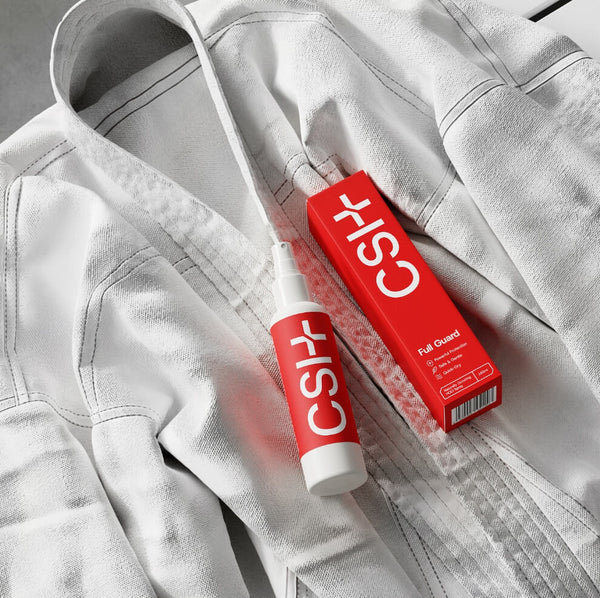
Gear Guard. Spray. Leave. Done.
Shop Gear Guard →Use biocides safely. Always read the label and product information before use.
How to wash it properly
Turn it inside out. This protects the print from rubbing against everything else in the drum, and it puts the sweatiest side in direct contact with the water and detergent.
Keep it cool. Around 30°C is plenty for synthetic fabric. Hot water is what kills elastane, and it's rough on prints too. A cooler wash is also cheaper to run, which is a nice bonus.
Don't go mad with the detergent. A normal mild detergent does the job, and a sports detergent is worth a go if smell keeps coming back. Either way, use less than you think. Too much leaves residue in the fibres, and residue holds on to smells and leaves the fabric feeling stiff.
Leave out the fabric softener. This is the big one. Softener coats the fibres in a waxy layer, which is lovely on a cotton towel and useless on technical fabric. It blocks the wicking and locks odour in. You'll smell like a spring meadow for roughly the first minute of warm-ups, and then the truth comes out.
No bleach. It fades sublimated prints and weakens the fibres. A properly washed rashguard doesn't need it.
Gentle cycle. A synthetics or delicate setting puts less strain on the seams. If you're washing it with your gis, stick it in a mesh laundry bag so it doesn't get snagged on zips, velcro or anything else lurking in there.
Drying: step away from the tumble dryer
Air dry it. Every single time.
Heat breaks down elastane, and that's why so many rashguards end up baggy in some places, tight in others and rippled all over. It can crack the print as well. Put a rashguard in the dryer on high and there's a fair chance it comes out a size smaller, and you'll be turning up to open mat in a crop top.
Rashguards are made to dry fast anyway. Hang it on a line, an airer or a hanger somewhere with a bit of airflow and it'll usually be ready in a few hours. Try not to leave it baking in strong sun for days, as UV fades colours over time. And don't wring it out. Give it a gentle squeeze, or roll it up in a towel to get the worst of the water out.
When the smell won't shift
Sometimes a normal wash just isn't enough. If you've got a rashguard that still smells straight out of the machine, try this:
- Soak it first. Leave it in cool water with a cup of white vinegar, or a scoop of sports detergent, for 30 minutes to an hour, then wash as normal.
- Strip out the build-up. If softener or too much detergent has been going in for a while, run the odd wash with no detergent at all to rinse the residue out.
- Check the machine. A musty drawer or door seal will happily pass its smell on to your clothes. Run a maintenance wash now and then.
- Use Gear Guard on the cause of the smell. Gear Guard, our UK-made HOCl spray, kills the bacteria behind the stink. Spray it on, then wash as normal. Use biocides safely. Always read the label and product information before use.
If it still smells the moment you start sweating after all that, it's probably time to let it go. There's more on this in our guide to getting the smell out of a rashguard.
Small habits that help
- Rotate. If you train a few times a week, having two or three rashguards on the go means each one gets washed and fully dried between sessions, and none of them wear out as fast.
- Trim your nails. Long nails snag fabric, yours and everyone else's.
- Take off jewellery. Rings and watches pull threads (and shouldn't be on the mat anyway).
- Only put it away dry. Folding away a rashguard that's even slightly damp undoes all your good work.
- Wash the bag too. A clean rashguard in a rank gym bag won't stay clean for long.
Knowing when it's done
Even the best-looked-after rashguard has a lifespan. It's time for a new one when:
- It's gone loose and doesn't sit close to your body any more
- The seams are splitting or fraying
- Holes or pulled threads keep getting bigger
- The smell comes back as soon as you start sweating, fresh wash or not
If yours is past saving, have a look at Scramble for the best BJJ gis and rashguards. They've been making grappling gear for years and have a solid range of rashguards, from plain ranked designs to some of the more entertaining graphic releases in the game. Scramble also make our own CSH Athlete Rashguard.