Why Your Rashguard's Print Cracks and Its Compression Dies
Educational information only – read the full notice
Share
A rashguard usually dies twice. First the print starts flaking off the shoulder, then a few months later the whole thing hangs off you like a wet T-shirt. Neither of those is bad luck. Both have specific causes, and most of them happen in your house, not on the mats.
This is about the garment itself: what cracks the print, what kills the stretch, and when a rashguard is genuinely finished. Odour and wash routines are covered elsewhere on the site, and there's a link at the end. This is purely about lifespan.
Sublimated print versus screen print
Two rashguards can look identical on a product page and behave completely differently after a few months of regular training.
Sublimated printing puts the dye into the polyester fibres using heat. There's nothing sitting on top of the fabric. Run your hand over a properly sublimated panel and you feel fabric, not ink. That design can't peel, because there's no layer to peel. It can fade over a long time, especially strong colours in direct sun, but it won't crack.
Screen printing and heat transfer put a layer of ink or vinyl on top of the fabric. That layer is a different material to the thing it's stuck to, and it stretches at a different rate. Every time you pull the garment over your head, every time somebody grips a fistful of your shoulder, that layer flexes more than it wants to. Eventually it fractures. That's your cracked logo.
So if you're looking at a rashguard with peeling graphics, the first thing to accept is that you didn't necessarily do anything wrong. You bought a printed layer, and printed layers on a heavily stretched, heavily abraded garment have a finite life. What you can do is stop accelerating it.
What heat actually does
Heat is the villain in both stories, for two different reasons.
For a printed layer, heat softens the ink or adhesive. Soften it, then stretch it in a drum, then let it cool while it's folded into a wrinkle, and you've set a crease into the print. Do that repeatedly and the crease becomes a crack. Tumble dryers are the worst offender because they combine heat, tumbling and constant flexing, which is every mechanism that damages a print happening at once.
For the fabric, heat matters just as much. Rashguards are typically polyester with a proportion of elastane. The polyester is tough. The elastane isn't. Elastane is a rubbery polymer, and hot water plus mechanical agitation breaks down its elasticity over time. Those fibres lose the ability to snap back to length. That's what people mean when they say a rashguard has gone baggy: the polyester is fine, the elastane has given up. Which is why a cool wash isn't a fussy preference, it's the main lever you have over how long the garment keeps its shape.
Myths and hacks that do not work
- Fabric softener. It works by depositing a waxy coating on fibres. On cotton towels that feels nice. On performance polyester it clogs the fabric and stiffens the weave, so the garment stops moving and recovering the way it was built to.
- Hot cycles. A 60 or 90 degree wash is very hard on elastane. You'll pull out a stretched garment with nothing gained for the fabric.
- Neat bleach on technical fabric. Bleach attacks elastane directly and will discolour dyes unevenly. A bleached rashguard is a ruined rashguard.
- The dryer as a shortcut. Worth repeating, since it's the single habit that undoes everything else: heat plus flex is the exact combination that cracks prints and fatigues elastane.
- Ironing over a print. Usually done by accident when someone irons a folded pile. Never put a hot plate on a graphic.
Turn it inside out, and other things that actually help
Turning it inside out is the habit worth building first. The printed side then faces inward, away from the drum wall, zips, Velcro and every other rashguard in the load. It costs you nothing and it directly reduces the abrasion that scuffs and cracks a printed layer.
- Gentle or synthetics cycle, lower spin. High spin twists and compresses the garment hard, which is mechanical fatigue on the elastane and creasing pressure on the print.
- Keep it out of the drum with heavy cotton and zips. A gi abrades light technical fabric, and zips on hoodies and shorts are what catch and scuff printed panels.
- Get it out of the drum promptly. A rashguard left compressed in a damp ball for a day sets creases into the print, and those creases are where cracks start.
- Air dry flat or on a hanger, out of direct sun. Direct sunlight fades sublimated colour over time, and a hot radiator does the same thing to a print that a dryer does, just more slowly.
- Rotate more than one, so each garment gets a rest. Elastane needs time to recover its shape between wears. Wearing the same one every session stretches it out regardless of how you launder it.
One more, learned the hard way. I once left a rolled up rashguard in the bottom of my bag over a bank holiday weekend, under a pair of shorts and a water bottle that had leaked. When I found it on the Tuesday, the print across the chest had permanently set into the exact folds it had been crushed into, and no amount of washing or hanging brought it back flat. The fabric was fine. The graphic looked like crazed paint on an old car. That garment went straight to the bottom of the rotation.
Where a dedicated gear spray fits
Some of your kit can't go in a machine at all, and a lot of it wouldn't survive one: headgear, shin pads, gloves, mat shoes, the inside of the bag itself. Foam, laminated panels and glued seams are damaged by exactly the things that damage a rashguard, heat and agitation.
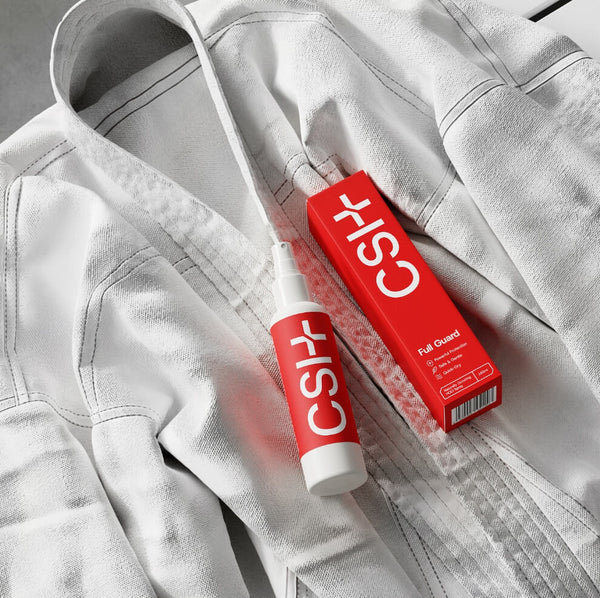
One option for that category is a dedicated HOCl spray made for gear. It's a textile and hard surface product: pads, gloves, bags, benches, the boot of your car if it's become a kit locker. You mist it onto the surface and let it dry. No heat, no drum, no wringing, which is the reason it suits items that would be wrecked by any of those. Use biocides safely. Always read the label and product information before use.
Two things worth being clear about. This category is for gear, not for skin. HOCl also turns up in skincare formulations, but those are different products formulated for a different job, and the two aren't interchangeable. Don't spray a gear product on yourself. And it's a step in a routine rather than a rescue mission: it sits alongside proper washing and drying, and nothing in a bottle will bring stretch back to fatigued elastane.
If your concern is skin rather than fabric, that's a different conversation. If something on your skin isn't settling, see a pharmacist or GP rather than reaching for a spray.
When to retire it
Rashguards are consumables. Retire yours when:
- The cuffs or hem no longer grip and the garment rides up mid roll.
- The fabric has gone thin and slightly translucent across the shoulders and back.
- Seams are opening, or the flatlock stitching has started to gape.
- It no longer compresses. If it hangs, it isn't doing the job, and loose fabric moves against you rather than with you. If that's causing you problems, read up on friction breakouts from gear.
A cracked print alone is cosmetic. Nobody on the mats cares. Lost compression and thinning fabric are functional failures, and those are the ones worth acting on. If you want the broader picture on keeping kit in good order, start with the rashguard hygiene basics.
FAQ
Can I fix a rashguard print that has already cracked?
No. Once a printed layer has fractured it can't be rebonded at home, and heat pressing it will usually make it worse. You can slow further damage by turning the garment inside out for every wash, but the existing cracks are permanent.
Will a sublimated rashguard outlast a screen printed one?
The graphic will, yes, because there's no separate layer to crack or peel. The fabric is a different question. Sublimation protects the design, not the elastane, so a sublimated rashguard can still lose its compression on exactly the same timeline as a printed one.
How long should a rashguard last?
There's no fixed number, because it depends entirely on how often you train and how you launder it. What matters is the failure mode: judge it by cuff grip, fabric thickness and whether it still compresses, not by the state of the logo.