Mould and Mildew on Training Gear: What to Do and What to Bin
Educational information only – read the full notice
Odour is one problem. Mould is a different one, and people confuse the two because both announce themselves the same way: you open the bag and pull a face.
Mould and mildew are living growth on the fabric. That means there is something physically on the fibres, not just residue in them, and it changes what you should do next. Some kit comes back from that perfectly fine. Some kit genuinely does not, and pretending otherwise just means you keep carrying a ruined shin pad around for another six months.
Here is how to tell what you are looking at, what is recoverable, and how to stop it happening again.
How to tell mould from staining
Old stains and mould can look similar on white cotton, so check these in order.
- Texture. Mould sits on top of the fabric. Run a fingernail across it. Staining is flat and part of the weave. Mildew often has a slight fuzz or powder to it, and early growth on a damp gi can feel faintly chalky.
- Pattern. Stains follow use: knees, collar, armpits, the bit of the rashguard that rubs the mat. Mould follows moisture and contact. It spreads out from where the fabric was folded, bunched or pressed against something else, in blotches that ignore where you actually sweat.
- Colour. Mildew is usually grey, white or a dull green. Mould can go black or dark green. A pink or rusty tinge on damp fabric is usually bacterial rather than mould, which puts you back in ordinary washing territory. Sweat and deodorant staining tends toward yellow or a dingy beige.
- Smell. Sour and sharp is bacterial. Earthy, damp, like a cellar or an old tent, is mould. Once you have smelled the difference once you will not mistake it again.
If it is on the outside of a bag, on a wall behind a drying rack, or on the underside of pad foam, it is almost never staining.
The weekend bag problem
I once left a full bag in the boot of the car after a Friday night session, and then the weekend happened. Gi, two rashguards, a towel and a pair of shorts, all rolled together, all still wet, in a car sitting in the sun on the Saturday.
By Sunday evening the gi was fine after a wash. The towel was fine. The rashguard had grey speckling across the shoulder where it had been pressed against the inside of the bag, and that never came out. The bag itself was the real casualty, because the lining had gone properly musty and the smell survived two attempts at wiping it down.
Warm, dark, still air and wet fabric in contact with wet fabric is the whole recipe. It does not take a week. Mine was speckled by the Sunday.
Myths and hacks that do not work
Advice for mouldy kit specifically is even worse than general laundry advice. These are the ones to ignore.
- "Wash it twice and it will go." If a correct wash, proper dose, right temperature, no softener, did not shift it, the identical cycle again just delays the decision. Change something about the wash, or accept the verdict.
- "An hour in the sun sorts it." Sunlight helps with drying, and drying matters. But a warm, fresh-smelling surface is not the same thing as a clear weave. The sun is part of drying, not a treatment.
- Wiping down mouldy pad foam. If growth has reached the foam, a surface wipe only ever deals with the surface. The outer looks clean while the inside carries on.
- A boil wash or 90 degree cycle. One idea in two outfits, and both wreck the garment. Elastane gives up well before boiling point, and almost nothing you train in is built for 90 degrees. You lose the kit and often keep the marks.
What can be recovered
Deal with it quickly and most of this list comes back.
- Cotton gis and cotton shorts. Usually recoverable. Brush off any surface growth outdoors first so you are not just rubbing it deeper into the weave, then wash at 40 degrees with a proper dose of detergent and no softener, and dry it fully.
- Rashguards, spats and synthetic shorts. Often come back if you catch it early. Wash inside out at 30 degrees. Light speckling on light-coloured synthetics may leave a shadow even once the growth is gone.
- Belts, straps and cotton wraps. Generally fine. They just need much longer to dry than you think.
- Bag linings and hard shells. Worth the effort. Empty it completely, take out any removable liner, wipe the inside down, then get it fully dry before anything goes back in.
- Pad and glove outers. The vinyl or leather outer wipes down fine.
Two rules on everything above: get it out of the drum as soon as the cycle finishes, and do not fold or stack anything until it is completely dry. Half dry and folded is how this started.
What genuinely cannot be saved
Be honest with yourself about these.
- Mould inside pad or glove foam. If growth has got into the foam core, you cannot reach it, you cannot wash it and you cannot dry it out properly. Surface wiping treats the outside of a problem that lives on the inside. Replace them.
- Anything with black growth deep in the weave that has been there for weeks. Established black mould on cotton can weaken the fibres. Even if you lift the colour, the fabric may tear where the growth sat.
- Mouthguards and anything else porous. Porous, cannot be cleaned through, cannot be dried out. New one.
- Foam in old bag bases and delaminated bag linings. If the lining is peeling away from the shell and mould is behind it, the bag is done.
Replacing a shin pad is cheaper than the fortnight you will spend trying to rescue one.
Where a gear spray fits
Some kit cannot go through a wash cycle at all. A dedicated hypochlorous acid (HOCl) spray made for gear is a textile and equipment product for exactly those items: pads, gloves, headguards and bag interiors. Spray, allow to dry fully, and air the item as usual.
Two things to be clear about. It is not for use on skin: HOCl also appears in skincare products, but those are formulated for a completely different job and the two are not interchangeable in either direction. And it is one step in a routine, not a substitute for one: clean, dry, rotated kit remains the foundation.
Use biocides safely. Always read the label and product information before use.
The purpose-built option
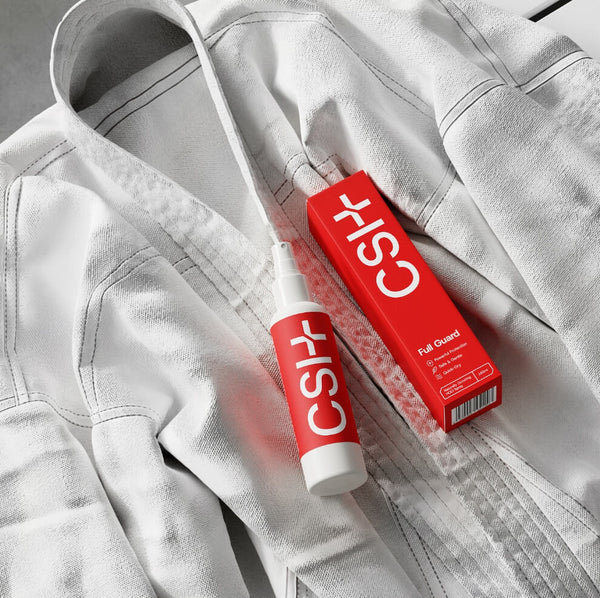
For hard kit surfaces, gloves, guards and bag shells, Gear Guard is the tested option: BS EN 1650 fungicidal on hard surfaces. Spray, wait a minute, wipe, air dry. The full method and comparison is on the Gear Guard guide page.
Prevention, which is mostly just drying
Mould needs moisture that hangs around. Remove that and the rest looks after itself.
- Unpack the bag the same day, every time. Not as a habit you are proud of, just as a reflex before you sit down.
- Get wet kit fully dry, fast. The how of drying indoors is covered in our guide to washing, drying and rotating kit.
- Air pads and gloves loose rather than zipped in. Leave them out of the bag entirely between sessions if you can.
- Empty the bag fully and leave it open. A closed bag with a damp towel in it is a small greenhouse. More on that in our guide to gym bag hygiene.
- Make sure everything is completely dry before it is folded or stacked. Thick collars, belts and waistbands hold water long after the rest feels fine.
- Keep your wash routine sensible in the first place, which is covered properly in our piece on washing kit properly.
FAQ
Can I wash mouldy kit with the rest of my laundry?
Wash it separately. Brush off surface growth outdoors first, then run it on its own so you are not spreading loose spores through clothes that were fine.
Does a hotter wash kill mould better?
Hotter helps up to a point, but most training kit cannot take it. Stick to 30 degrees for synthetics and 40 for cotton, and put the effort into fast, thorough drying instead. Drying is doing more work here than temperature.
My gi came out of the wash still smelling earthy. Now what?
That usually means it went in overloaded, or it did not dry fully afterwards and started again in the airing cupboard. Rewash it on its own with a full detergent dose and no softener, then get it fully dry, fast. If the smell survives a second correct wash, the growth is established in the weave and the gi is on its way out.

For the gear that can't be washed
Gear Guard Equipment Cleaner Spray
A targeted HOCl surface spray for the kit no washing machine can help: gloves, pads, headgear, boots and bag linings. Spray until visibly wet, wait 60 seconds, wipe, and let it air dry.
- Independently tested surface biocide (BS EN 13727, BS EN 1650)
- One-minute contact time, then wipe and air dry
- No fragrance, dries clear, nothing left behind once dry
- 100ml fine mist, hundreds of targeted sprays, UK-made
Use biocides safely. Always read the label and product information before use. Gear Guard is for equipment, not skin. Fabric kit goes in the washing machine.