Spats, Shorts and Grappling Socks: The Kit Everyone Forgets
Educational information only – read the full notice
Share
Everyone has a system for their gi. Almost nobody has one for the rest of it.
Spats, fight shorts, grappling socks: these are the layers that get pulled on, sweated through, rolled into a ball and then, more often than anyone admits, worn again on Thursday because they looked fine. They are also the layers sitting closest to the parts of you that sweat hardest, under the most friction, for the longest time.
This is how to wash them properly, what to do when a normal wash stops working, and which popular fixes are actively making things worse.
Why these items are the worst offenders
Spats are the obvious one. They are a full leg of tight synthetic fabric, worn under a gi or under shorts, which means they get a second layer of insulation on top of them for the entire session. Sweat goes in and very little air gets to it. By the time you peel them off they are holding more moisture than anything else you own.
Fight shorts are a different problem. Most decent pairs have panels that are not simple polyester: waxed or coated stretch panels, welded seams, rubberised logos, a Velcro fly and a drawcord that never dries at the same rate as the fabric around it. Those coatings are the reason shorts hate hot water and hate the tumble dryer even more.
Grappling socks are small enough to be forgotten entirely. They come off last, they go in the bottom of the bag, and because they are compact they can sit damp for days without anyone noticing. Same with the socks worn inside mat shoes for wrestling and MMA rooms. The sock is a textile and needs washing like one, even if the shoe itself is a separate job.
The honest reason all of this smells is not bacteria appearing from nowhere. It is residue. Sweat, skin oils, detergent that never rinsed out and softener that was never meant to be there build up in synthetic fibres and stay put. Wet that residue with fresh sweat and the smell comes straight back, which is why kit can go in clean and be foul again forty minutes into a session.
My bag was the one everyone could identify
I once left a full kit bag in the boot over a bank holiday weekend. Spats, shorts, socks, all of it damp, all of it zipped in. I opened it on the Tuesday and genuinely stood back from it.
What annoyed me was not the weekend. It was that the spats had been washed twice since, and they still turned on me the second I warmed up in the first round.
Myths and hacks that do not work
- Fabric softener. It works by coating fibres. On technical fabric that coating traps odour compounds and kills wicking at the same time. Softener is one of the most common reasons gym kit smells worse over time.
- Doubling the detergent. The machine cannot rinse out what you overdose it with. Extra detergent becomes extra residue, and residue is what the smell lives in. If anything, use slightly less and wash more often.
- Boil washing or a 90 degree cycle to fix everything. Elastane starts giving up long before that. You get baggy spats, delaminated shorts panels and cracked printed logos, and the residue is still there.
- Neat bleach on technical fabric. It will strip colour, weaken elastane and can leave shorts panels tacky. Not a fix.
- Freezing kit. A freezer does not remove residue. Cold slows things down and that is all. It comes out of the freezer smelling like cold kit and then thaws back to normal.
- Tumble drying to bake the smell out. Heat sets odour into synthetics rather than removing it, and it is exactly what coated shorts panels and waistbands cannot take. Air dry.
- Deodorant, body spray or aftershave on kit. You are layering fragrance over the problem and adding more oil for the fibres to hold. Everyone can smell both.
- Soaking in vinegar for days. A short soak has its uses. Leaving kit sitting in acid for two days does nothing extra and is not kind to elastic.
What actually works
- Get it out of the bag the same day. Not into the machine necessarily, just out and hung up. Damp time is the whole ballgame.
- Rinse spats and socks under cold water if the wash is not happening tonight. A quick cold rinse gets a lot of the sweat out before it dries in.
- Wash at 30 or 40 degrees. That is the standard range for synthetics and it is enough when the detergent and dose are right.
- Turn everything inside out. The dirty side is the inside. Fasten Velcro flies before they go in or they will shred your spats.
- Use a proper dose, no softener, and consider a sports or activewear detergent. These are formulated to lift oils out of synthetics rather than sit on them.
- Run an extra rinse. Cheapest upgrade available for smelly kit.
- Get it out of the drum promptly. Clean wet kit left in a warm machine for six hours is no longer clean kit.
- Air dry, ideally somewhere with moving air. Not on a radiator, not in the dryer, not in a heap over a chair.
- Run an empty hot maintenance wash on the machine monthly. The machine holds residue too, and it hands it straight back to your kit.
The rules here overlap heavily with the same rules that apply to rashguards, which is not a coincidence: it is all the same family of synthetic stretch fabric with the same weakness for heat and residue.
Where a dedicated gear spray fits
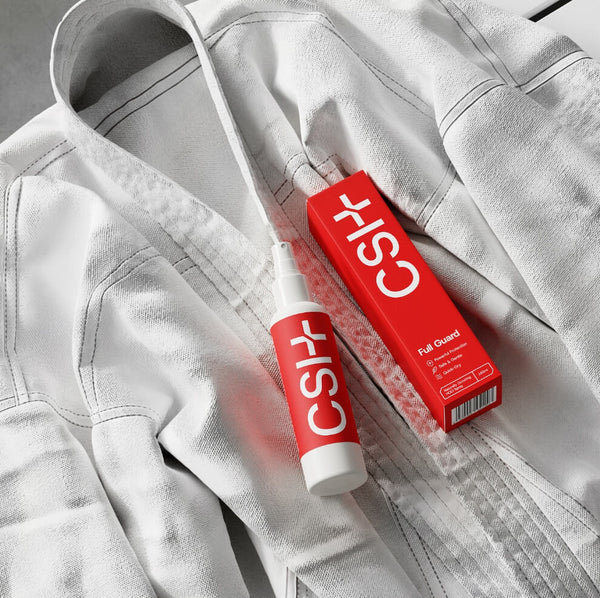
Some items cannot go through a machine at all. That is why a separate gear-and-equipment spray category exists.
This is a textile and equipment product category. It is intended for fabric, pads, gloves, shin guards, bag linings, mats and hard surfaces. It is not a skin product and should not be used on skin. HOCl also turns up in skincare formulations, and those are separate products doing a separate job with separate formulation and testing behind them. Do not treat them as interchangeable in either direction.
Used sensibly, a HOCl gear and equipment spray is a step in a routine rather than a replacement for one: the inside of a bag once it has been emptied, shorts and spats between washes, and the pads and guards that cannot be laundered at all. Let treated items dry fully before they go back in a bag. If you are hoping it will rescue kit you left damp for a fortnight, wash it first and reassess.
TrueFAQ
Can I wear spats twice between washes?
No. They are the tightest, dampest layer you own and they get sweated through completely every session. Wash after every use. If that is not realistic, buy a second pair rather than a stronger detergent.
Why do my fight shorts smell only when I start sweating?
That is residue in the fabric being rewetted. Strip washing helps: one wash with no detergent at all at your normal 40 degrees, plus an extra rinse, to flush out old build up. Then go back to a correct dose and no softener.
Do grappling socks need anything special?
Only the basics done consistently. Cold rinse when you get home, 30 or 40 degrees, no softener, air dry properly, and never let them dry inside a shoe. If your feet or skin are showing anything unusual, that is a question for a pharmacist or GP rather than a laundry problem.
Use biocides safely. Always read the label and product information before use.