Getting Blood, Mat Stains and Grass Out of a White Gi
Educational information only – read the full notice
A white gi is a magnet for everything on the mat. Blood from a stray elbow, black scuffs from mat rubber, green streaks from an outdoor session, a collar gone the colour of weak tea. Most of it comes out if you deal with it correctly and quickly. Most of it sets permanently if you guess.
This is a stain by stain guide: blood, mat marks, grass, collar yellowing and rust, plus what bleach really does to cotton. The routine side is covered separately in the basic wash routine.
Blood: cold water, immediately, and never hot
Blood is a protein stain. Heat cooks protein and bonds it to the fibre, which is why a hot rinse or a warm wash fixes a nosebleed into your lapel for good. That rule governs the whole article: while any stain shadow is visible, keep the garment away from heat, so no hot wash, no tumble dryer, no radiator.
- Get it under cold running water as soon as you are off the mat. Cold. Not tepid, not warm.
- Work it from the back of the fabric so you push the blood out rather than through.
- If it has dried, soak the area in cold water for 20 to 30 minutes to rehydrate it first.
- For a stubborn mark, work in an enzyme based laundry liquid and leave it 15 minutes to break down the protein. Then wash cold, or at 30 at the very warmest while any blood shadow remains.
- Air dry, check the spot in daylight, and repeat if a shadow is still there.
The household strength hydrogen peroxide sold in pharmacies will lift dried blood from white cotton if you are desperate, but test it on an inside seam first and rinse thoroughly. It fades coloured patches and contrast stitching without much warning.
Mat marks and rubber transfer
The grey and black smears down the back of your jacket and along your trouser hems are not dirt. They are pigment and rubber from the mat surface, ground into the weave by your own bodyweight, so water alone does nothing.
They need solvent action rather than a soak. A dab of washing up liquid or a solvent based stain remover, worked in with an old toothbrush along the direction of the weave and left for 10 minutes before washing, gets most of it. Pearl weaves need more patience than a single weave because the marks sit deeper. The same friction that leaves rubber on your gi leaves it on you, so if that is the bigger problem, read up on mat burn and skin friction instead.
Grass and mud from outdoor sessions
Grass is a dye stain. Chlorophyll behaves more like ink than soil, which is why rubbing it with water spreads it into a wider green smudge. Let mud dry, then brush it off with a stiff brush before it goes near water. For the green underneath, blot with a cloth dampened with surgical spirit or a clear alcohol, working from the outside in, then wash normally. An oxygen based stain remover soak, an hour in cool water, handles the rest.
Surgical spirit is highly flammable. Use it in a ventilated room away from any heat source, and rinse the fabric out fully before the garment goes near a dryer or radiator.
Collar yellowing and sweat
The collar takes the most sweat, skin oil and deodorant residue. Aluminium salts in antiperspirant react with sweat and leave a yellow deposit, and because the collar is thick and dries slowly, that residue sits in place and greys it before the rest of the jacket.
An oxygen based soak is the standard answer. Dissolve oxygen bleach powder in warm water, submerge the collar and lapel only, leave it a few hours or overnight, then wash. Repeat over two or three washes rather than trying to fix a year of build up in one go.
Rust marks from cage frames and racks
Small orange dots along a shoulder or hip usually come from a cage frame, a rusted rack in the changing room, or a damp radiator. Rust is iron oxide, and it is one of the few stains where bleach makes things worse: chlorine bleach reacts with iron and sets the mark as a darker permanent brown.
Use a dedicated rust remover made for fabric, follow the instructions on the bottle, and rinse thoroughly, because acid left sitting in cotton weakens it. The lemon juice and salt trick sometimes works on very light marks, but it is unreliable on iron oxide and salt plus strong sunlight is hard on cotton.
One safety point covering the whole article: never mix a chlorine bleach product with an acid rust remover, or with vinegar. That combination gives off chlorine gas.
What bleach actually does to cotton
Household chlorine bleach whitens by oxidation, and it oxidises the cellulose in the cotton as well as the stain. That weakens the fibre: repeatedly bleached gis tear at the shoulder or split at the knee earlier than they should, and the collar goes soft and floppy.
Counterintuitively, it also makes the gi yellower. Unrinsed chlorine residue keeps reacting in the fabric and strips out the optical brighteners that made the gi look bright white when it was new, so the more you bleach, the more you need to bleach. Oxygen bleach, the powdered percarbonate kind, is the better default: slower, gentler, and no threat to stitching or coloured patches.
Stain myths and hacks that do not work
- Hot water on blood. The hot tap is the most common way a removable stain becomes a permanent one.
- Neat chlorine bleach on white cotton. It bleaches a halo around the spot, leaves a patch that is a different white to the rest of the jacket, and thins the fabric where it sat.
- Neat bleach on technical fabric. Straight onto a rashguard or printed panel, it eats the print and the elastic.
- Bleach on rust. It does not lift iron oxide, it sets it darker.
- Scrubbing grass with water. Chlorophyll is a dye. Water and friction spread it into a bigger, fainter area that is harder to treat than the streak was.
- Lemon juice left on indefinitely. Acid does not stop working once the mark has gone. Hours later it is still attacking the cotton, and you get a thin patch that tears.
- A long soak fixes mat rubber. Rubber and pigment are not water soluble, so soaking does nothing at all.
Where a dedicated gear spray fits
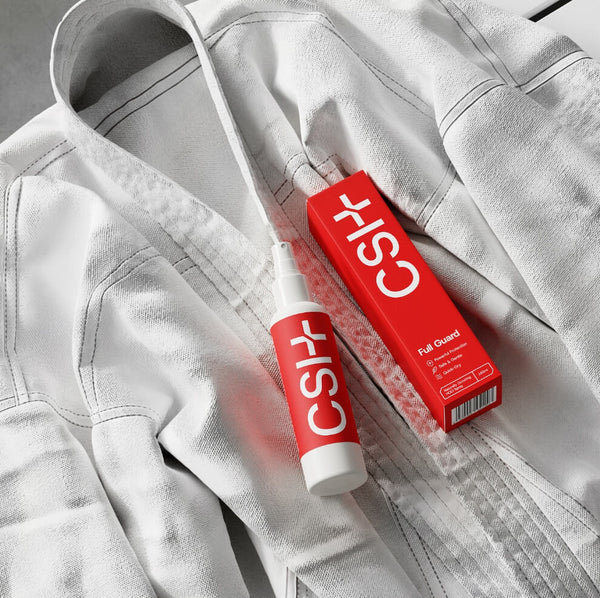
Some kit never goes in a machine. Headgear, shin pads, gloves, a wrestling bag lining, mat surfaces, the boot of the car. A HOCl gear spray made for gear is one option for that category: a dedicated gear spray for fabric, pads, hard surfaces and bag interiors between washes.
It is not a stain treatment. It does not clean or whiten fabric, and nothing in this article is a job for it. It is for kit and surfaces, never for use on skin, and although hypochlorous acid also turns up in skincare, those are different products for a different job and not interchangeable. Treat it as a step in a routine rather than a rescue.
TrueThe weekend I left a gi in the car boot
I once left a gi in the boot of the car after a Saturday open mat. Not overnight. The full weekend, in July, in a closed bag, with a rashguard folded inside the jacket. I could smell it from the driveway on Monday. The gi washed out fine. The bag did not, and I threw it away, because whatever had happened in the lining was beyond negotiation. Now the bag gets emptied in the hallway before I sit down, every time.
FAQ
Can I get blood out of a gi that has already been through a hot wash?
Sometimes you can fade it, rarely can you remove it. Try an oxygen bleach soak in cool water over several hours, repeated across a few washes. Prevention here is easier than cure.
Will an oxygen bleach soak damage my patches?
Generally no. Embroidered and printed patches usually survive it fine. Test an inconspicuous corner first if the patches are heavily coloured, and keep the soak cool rather than hot.
Can I spot treat blood without washing the whole gi?
Yes, and for a small mark it is the better move. Rinse the spot under a cold tap from the back of the fabric, work in a little enzyme based laundry liquid, leave it 15 minutes, then rinse the area thoroughly so no detergent dries into the weave. Air dry and check in daylight, and treat it again if a shadow remains.
Use biocides safely. Always read the label and product information before use.
A gi can be soaked and washed. Gloves, pads and headgear can't, so they need a different approach.

For the gear that can't be washed
Gear Guard Equipment Cleaner Spray
A targeted HOCl surface spray for the kit no washing machine can help: gloves, pads, headgear, boots and bag linings. Spray until visibly wet, wait 60 seconds, wipe, and let it air dry.
- Independently tested surface biocide (BS EN 13727, BS EN 1650)
- One-minute contact time, then wipe and air dry
- No fragrance, dries clear, nothing left behind once dry
- 100ml fine mist, hundreds of targeted sprays, UK-made
Use biocides safely. Always read the label and product information before use. Gear Guard is for equipment, not skin. Fabric kit goes in the washing machine.