How to Stop a Gi Shrinking (and Rescue One That Already Has)
Educational information only – read the full notice
Share
A gi that fits on Monday and finishes above your wrists by Friday is not bad luck. It is cotton doing exactly what cotton does, helped along by a hot wash and a hotter dryer. The good news is that shrinkage is mostly predictable, largely preventable, and often reversible if you catch it early.
Why cotton shrinks in the first place
Relaxation shrinkage. Weaving and finishing stretch the yarn under tension, and the fabric leaves the factory holding that tension like a coiled spring. The first time it gets properly wet, the fibres swell, the tension releases, and the weave pulls back towards its natural resting size. This is the big one, and you should generally expect it early in a gi's life.
Heat and agitation shrinkage. Hot water and mechanical tumbling make cotton fibres swell and shift against each other, tightening the weave further. Unlike relaxation shrinkage, this one keeps happening. Every hot wash and every dryer cycle takes a little more.
Trousers usually lose length faster than jackets, too: the leg is one long straight run of fabric, and the drawstring waist hides the change until your ankles are on show.
Which weaves shrink most
- Single weave. Lightest and loosest. Shrinks readily, but it also stretches back the most willingly.
- Double weave. Dense and heavy: a small percentage change is a big change in centimetres, and slow drying tempts people into the dryer, which is where it dies.
- Pearl weave. The modern default. Tighter and more dimensionally stable than single weave, and a decent pearl weave jacket usually settles down after its early washes rather than creeping forever.
- Ripstop trousers. The most stable thing in your bag, but still cotton. Ripstop is tightly woven and tends to shrink less than cotton drill, though it will still lose some length.
What "pre-shrunk" actually means
Pre-shrunk is not shrink-proof. It means the fabric has been through a controlled wet or steam process to release most of the relaxation shrinkage before it was cut and sewn. Expect a pre-shrunk gi to move a little on its first wash, then stabilise. Expect an unshrunk gi to move noticeably.
Manufacturers rarely publish a figure, and it varies by batch. Treat "pre-shrunk" as "will not surprise you", not "will never change size".
Myths and hacks that do not work
Boiling it to get the smell out. This is the single fastest way to ruin a gi: shrinkage, faded dye, and patches that lift at the edges. Whatever a scalding wash does or does not do for the smell, the fabric pays for it every time.
Fabric softener to "relax" the fibres. Softener coats fibres in a waxy residue: it does not make cotton hold its size, and it makes the fabric less absorbent. Skip it.
Doubling the detergent. More detergent than the drum can rinse out leaves residue behind. That residue stays in the weave, holds onto sweat and stiffens the fabric so it feels smaller than it is.
The panic hot wash
I once left a gi in the bottom of my kit bag over a bank holiday weekend. Four days, zipped, in a warm hallway. When I opened it the smell arrived before the bag did, and my first instinct was the obvious one: hottest wash on the machine, full dose, then the dryer to be sure.
It came out fitting like a child's. Sleeves a few centimetres short, trousers riding above the ankle, and a jacket that no longer crossed over properly at the lapel. I got most of the length back over two soak-and-stretch sessions, but the jacket never sat the same again.
How to stop it: the actual routine
- Wash cold or at 30 degrees. Thirty should be your default. Save 40 for the one job it is good at: deliberately shrinking a gi to fit, covered below.
- Wash it alone or with other gis. Less crowding means better rinsing and less abrasion.
- Use a normal dose of ordinary detergent. No softener, no scoop and a half.
- Get it out of the drum promptly. A gi left crumpled and warm sets creases and starts to smell, which is how panic hot washes happen.
- Air dry, and hang it properly. Trousers by the cuffs, jacket on a broad hanger. Gravity is doing free stretching work while it dries.
- Never the dryer. Not for a gi, ripstop trousers included. Low heat is still heat, and the tumbling itself is half the problem. If you genuinely have no choice, take it out while still properly damp: a few minutes is a compromise, a full cycle is a size change.
Most sizing disasters are really washing disasters, so get washing a gi properly nailed down before you blame the manufacturer.
Sizing up deliberately
If you are buying an unshrunk or unbranded gi, buying slightly long and shrinking it to fit is a legitimate strategy. Do it on purpose, once, in a controlled way: a 40 degree wash, then hang dry, and check the fit before deciding whether it needs another pass.
What you should not do is buy two sizes up and hope. Cotton does not shrink evenly across width and length, and you can end up with sleeves that fit and a body that still looks borrowed.
How to rescue a gi that has already shrunk
A weave that has pulled in can usually be coaxed back out: you are undoing tension, not adding material.
- Soak the garment in lukewarm water for about half an hour. A capful of plain, silicone-free hair conditioner in the water helps the fibres slide; rinse it out thoroughly afterwards.
- Rinse, then press the water out. Do not wring it: wringing tightens the weave.
- Lay it flat on towels and stretch it by hand, working outwards from the centre in small sections. Sleeves and legs get length, the body gets width.
- Hang it to dry with care. Support the jacket across the shoulders on a broad hanger and never weight the lapel: a soaked jacket can distort at the collar and pull at the seams. Save the weighting trick for the trousers, where a modest weight at the waistband recovers a surprising amount of length.
- Repeat once if needed. Two gentle passes beat one aggressive one.
Expect to recover some of it, not all of it. Getting a sleeve back to the wrist bone is realistic. Turning an A1 into an A2 is not.
When it is genuinely unrecoverable
Repeated hot washes and dryer cycles consolidate the weave and set it in its tightened position. The signs are a gi that feels board-stiff, sits noticeably thicker than it used to, and springs straight back when you stretch it wet. At that point it is a spare, or something to hand on to a new starter.
Where a gear spray fits
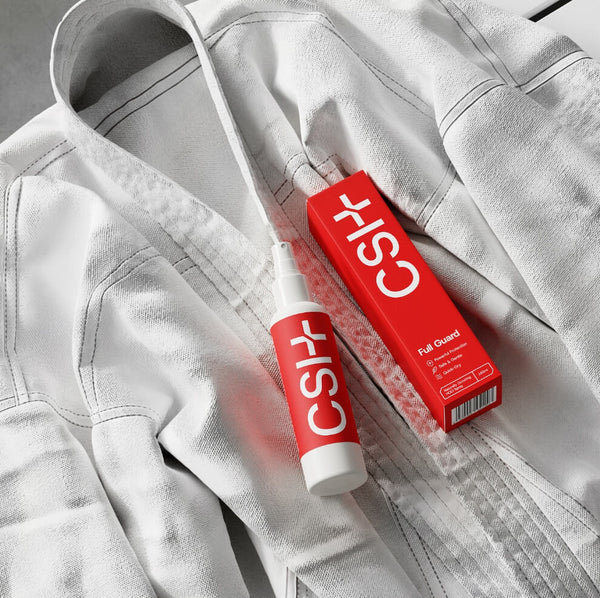
Some kit cannot go through a wash cycle at all. A dedicated hypochlorous acid (HOCl) spray made for gear is a textile and equipment product for exactly those items: pads, gloves, liners and bag interiors. Spray, allow to dry fully, and air the item as usual.
Two things to be clear about. It is not for use on skin: HOCl also appears in skincare products, but those are formulated for a completely different job and the two are not interchangeable in either direction. And it is one step in a routine, not a substitute for one: clean, dry, rotated kit remains the foundation.
Use biocides safely. Always read the label and product information before use.
FAQ
How much will a BJJ gi shrink?
It depends on the weave and whether it was pre-shrunk. Manufacturers rarely publish a figure, and it varies by batch. A reasonable expectation is a small, noticeable change over the first few cold washes on a pre-shrunk gi, and much more on an unshrunk gi or anything that has seen a hot wash and a dryer.
Can I shrink just the trousers and not the jacket?
Yes, and this is a common fix when the jacket fits but the trousers are long. Wash the trousers on their own at 40 degrees, hang dry, and check the length before repeating. Keep the jacket out of it entirely and wash that cold as usual.
Does air drying a gi outside cause shrinkage?
No. Air drying is the safe option. Direct strong sunlight can fade coloured gis and yellow white ones over time, so dry a coloured gi in the shade or indoors if you can.