Drying Training Kit Indoors: Racks, Dehumidifiers and Damp Flats
Educational information only – read the full notice
Share
Between October and March, most of us in the UK have nowhere to dry training kit except indoors. No garden line, no dryer, or a dryer we would rather not put a rashguard through. So the gi goes over the bannister, the shorts go on the radiator, and three days later the whole flat smells faintly of a changing room.
Indoor drying is one of the main reasons kit ends up musty in a British winter. It is also completely fixable, and it does not require an expensive kit list. Here is what actually causes the smell, and what to do about it.
Why indoor drying makes kit smell
Wet fabric is not neutral. After a wash there is still a small amount of moisture, body oil residue and detergent left in the fibres, and synthetic kit holds onto that residue far more stubbornly than cotton does. As long as the fabric stays damp, that residue sits there in a warm, wet environment.
The working guideline I use: if something is taking much more than about a day to dry, treat that as a warning sign rather than a rule about what will happen. Slow drying gives bacteria the time and conditions they need to multiply and produce odour compounds. It tends to be the drying time that does the damage, not the drying method.
That is why the smell often appears in a specific pattern. Cotton tees come out fine. The gi jacket smells at the collar and lapel, where the fabric is thickest and dries last. The rashguard smells at the seams and under the arms. Thick sections dry slowly, and slow-drying sections smell.
A synthetic garment that dried in three hours in July will smell after drying for two days in January, washed at exactly the same temperature with exactly the same detergent. Nothing changed except the drying.
Airflow beats heat, every time
This is the part most people get backwards. They assume the answer is more heat, so they crank the heating and drape everything over the radiators.
Drying is really about moving water out of the fabric and then getting that water out of the room. Heat helps evaporate it. Airflow carries the moist air away and replaces it with drier air. If you only add heat, the water leaves the fabric and then just sits in the room as humidity, and once the air near the garment is saturated, drying effectively stalls.
A cheap desk fan pointed at an airer will usually out-dry a hot radiator in a closed room. Fans draw very little power compared with heating a room. If you buy one thing this winter, buy the fan.
Practical airflow rules:
- Spread it out. A gi jacket folded double over one rail has effectively become one thick garment. Open it, use two rails, hang it on a broad hanger so the sleeves and lapel are exposed.
- Turn things inside out. Rashguards, spats and compression gear dry faster inside out because the seams and gussets get direct air.
- Pick the right rack. A tall three-tier or winged airer beats a flat two-rail one, because vertical space gives you gaps rather than overlaps. If you wash gis, you want rails long enough to take a jacket open rather than folded.
- Put it in the right place. Middle of the room, off external walls, with clear space on all sides so air can circulate around it rather than just over the top.
- Do not cram it. One rack loaded twice dries faster than two loads crammed on at once. Gaps matter more than rail space.
- Spin it properly first. A higher spin on the final cycle removes water mechanically, which is free. Check the care label, but most synthetic training kit tolerates a decent spin well.
Dehumidifiers, heated airers and the radiator myth
For most UK flats, a dehumidifier in a closed room is the setup that works best. It pulls moisture out of the air continuously, which keeps the air near the kit thirsty, which keeps drying going. It also protects the room, which the radiator approach does not. Put the airer and the dehumidifier in the same small room, shut the door, and leave it. Compressor models work well in normal heated rooms; desiccant models cope better in cold, unheated spaces like a utility room or a garage.
A heated airer is the middle ground. It gives gentle warmth across the whole rack rather than a single scorching contact point, and it works far better with the cover on, because the cover traps warm air around the kit and creates a small chimney of rising air. Worth knowing: a heated airer still dumps all that moisture into your room. Pairing one with a dehumidifier, or at least an open window in that room, is the combination that actually works.
Now the radiator myth. Draping kit directly on a radiator feels efficient and is a bad habit for three reasons. It blocks the radiator, so the room heats less well and you use more energy heating the room. The contact side of the fabric gets hot while the outer side stays damp, which is a great way to bake odour into synthetics and stiffen elastic. And every gram of water goes straight into your air. If you insist on using radiator heat, put an airer near the radiator, not on it, so the rising warm air passes through spread-out fabric.
Condensation: the bit nobody warns you about
A wash load releases a significant amount of water into your home as it dries, and doing that four or five times a week for training kit means running a humidifier you did not ask for. In a well-insulated flat with the windows shut, that moisture finds the coldest surface it can and condenses on window reveals, the corner behind the wardrobe, the outside wall of the bedroom. Keep it simple: dry in one room with the door shut, ventilate that room with a window on the trickle vent setting or a dehumidifier running, keep the airer off external walls, and never dry kit in a closed bedroom overnight with no ventilation. If you are getting condensation on the inside of your windows most winter mornings, that is your signal that the moisture has nowhere to go.
Myths and hacks that do not work
Most of the advice floating around either does nothing or actively makes kit worse.
- Fabric softener. It works by coating fibres with a waxy film. On technical fabric that film traps body oil and odour, and it kills the wicking. It is the fastest way to make a rashguard permanently smelly.
- Doubling the detergent. More detergent than the machine can rinse out leaves residue in the fabric. Residue holds oil, oil feeds odour. If anything, use slightly less and run an extra rinse.
- Boil washing synthetics. Elastane does not survive it. You get a stretched, wrecked garment that still smells, because heat alone does not remove the residue causing the smell.
- Washing everything at 90 degrees to fix everything. Same problem, plus shrinkage and colour damage. 30 or 40 degrees with a proper detergent and a good rinse is the standard for training kit, and it is the standard for a reason.
- Neat bleach on technical fabric. It attacks elastic fibres and leaves patchy discolouration. Not a wash additive for kit.
- Tumble drying to bake the smell out. Heat tends to set odour into synthetics rather than remove it. If it smells when it comes out of the machine, it needs rewashing, not drying harder.
The rashguard I forgot about
I once did a Saturday morning session, chucked everything in the bag, and did not open it again until Monday evening because the weekend got away from me. The gi was fine, oddly. The rashguard was not. I washed it, hung it on the airer in a cold hallway, and it felt dry when I grabbed it later that week. It was not dry at the seams, and I found that out about ten minutes into the drive to the gym with the heaters on.
Both halves of that were drying problems. Nothing to do with the detergent. Sorting out how kit gets from wet to dry, and keeping damp kit out of your bag in the first place, fixes more smell issues than any change of washing powder.
Drying kit between two sessions in a day
Lunchtime session, evening session. Six hours. This is where people give up and just put the damp rashguard back on. The order that works:
- Rinse it as soon as you get home, in the sink if necessary. Do not let it dry stiff and then rewet it.
- Towel-roll it. Lay the garment flat on a dry bath towel, roll it up tightly and press down with your bodyweight. Press, do not twist. Wringing is what wrecks elastane.
- Hang it inside out with a fan on it. Not on a radiator. A gi jacket is not drying in six hours whatever you do, so own a second one or plan around it.
If you train twice a day regularly, two of everything synthetic is not indulgent, it is the cheap fix.
Where a gear spray fits
Some things cannot go in a machine at all. Boxing gloves, shin pads, headgear, MMA gloves, the inside of a kit bag, wraps drying on a rack, a grappling mat at home. These are the items that live permanently damp through winter and never get properly cleaned.
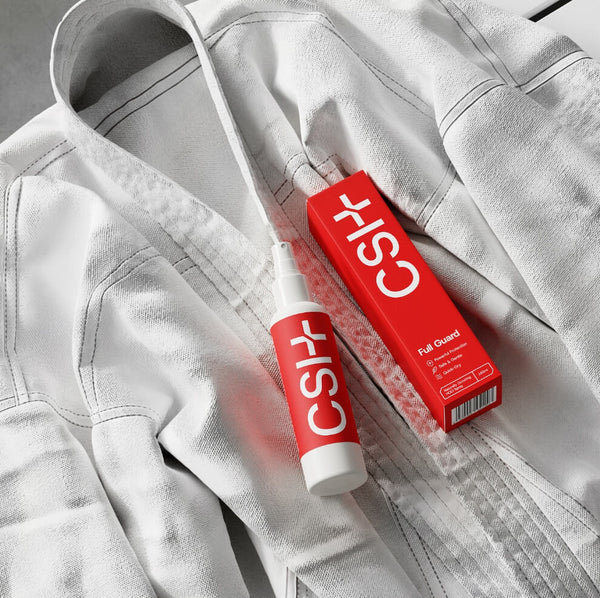
One routine step for that category is an HOCl gear spray formulated for equipment. It is a textile and hard-surface product: you spray it onto pads, gloves, bags and kit that cannot be washed, and you let it dry properly afterwards. That last part is not optional. Spraying gear and then zipping it into a bag defeats the point entirely.
Two things to be clear about. First, this is not a skin product. HOCl also turns up in skincare, but those are different formulations doing a different job, and they are not interchangeable in either direction. Do not put a gear spray on your skin. Second, it is a step in a routine, not a rescue. It does not replace washing what can be washed, and it does not replace drying things properly. If your kit is damp for two days, no spray is going to save it.
If you have any skin problem you are worried about, that is a question for a pharmacist or GP, not a kit spray.
TrueFAQ
How long should training kit take to dry indoors?
A rashguard with decent airflow should be dry in a few hours. A gi will take considerably longer and that is normal, but it should not still be damp at the lapel the following evening. If synthetics are consistently slow, treat that as a problem with your setup rather than the weather.
Is a dehumidifier or a heated airer better for drying kit?
A dehumidifier is better if you can only have one, because it dries the kit and protects the room from condensation at the same time. A heated airer dries kit faster in the short term but pushes all that moisture into your home. The two together, in a small room with the door shut, is the best setup most UK flats can manage.
My kit still smells after washing. Is that a drying problem?
Often, yes, but check the sequence. If it smells the moment it comes out of the drum, it is a wash problem: residue build-up, an overloaded machine, or fabric softener. If it comes out fine and smells once dry, or only smells once it warms up on your body, it is almost always drying too slowly. Rewash it, then dry it fast with airflow and see which one it was.
Use biocides safely. Always read the label and product information before use.