Neutral-Charge Advantage: HOCl vs Bleach
Educational information only – read the full notice
One of the most common worries people have about hypochlorous acid is "isn't that basically bleach?" It's an understandable question, since they're chemical cousins. But the differences between them are large, and they come down to two things: pH and electrical charge. Get those, and you understand why one belongs in a skin mist and the other under your kitchen sink.
Plain-English chemistry, fact-checked with our medical team.
Same family, different behaviour
Household bleach is sodium hypochlorite. Dissolve it in water and it's strongly alkaline (high pH), and its active component exists largely as the hypochlorite ion, OCl-, which carries a negative charge. Hypochlorous acid, HOCl, is the near-neutral-pH form, and the molecule itself carries no net charge. Which form you get is set by pH, the subject of the pH tightrope.
Is Bleach Acidic, Alkaline or pH Neutral?
Household bleach is strongly alkaline. It sits right up at the alkaline end of the pH scale, which is part of why it's so harsh on skin.
This is also where the phrase "neutral charge" in the title of this article trips people up. They're two completely different ideas:
| Term | What it describes | HOCl | Household bleach |
|---|---|---|---|
| pH | How acidic or alkaline a liquid is, from 0 (very acidic) through 7 (neutral) to 14 (very alkaline) | Skin-friendly HOCl products are kept mildly acidic. Full Guard, for example, is pH 5.5 to 6.5. | Strongly alkaline |
| Charge | Whether a molecule carries an electrical charge | The HOCl molecule has no overall charge | The active part, the hypochlorite ion, carries a negative charge |
So "neutral charge" is about the HOCl molecule itself. It doesn't mean the product has a neutral pH, and it certainly doesn't mean bleach is neutral.
The pH scale in everyday terms:
| pH | Where it sits | Everyday example |
|---|---|---|
| 1 to 3 | Strongly acidic | Stomach acid, lemon juice |
| 4 to 6 | Mildly acidic | Healthy skin's surface, black coffee |
| 7 | Neutral | Pure water |
| 8 to 10 | Mildly alkaline | Baking soda solution, most bar soaps |
| 11 to 14 | Strongly alkaline | Household bleach, oven cleaner |
Hypochlorous Acid, Hypochlorite and Sodium Hypochlorite: Three Names Explained
These three names cause most of the "isn't that just bleach?" confusion. They're closely related, and pH decides which one you actually have.
| Name | Formula | What it is | Where you meet it |
|---|---|---|---|
| Hypochlorous acid | HOCl | An uncharged molecule and a weak acid | HOCl skincare mists, and made naturally by white blood cells |
| Hypochlorite ion | OCl- | What HOCl turns into as a solution gets more alkaline | The main active form in bleach |
| Sodium hypochlorite | NaOCl | A salt that dissolves in water to release hypochlorite | Sold as household bleach |
How pH links them: in a mildly acidic solution, almost all of it stays as HOCl. As the pH climbs past about 7.5, more and more of it becomes the hypochlorite ion. At bleach's strongly alkaline pH, hypochlorite dominates. Same chemical family, very different behaviour on your skin.


Why neutral charge matters
Here's the elegant bit of physics. Many surfaces, including a lot of cell surfaces, carry a slight negative charge. A negatively charged hypochlorite ion is electrically repelled by them (like poles of a magnet pushing apart). A neutral HOCl molecule isn't repelled in the same way, so it moves more freely. Same chemical family, very different approach.
Add the pH difference, skin-friendly neutral versus harsh alkaline, and you can see why HOCl suits skin while bleach absolutely does not. They are not interchangeable.
Why the confusion is so common
The "isn't it just bleach?" worry is understandable, because the two genuinely are chemically related, being part of the same family, built from the same elements, and even share a faint pool-like smell. If you only looked at the raw ingredients on paper, you might lump them together. But chemistry is full of cases where closely related substances behave completely differently depending on their exact form, and this is one of the clearest examples. The same building blocks, arranged and balanced differently, give you either a harsh industrial cleaner or a gentle skin-friendly mist. The family resemblance is real; the behaviour could hardly be more different.
The charge story in a bit more depth
The electrical-charge point is the elegant bit, so it's worth lingering on. Many biological surfaces carry a slight negative charge. A negatively charged hypochlorite ion, the active form in alkaline bleach, is therefore electrically pushed away from those surfaces, like two magnets repelling. A neutral hypochlorous acid molecule carries no such charge, so it isn't repelled in the same way and can approach far more freely. Same chemical family, but one form is fighting an electrostatic headwind and the other isn't. Pair that with the pH difference, skin-friendly neutral versus harsh alkaline, and you can see these aren't interchangeable substances that happen to differ in strength; they behave differently at a fundamental level.
Using each safely
The practical upshot is simple and worth being firm about. Household bleach is a powerful cleaner for surfaces, used with ventilation and care, and kept well away from skin. Hypochlorous acid, at cosmetic strength, is formulated to be gentle on skin. They live in different worlds and shouldn't be swapped: you don't put bleach on your skin, and you don't expect a gentle skin mist to do an industrial cleaning job. Respecting that boundary is partly why understanding the chemistry matters. It stops people doing daft, potentially harmful things like diluting bleach as a "cheap" skin product.
Is Hypochlorous Acid Stronger Than Bleach? Will It Bleach Your Clothes?
"Stronger" depends on what you mean.
| If you mean | The answer |
|---|---|
| Concentration | Household bleach is far more concentrated. It's usually sold at a few percent strength. A 200ppm HOCl mist is 0.02%. |
| Chemical reactivity, molecule for molecule | In chemistry terms, the uncharged HOCl molecule is the more reactive of the two forms |
| Harshness on skin | Bleach, by a long way. It's strongly alkaline and far more concentrated. |
Will it bleach clothes? Hypochlorous acid is an oxidiser, like bleach. But skincare mists are so much more dilute that they're far less likely to mark fabric the way household bleach does. It's still sensible to:
- Let the mist dry on your skin before pulling on dark or brightly coloured kit.
- Avoid spraying directly onto coloured fabric, especially delicate or vintage items.
- If you want to use it on kit, test a hidden area first.
The takeaway
Strip it all back and the message is this: hypochlorous acid and bleach are chemical cousins that behave like strangers. pH and charge, not some exotic added ingredient, are what separate a gentle, skin-friendly molecule from a harsh household cleaner. So the honest answer to "isn't it just bleach?" is a clear no. It's a related but genuinely different substance, which is exactly why one belongs in a skin mist and the other under the sink. Understanding that is the best defence against both the hype and the lazy dismissals you'll hear about HOCl.
One last myth to bust
There's a persistent half-truth worth tackling head-on: "they're basically the same thing, just different strengths." It's the kind of line that sounds plausible and is completely wrong. Strength, or concentration, is a real variable, but it's not what separates hypochlorous acid from bleach. You could dilute household bleach all day and it would still be alkaline sodium hypochlorite, with its negatively charged active form and its harsh, skin-unfriendly nature. Diluting it doesn't turn it into gentle, neutral HOCl; it just makes weak bleach. What actually distinguishes the two is the pH window the solution sits in and the resulting form of the molecule: a difference of chemistry, not dilution. That's why the home "life hack" of watering down bleach as a cheap skin or face product is genuinely a bad idea: you're not making a budget version of a gentle mist, you're putting weak bleach on your skin. Understanding that one point, that it's pH and form, not strength, that matter, inoculates you against a surprising amount of nonsense online. Hypochlorous acid earns its gentleness through its chemistry, and no amount of diluting bleach will replicate it. When you see the two treated as interchangeable, you can now confidently file that under "things people say that aren't true," and reach for a properly made HOCl product rather than improvising with the wrong chemical entirely.
FAQ
So can I just dilute bleach instead?
No. Diluted bleach is still alkaline sodium hypochlorite, not skin-friendly HOCl. pH and charge make them genuinely different things. Don't put bleach on your skin.
Why does my HOCl product smell faintly like a pool?
That faint chlorine-family note is normal for the chemistry and fades as the product is used and ages. See shelf life.
Is "no charge" why it feels so mild?
The mildness owes more to the near-neutral pH, but the neutral charge is part of what makes HOCl behave so differently to its harsh cousin.
Keep reading
- The pH tightrope: what keeps HOCl stable.
- How hypochlorous acid works.
- Shelf life.
Related reading: why hypochlorous acid behaves differently from a single-target drug.

Our HOCl mist
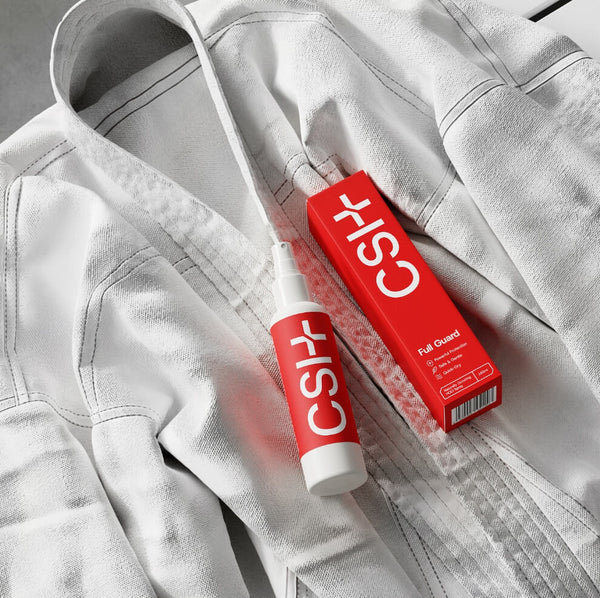
Full Guard Hypochlorous Acid Spray
An ultra-pure, fragrance-free HOCl mist made in the UK. Rinse-free, no alcohol and no sting, it dries in a minute or two and leaves skin feeling clean and fresh, the perfect freshen-up when a shower isn't happening yet.
- 95% pure hypochlorous acid, skin-friendly pH 5.5-6.5
- Fragrance-free and non-stripping, kind to sensitive skin
- Rinse-free, dries fast, fits any bag or desk drawer
- UK-made to ISO 22716 (GMP) standards
Want the full picture on Full Guard? See what makes our hypochlorous acid spray different, for sport and for skin.
Full Guard is a cosmetic skin cleansing spray registered under the UK Cosmetic Products Regulation. It is not intended to treat, cure, prevent or diagnose any skin condition. For any active skin concern, consult a GP, dermatologist or pharmacist.
Keep reading
- How hypochlorous acid works - the neutral-charge science, explained properly.
- Electrolysed water 101 - brine, electricity and where HOCl actually comes from.
- Is hypochlorous acid safe? - why the bleach comparison worries people, answered.