Shin Guards, Thai Pads and Focus Mitts: Cleaning Foam and Synthetic Leather
Educational information only – read the full notice
Shin guards and pads are the worst offenders in most gym bags. They soak up sweat, they never get washed properly, and unlike a rashguard you cannot just chuck them in the machine on a Sunday night. So they get shoved back in the bag damp, and by Wednesday the whole changing room knows about it.
The good news is that foam and synthetic leather are not difficult to look after. They just need a different method to fabric. Here is what actually works, what wrecks your kit, and how to keep club pads from turning feral.
Why foam cannot be soaked
Almost every shin guard, Thai pad and focus mitt is built the same way: a foam core wrapped in a synthetic leather or cloth shell, stitched together. The shell is waterproof-ish. The foam is not. It is a sponge.
Once water gets past the seams and into that core, it has nowhere to go. Foam has no airflow through the middle, so it stays wet for days. That is the point where a pad starts to smell permanently rather than temporarily, and where the foam itself starts to break down and go soft and lumpy.
This is also why a pad that has been through a washing machine often comes out heavier than it went in and never quite recovers. Water is driven through the stitching under pressure, and the spin cycle pulls the core out of shape.
So the rule for anything with a foam core: clean the surface, never submerge the item.
Cleaning synthetic leather without cracking it
Synthetic leather, the vinyl or PU shell on most pads and mitts, hates two things: heat and harsh solvents. Both attack the coating, and on vinyl they strip out the plasticisers that keep it flexible. Once that happens the surface goes stiff, then it crazes, then it flakes off in little grey bits all over the mats.
What to do instead:
- Wipe down with a cloth wrung out in warm water and a little washing up liquid or a mild detergent solution. Damp, not dripping.
- Work the seams and the stitching with a soft brush. That is where the sweat salts collect.
- Go over it a second time with a cloth wrung out in plain water to lift the detergent residue off. Leftover detergent on vinyl attracts dirt and feels tacky.
- Wipe dry with a towel, then air dry properly.
What to avoid on the shell: neat bleach, acetone, methylated spirits, oven cleaner, antibacterial wipes with high alcohol content used daily, and anything abrasive. A one-off wipe with a household disinfectant will not destroy a pad, but making it your routine will dry the surface out fast.

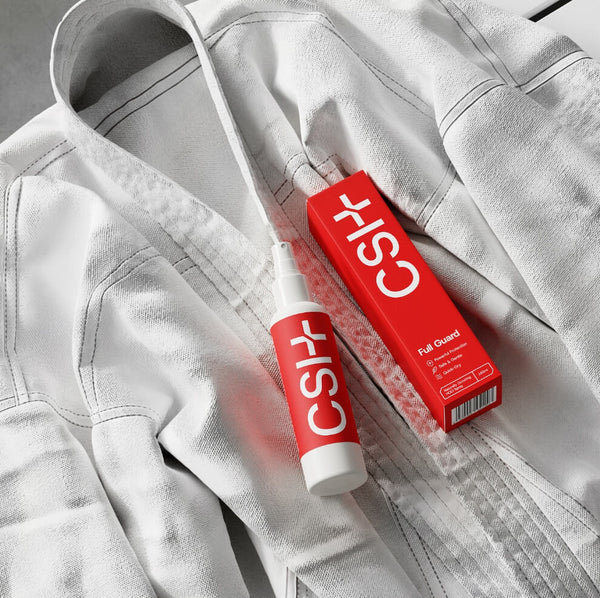
Gear Guard: the spray built for the kit that can't be washed
Kills 99.999% of bacteria and 99.99% of fungi in 60 seconds, tested to BS EN standards. No fragrance, no residue, kind to leather and foam. 100ml, UK made, £16.49.
Cloth shin guards versus synthetic leather ones
These are two different jobs and people get it wrong constantly.
Cloth or neoprene shin guards, the slip-on Muay Thai style ones and most MMA compression guards, are usually a foam or gel insert inside a fabric sleeve. Check the label first, but many can be hand washed in cool water, squeezed gently and dried flat. Never wring them out, because that is what folds and cracks the insert. Some have a removable insert, which makes life easy: pull it out, wash the sleeve at 30 degrees in a mesh bag, wipe the insert.
Synthetic leather shin guards, the strapped Thai style with a hard front, get the surface wipe described above and nothing else. No machine, no bucket, no soak. Pay attention to the inside face, because that is the bit that sits against your skin and takes the sweat, and it is usually a softer lining that holds odour longer than the outer.
Hook and loop straps deserve a mention. They fill up with lint and hair and stop gripping, and dirty hook and loop then chews up everyone's gi and rashguards. Pick them out with an old toothbrush or a comb every few weeks.
How to Clean Shin Guards, Step by Step
This works for Muay Thai, MMA and kickboxing shin guards. The two jobs people skip are the ones that matter most: the quick wipe after every session, and drying them properly.
After every session (2 minutes)
- Get them out of the bag as soon as you're home. Don't leave them zipped in overnight.
- Undo the straps and open them right up, so the inside can breathe.
- Wipe inside and out with a cloth dampened with warm water and a small amount of mild soap.
- Wipe again with a clean damp cloth to take the soap off.
- Towel off the excess, then leave them to air-dry, open, somewhere with airflow.
Once a week (10 minutes)
- Clean the straps and Velcro with a soft brush to lift the sweat, lint and skin that build up in the hooks.
- Give the inside padding a more thorough wipe, paying attention to the seams where sweat collects.
- Wash any removable sleeves or liners with your training kit.
- Check for cracks, splits or peeling, because damaged covers trap sweat and are harder to keep clean.
Deep clean (when they start to smell)
- Never soak foam-filled guards. Water gets into the foam and doesn't come out.
- Work around the inside with a barely damp cloth and mild soap, section by section.
- Wipe off with clean water, then towel dry.
- Dry fully before the next use, which can take a day. Stuff them loosely with newspaper to speed it up.
Drying rules: air and airflow, yes. Radiators, tumble dryers and direct sun, no: heat cracks synthetic leather and warps foam.
Myths and hacks that do not work
There is a lot of confident nonsense in gym WhatsApp groups. Some corrections:
- Freezing kit kills the smell. Popular and wrong. Cold slows bacteria down, it does not remove the sweat residue and oils they feed on. Thaw it out and the smell walks back in.
- Boil wash it to fix everything. A 90 degree wash destroys elastane and shrinks anything with a synthetic content. On a pad it will melt or warp the shell outright.
- Tumble dry it to bake the smell out. Heat sets odour rather than removing it, and it is brutal on elastic and on synthetic leather, which crazes and cracks.
- Leave it in vinegar for a few days. A vinegar soak has its uses on cotton, but on foam all you are doing is leaving the core saturated for days, which is exactly what you are trying to avoid.
- Spray deodorant or aftershave on it. You are layering fragrance over the residue. Everyone can tell.
Two more worth naming, for the fabric half of your bag: fabric softener leaves a waxy coating on fibres that traps odour, and doubling the detergent just leaves residue behind that feeds the next round of smell. Neither belongs anywhere near pads either.
Where a HOCl gear spray fits
For kit that cannot go in a machine, a HOCl gear spray is one product category worth knowing about. This is a textile and equipment product category: pads, mitts, guards, bags, benches, mat edges, hard surfaces.
Two things to be clear about. First, these are gear products and are not for use on skin. HOCl also turns up in skincare, but those are different products formulated for a different job, and they are not interchangeable with a gear spray. Second, it is a step in a routine, not a substitute for one. Wipe the pad down, then treat it, then dry it properly. Spraying anything onto a pad you never actually clean just gets you damp dirty foam.
If you have a skin issue of any kind, that is a conversation for a pharmacist or GP, not something to solve with a kit spray.
Use biocides safely. Always read the label and product information before use.
Drying, properly
Drying is where most people lose. A pad that is clean but still damp will smell.
- Get kit out of the bag the moment you are home. Not later.
- Air dry at room temperature with airflow around all sides. Stand shin guards on end, hang mitts by the straps, prop pads open rather than stacking them flat.
- No radiators, no hairdryers, no airing cupboard blast, no direct sun for long periods. Heat is what cracks synthetic leather.
- Allow longer than you think. Foam can take a full day or more.
- For anything that does go in the machine, wash at 30 or 40 degrees and get it out of the drum as soon as the cycle ends. Kit left sitting in a warm damp drum for hours is a very common cause of the wash-it-and-it-still-stinks problem.
I learned the foam version of this the hard way with a pair of Thai pads. Held for an hour of heavy rounds on a Thursday, wiped over quickly, then racked face to face against the wall because I was in a rush and they looked fine. Pulled them off the rack the following Tuesday and the inside faces were still faintly cool to the touch. They never smelled right again, and the whole rack got the blame for weeks.
Can You Put Shin Guards in the Washing Machine? By Type
It depends entirely on what they're made of. Always check the care label first. If there isn't one, go by the table below.
| Type of shin guard | Washing machine? | How to clean it instead |
|---|---|---|
| Cloth or fabric sleeve guards (elasticated, slip-on, thin padding) | Usually yes: cool wash, in a laundry bag, air-dry | Follow the care label |
| Synthetic leather Muay Thai or kickboxing guards | No | Wipe with a damp cloth and mild soap, then air-dry |
| Real leather guards | No | Damp cloth only, and dry slowly away from heat |
| Foam-filled MMA hybrid guards | No | Wipe clean, never soak |
| Football shin pads with a hard shell | The shell, no. Fabric sleeves and ankle guards, often yes. | Hand wash the shell, and machine wash the sleeves if the label allows |
| Removable liners and sleeves | Usually yes | Wash with your training kit |
Why the machine is a bad idea for padded guards: the foam soaks up water it can't release, it stays damp inside for days, and that's exactly how a smell sets in for good. The spin cycle can also crack shells and tear the stitching.
How to Clean Football Shin Pads
Football shin pads (the UK name for what the US calls soccer shin guards) are a different design from combat sports guards, and easier to keep fresh.
| Part | How often | How |
|---|---|---|
| Hard plastic shell | After every match or session | Rinse or wipe with warm soapy water, rinse, and air-dry |
| Foam backing | Weekly | Wipe with a damp soapy cloth. Don't soak it. |
| Slip-in sleeve or compression sock | After every use | Machine wash with your kit, if the label allows |
| Attached ankle guards (stirrup pads) | Weekly | Hand wash, or machine wash in a bag if the label allows |
For parents: the single most useful habit is getting pads out of the kit bag the same day. A pair of pads left in a closed bag from Saturday morning to Tuesday training is where the smell comes from. Open them up, wipe them, and leave them out to dry overnight.
Club pads and the rota problem
Shared pads are a different beast because nobody owns them, so nobody cleans them. The fix is boring and it works: put a name against it.
- Assign the wipe down to whoever is on mat duty that night, same as sweeping.
- Keep a bottle and a stack of cloths on the wall by the pad rack. If people have to go looking, it does not happen.
- Rotate stock, so the same few pairs are not used every session while another set sits in a cupboard.
- Never rack pads face to face while they are still warm and damp.
- Retire pads that have split. Once the shell is open, the foam is exposed and you cannot clean it.
The same principle applies across every bit of communal kit in a gym, and it is worth reading up on how shared club equipment should be handled generally.
The purpose-built option
Foam and synthetic leather are exactly what Gear Guard is kind to: no alcohol to dry them out, no bleach to discolour them. Spray, wait a minute, wipe, air dry. The full method and comparison is on the Gear Guard guide page.
FAQ
Can I put shin guards in the washing machine?
Cloth or neoprene guards often can, at 30 degrees in a mesh bag, if the label allows it. Synthetic leather guards with a solid foam core should never go in. The core soaks up water it cannot release, and the spin cycle leaves it misshapen.
How often should Thai pads and focus mitts be cleaned?
A quick wipe after every session is the habit that matters more than anything else, and it takes seconds. A more thorough clean of the seams and lining every couple of weeks is sensible for personal pads, and more often for club stock in heavy use.
My pads already smell bad. Is it too late?
Usually not, but there is no quick fix. Clean the surface and seams properly, then let them dry fully with airflow, which may take a couple of days. Repeat that rather than escalating to harsher chemicals. If the shell has split and the foam has been sitting wet inside for months, the pad is done.

For the gear that can't be washed
Gear Guard Equipment Cleaner Spray
A targeted HOCl surface spray for the kit no washing machine can help: gloves, pads, headgear, boots and bag linings. Spray until visibly wet, wait 60 seconds, wipe, and let it air dry.
- Independently tested surface biocide (BS EN 13727, BS EN 1650)
- One-minute contact time, then wipe and air dry
- No fragrance, dries clear, nothing left behind once dry
- 100ml fine mist, hundreds of targeted sprays, UK-made
Use biocides safely. Always read the label and product information before use. Gear Guard is for equipment, not skin. Fabric kit goes in the washing machine.