How to Wash Boxing Hand Wraps (and Stop Them Going Stiff)
Educational information only – read the full notice
Hand wraps are the dirtiest thing in your bag and the thing you clean least. They sit between your sweat and the inside of a glove for an hour, they come off soaked, and then most people ball them up and throw them back in the same bag they came out of.
Do that a few times and you get the classic set: stiff as cardboard, grey where they used to be black, and carrying a smell that survives a wash. This is how to fix that, and how to keep it from happening again.
Why wraps go stiff and grey in the first place
Two things are happening. The first is salt and body oils drying into the cotton. Sweat is not just water, and when the water evaporates the rest stays behind. That residue is what makes an unwashed wrap feel like it has been starched.
The second is the residue you add yourself. Fabric softener and too much detergent leave a film in the weave. That film holds onto odour and stops the cotton drying out cleanly.
On dark wraps, the greying is a mix of dye loss from repeated washing and a pale layer of detergent and sweat salts sitting on the surface of the fibres. Add glove dye transfer and gym dust on top of that. Wraps are thin and porous, so they show all of it faster than anything else you own.
The actual washing routine
Unroll them the moment you finish
This is the single highest value habit. Do not roll a wet wrap back up. A rolled wrap dries from the outside in and the core stays damp for hours, which is exactly the condition that makes a bag smell.
Unroll them, drape them over the outside of your bag or hang them on the handle for the walk to the car, and get them out of the bag entirely when you get home.
Use a wash bag, or fasten them
Loose wraps in a drum will find every other item and wrap around it. You will pull out a knotted rope of wrap, sock and t-shirt, and the middle of that knot never gets properly washed or rinsed.
Roll each wrap loosely, fasten the hook and loop to itself, and put the pair in a mesh laundry bag. That fastening matters as much as the bag: unfastened hook and loop shreds technical fabric and picks up lint that then lives on your wraps forever.
Machine wash at 30 or 40 degrees
A normal 40 degree cottons wash with a normal dose of detergent does the job on cotton wraps. If your wraps have elastic in them, and most modern ones do, 30 degrees is the safer default and will still clean them. If you run everything at 30, add an extra rinse rather than raising the temperature.
Wash them with t-shirts, shorts and other training kit rather than on their own, because a nearly empty drum gives you poor mechanical action. Keep them out of towel loads, because towels shed more lint than anything else in the house. Do not wash wraps with anything that has hooks, zips or hard trims.
Hand washing works fine
If you only own one pair and you train tomorrow, hand washing is quicker overall. Warm water, a small amount of detergent, work them through with your hands for a minute or two, then rinse until the water runs clear and there is no slipperiness left on the fabric.
Squeeze the water out. Do not wring hard, especially on wraps with elastic, because twisting them tight is what turns a stretchy wrap into a loose one.
Air dry, always
Hang them full length. Over a door, over the shower rail, on an airer, anywhere with air moving. A wrap that dries flat and fully dries soft. A wrap that dries in a heap dries stiff.
Get them out of the machine as soon as the cycle ends. Kit left sitting in a warm damp drum for a few hours picks up that flat musty smell, and once it is in there you are washing again.
Myths and hacks that do not work
Fabric softener. It seems like the obvious answer to stiffness and it is the exact wrong move. Softener works by coating fibres, and that coating is what traps odour and stops the wrap absorbing sweat properly. Skip it entirely on all training kit.
Doubling the detergent. More detergent than the machine can rinse out means residue, and residue holds sweat and moisture in the weave, which is what the smell comes back from. If your kit smells, the answer is usually a better rinse, not a bigger dose.
Boil washing or 90 degrees to fix everything. It wrecks the garment. Any elastane in a wrap will be destroyed, and it accelerates the fading and fraying on the cotton. You are trading a smell problem for a bin problem.
Neat bleach. On technical fabric it damages the fibres and can leave wraps weak, patchy and discoloured. It is not a shortcut to white.
Tumble drying to bake the smell out. Heat sets odour into fabric rather than removing it. If a wrap comes out of the wash still smelling and you tumble it, you have just made that smell permanent.
Freezing kit. Popular advice, does not work. Cold does not remove the residue that causes the smell, and once the item warms up you are back where you started.
Spraying deodorant or aftershave on kit. You get gym smell plus aftershave, which is worse than either on its own, and the alcohol and oils build up in the weave.
Soaking in vinegar for days. A short vinegar rinse is harmless on its own, but never use vinegar in the same wash, soak or spray as bleach or any chlorine product. Leaving wraps sitting in acid for days does not add anything either, and it can degrade elastic. There is no long soak that substitutes for actually washing them.
Where a HOCl gear spray fits
Some kit cannot go in a machine at all. Pads, guards, bags and hard surfaces are where a dedicated gear spray is used instead of a wash cycle.
It is a textile and equipment product. You would use a HOCl gear spray made for gear on things like the inside of a kit bag, pads, shin guards, headgear straps, equipment cases and kit shelves, and on kit bags and equipment as part of the between-sessions routine. It is not a replacement for washing. It is a step in a routine that already includes washing and drying properly.
Two things worth being clear about. This category is for fabric, kit and hard surfaces, never for use on skin. And although you may have seen HOCl mentioned in skincare, those are entirely different products formulated for a different job. They are not interchangeable, and you should not treat one as a substitute for the other.
For your hands themselves, that is a separate routine. Once the wraps come off, hand and skin hygiene after wraps come off is where to look.
True
How many pairs you need
Three pairs is the honest answer for anyone training two or three times a week. One in use, one drying, one clean and in the bag. Two pairs works but leaves you with no margin when you train back to back nights or forget a wash.
When to bin them
Wraps do not last forever. Replace them when the elastic has gone and they no longer tension when you wrap, when the fabric has thinned enough to see through, when the hook and loop no longer holds through a round on the bag, or when they still smell straight out of a proper wash and a full dry.
That last one is the real test. If a wrap comes out clean, dries fully, and still smells within an hour of being on your hand, the residue is in the fibres and it is not coming out.
The bag is usually the real problem
I once spent a fortnight convinced my gi was faulty. Washed it, aired it, washed it again on a longer cycle, and it kept coming back with that damp cupboard note by the time I got to the mats. Then I emptied the bag properly and found a rashguard that had been sat in the bottom corner since the previous month, half wrapped around a water bottle. The gi was fine. The bag was the problem, and it was putting the smell straight back into everything I put in it, including a pair of wraps that had come out of the machine clean that morning and smelled like the bag by the time I unrolled them.
Empty your bag every single time. Leave it open to dry.
FAQ
Can I wash hand wraps with the rest of my normal laundry?
Yes, as long as they are fastened and in a mesh bag, and as long as nothing in the load has hooks or zips. Keep them out of loads with heavy dye transfer risk, like new dark denim, and do not add fabric softener to any load your training kit is in.
Does an extra rinse actually do anything?
It is the one setting worth using on training kit. A rinse cycle is plain water and agitation, so it pulls out detergent and dissolved sweat salts that the main wash loosened but never fully carried away, particularly on a short cycle or a full drum. Run a normal detergent dose plus an extra rinse, then a full air dry. Give that two or three goes. If the smell is still there on the third attempt, more rinsing will not save them.
How often should hand wraps be washed?
Every session. There is no version of this where a used wrap goes back in the bag and comes out fine. If washing after every session is not realistic, that is the argument for owning a third pair rather than the argument for skipping a wash.
Use biocides safely. Always read the label and product information before use.
Wraps go in the wash. The gloves they spend their life inside can't, and that is a job for an equipment spray rather than a washing machine.

For the gear that can't be washed
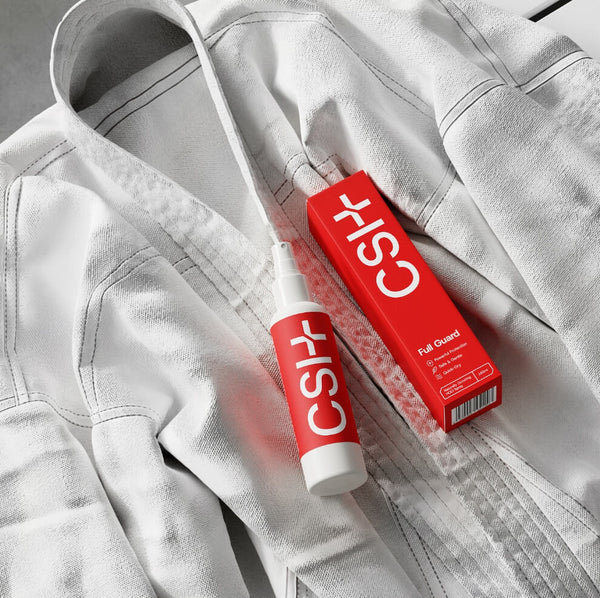
Gear Guard Equipment Cleaner Spray
A targeted HOCl surface spray for the kit no washing machine can help: gloves, pads, headgear, boots and bag linings. Spray until visibly wet, wait 60 seconds, wipe, and let it air dry.
- Independently tested surface biocide (BS EN 13727, BS EN 1650)
- One-minute contact time, then wipe and air dry
- No fragrance, dries clear, nothing left behind once dry
- 100ml fine mist, hundreds of targeted sprays, UK-made
Use biocides safely. Always read the label and product information before use. Gear Guard is for equipment, not skin. Fabric kit goes in the washing machine.