How to Wash a Microfibre Training Towel (and Why It Stops Absorbing)
Educational information only – read the full notice
Share
Your microfibre training towel used to pull sweat off you in one pass. Now it skids across your back and leaves you damp. Nothing is wrong with the towel itself. Something is sitting on top of it.
It is fixable, and it is almost always about how the towel is washed rather than how old it is. Here is what is happening in the fibres, how to wash a quick-dry towel properly, how to strip one that has gone bad, and when to give up on it.
Why microfibre stops absorbing
Microfibre is not absorbent the way cotton is. Cotton soaks water into the fibre itself. Microfibre works by structure: the filaments are split into wedge shapes, and the tiny channels between them pull water in by capillary action. That is also why it dries so fast.
Anything that fills those channels kills the effect. The two main culprits:
- Fabric softener. Softener works by depositing a thin waxy, water-repellent layer on fibres so they feel slick. On a bath towel that is already a bad idea. On microfibre it is close to a death sentence, because the coating blocks the capillary channels completely.
- Detergent residue. Too much detergent, or detergent that never fully rinses out, leaves a film that does the same job more slowly. Add hard water minerals and you get a stiff, greasy towel that repels water instead of drinking it.
Body oils, moisturiser and hair products contribute too. They go in with the sweat, and if the wash is too cool or too crowded, some of it stays there.
The tell is simple. This is the drip test, referred to throughout this article. Drip water onto a dry patch. If it beads or sits there before slowly sinking in, the towel is coated. If it vanishes on contact, the towel is fine.
A training towel is not a bath towel
A bath towel is cotton and meets a clean body in a warm room, so it tolerates hot washes and tumble drying. A training towel meets sweat, mat grime, chalk and tape residue, then gets stuffed damp into a bag. That soil load is largely protein and oil, and most training towels are polyester and polyamide with a little elastane in the hem. Those fibres deform with heat, and heat sets odour into synthetics rather than removing it.
Whether a towel should be shared is a separate question, covered in towel and equipment hygiene for shared spaces.
Myths and hacks that do not work
Fabric softener to make it feel nicer. No. It is the main cause of the problem you are trying to solve. It traps odour compounds in the coating, so the towel smells fine in the cupboard and terrible ten minutes into a session. Dryer sheets are the same coating, different delivery.
Boil washing to fix everything. A 90 degree wash will not save a synthetic towel, it will wreck it. Elastane loses recovery well below that, polyester goes limp, and bonded seams and printed logos give up. You lose the towel and keep the smell.
Doubling the detergent. This is the most common self-inflicted wound. Excess detergent does not rinse out, and the residue holds oils and soil that odour-causing bacteria live in. More detergent usually means more smell over time, not less.
Neat bleach. Chlorine bleach straight onto technical fabric attacks elastane and yellows polyester, and does nothing about residue.
Freezing kit overnight. Popular and useless. Cold slows bacteria down, it does not remove the oils and residue they are living in. Everything wakes up when it warms up.
Tumble drying to bake the smell out. Heat sets odour into synthetics. It also glazes and flattens the finer filaments in microfibre and makes the towel permanently less absorbent.
Spraying deodorant or aftershave on kit. You are adding oil and fragrance to a fibre that is already clogged. It buys twenty minutes and makes the next wash harder.
Soaking in vinegar for days. A short vinegar rinse has a real job, breaking down alkaline detergent and mineral residue. Days of soaking does not double the effect, it just gives bacteria a warm wet home and can degrade elastic.
How to wash a microfibre training towel properly
- Get it out of the bag the same day. Hang it to dry if you cannot wash it immediately. Damp and sealed is where the damage happens.
- Wash it with like fabrics. Microfibre grabs lint from cotton and holds onto it. Keep towels, rashguards and synthetic kit together.
- 30 to 40 degrees, on a normal cycle, not a delicate one. Delicate cycles use less mechanical action and more water, the wrong trade for greasy soil. You need agitation. There is more in our guide to wash temperature and sports fabric.
- Use less detergent than the cap says. Roughly half a normal dose for a load of synthetics. Liquid rather than powder, and skip anything with conditioner or softening built in.
- Add an extra rinse. The highest value setting on your machine for technical kit, and what actually gets the residue out.
- No softener. No dryer sheets.
- Take it out of the drum straight away. An hour sitting in a warm wet drum undoes a good wash.
- Air dry, always, ideally with airflow around it. Not in a tight ball on a radiator, not draped over a bag.
Stripping a towel that has already stopped absorbing
If the drip test fails, do a reset wash. Run the towel on its own at 40 degrees with no detergent, and put around 100ml of white vinegar in the softener drawer so it goes in at the rinse. That first wash will often foam, which tells you how much soap was in there.
Repeat only while it is still foaming, and stop at no more than two or three cycles. Keep this as an occasional reset, not a routine step: some machine manufacturers advise against repeated acid cycles because of the effect on seals and hoses. Do not mix it with bleach. Dry the towel and test again.
A towel that still repels water after two strip washes is coated beyond recovery.
Where a gear spray fits in
Machine washing solves the towel. It does not solve the shin pads, headguards, gloves, mouthguard cases, mat shoes and the bag itself, none of which go through a wash cycle.
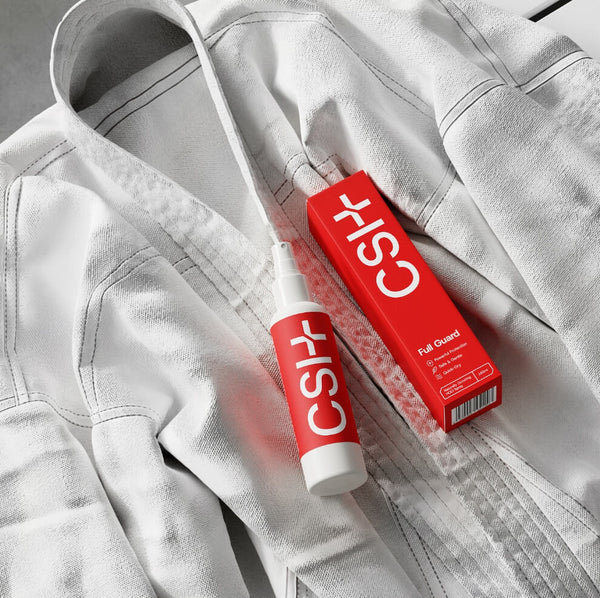
That is the gap a dedicated gear spray is aimed at. A hypochlorous acid gear spray is a product category formulated for textiles, pads, hard surfaces and bag interiors, used as a between-sessions step alongside normal washing rather than in place of it. Use biocides safely. Always read the label and product information before use.
Two things to be clear about. This category is for kit and surfaces, never for use on skin. And you will also see hypochlorous acid in skincare products: different formulations for a different job, not interchangeable in either direction.
I learned the drying part the honest way. I once left a full bag in the boot from Friday night until Monday evening in the summer. The gi survived a wash. The bag never really recovered, and for weeks people would sniff, look around the changing room, and quietly work out whose it was. That bag was famous.
How often to replace a training towel
A microfibre towel washed correctly will last years. What kills them is not use, it is heat and softener.
Replace it when it still fails the drip test after two strip washes, when the surface has gone shiny and slick where it used to have a slight cling, or when it has visibly glazed or hardened patches from a dryer or radiator. Smell returning within one session of a proper wash is a fair signal too.
If you train most days, two towels in rotation beats one expensive one. Nothing ruins a towel faster than needing it before it has dried.
FAQ
Can I wash my microfibre towel with my gi?
Better not to. A cotton gi sheds a lot of lint and microfibre is very good at collecting it, which is another way to clog the surface. Keep synthetics and cotton separate.
Does a vinegar rinse damage the towel?
A short rinse-cycle dose is fine and genuinely useful for cutting residue. Long soaks are the problem, especially with elastane. Use it in the rinse, not as a bath, keep it occasional, and never mix it with bleach.
My towel smells clean at home and bad at the gym. Why?
Classic residue signature. Odour compounds sit in the detergent or softener film and are released by heat and moisture, so they only show up once you sweat. Run the strip wash above and it usually disappears.
One last note: this is about fabric and kit, not skin. If something on your skin is not right, that is a conversation for a pharmacist or GP, not a laundry guide.